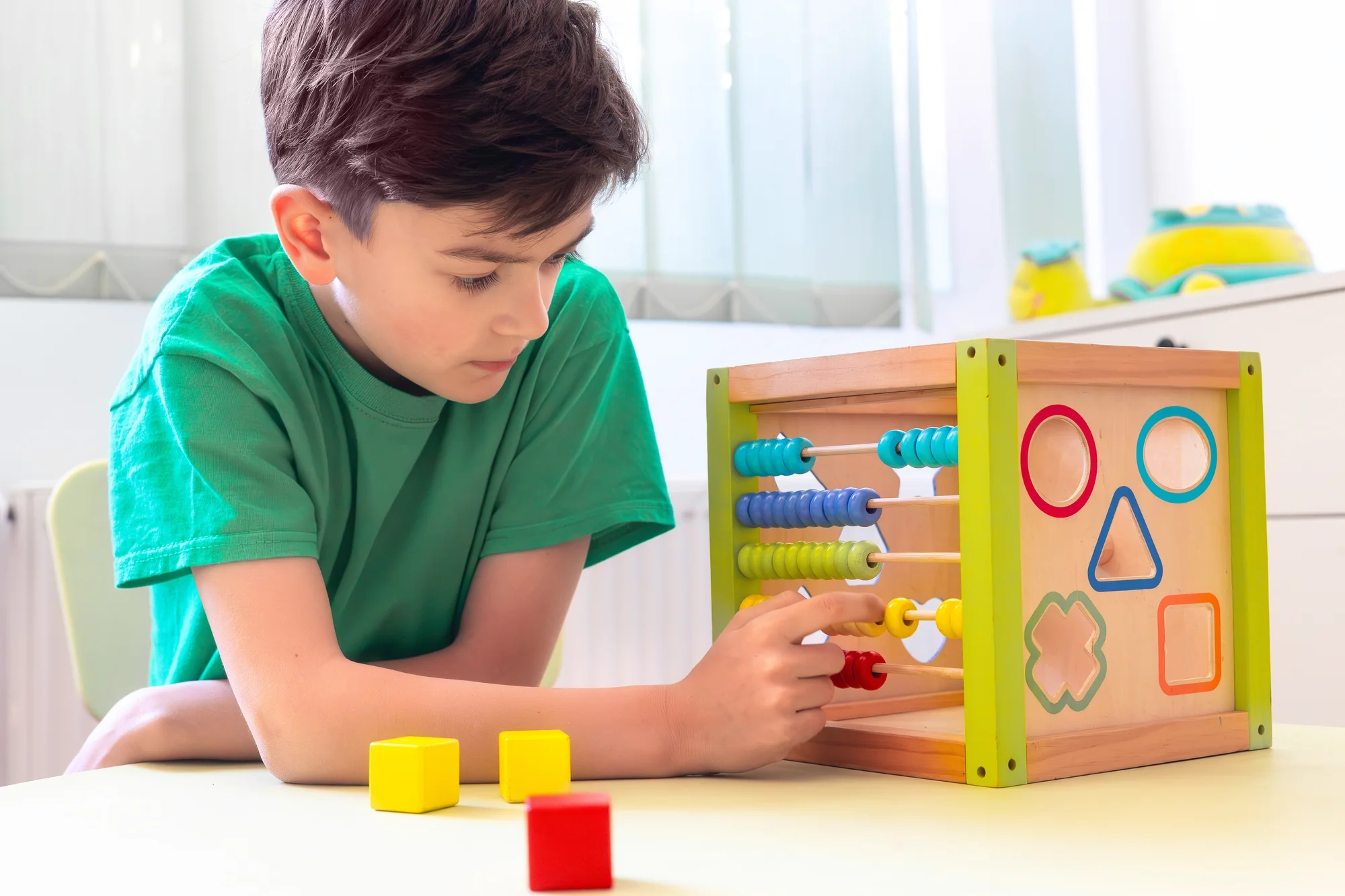
At Mathnasium, we believe every child can learn and master math, as long as they're taught in a way that makes sense to them. And what makes sense to one child won't always work for another, because not all children learn math the same way.
That's why we incorporate multi-sensory teaching techniques that adapt to different learning styles and teach for true understanding, rather than just memorization.
One of those techniques is kinesthetic learning.
Today, our tutors are here to shed some light on it—what it is, how it impacts math learning, and how you can support it at home to help your child build a deep, lasting understanding of math.
What Is Kinesthetic Learning?
Kinesthetic learning, sometimes called tactile learning, is a style of learning in which children best understand new concepts by doing: touching, moving, building, and physically interacting with the material in front of them.
Rather than absorbing information by watching or listening, kinesthetic learners need to experience it firsthand to make it stick.
This is one of several learning styles that educational science recognizes. Others include:
-
Visual learning: understanding concepts best through diagrams, charts, and imagery that make abstract ideas visible and concrete.
-
Auditory learning: processing information most effectively through listening, verbal explanation, and discussion.
-
Read/write learning: connecting with material primarily through reading and writing, whether that's taking notes, reading instructions, or working through written explanations.
Kinesthetic learning can take many forms: hands-on manipulatives, physical sorting and grouping, building and constructing, movement-based activities, and even purposeful gestures.
In a math context specifically, that might look like a child using coins to understand place value, snapping building blocks together to visualize multiplication, walking a number line taped to the floor, or physically distributing objects to solve a division problem.
For some children, kinesthetic learning is one helpful piece of the puzzle, like an extra angle that deepens their understanding alongside other approaches.
For others, it's their dominant learning style, the way math truly clicks for them. If your child falls into that second group, you may notice that they:
-
Need to touch or move objects to work through a problem, rather than solving it mentally
-
Get restless or lose focus during longer explanations, but engage immediately when given something hands-on to do
-
Tends to act things out or use gestures while thinking or explaining
-
Gravitate toward building, constructing, or taking things apart in their free time
-
Remember math concepts better after doing an activity than after reading or listening to an explanation
Sound familiar? It's easy to mistake these signs for restlessness, but more often than not, it simply means your child learns best by doing.
📕 You May Also Like: How to Understand & Support Your Child’s Math Learning Style
How Kinesthetic Learning Shapes Math Engagement & Understanding
While it may be a learning preference for certain students, kinesthetic learning is also an effective way to build real math understanding. Research supports it, and we see it firsthand at Mathnasium.
In an educational study, elementary students learned math through active play. Students who participated showed stronger number skills and improved problem-solving compared to peers taught through traditional instruction.
Another study focused on junior high students who learned through hands-on, movement-based activities. These students showed higher interest in math and earned stronger test scores than peers taught with standard methods. The impact was consistent across both boys and girls.
As for our own experience, kinesthetic learning, or as we refer to it, tactile learning, is an important part of how we teach math at Mathnasium. We incorporate it alongside visual, verbal, mental, and written techniques to present math from every angle, so that every child finds their way in.
We've seen that "aha" moment arrive when a student finally gets to physically group objects to understand multiplication. Suddenly, 4 groups of 3 become something they built with their own hands.
And that kind of understanding, the one built through experience, tends to stay with a child long after the lesson is over.

Tactile learning at Mathnasium turns abstract math into something students can see and touch.
How to Support Kinesthetic Math Learning at Home
Supporting kinesthetic learning at home doesn't require a classroom setup or special equipment. Our tutors have put together a few simple, practical ways to bring math to life, right in your living room or kitchen.
1. Let Them Use Their Fingers and Body
This one is as simple as it gets, and it works across a wide range of ages, from early elementary through middle school.
Before reaching for worksheets or flashcards, try these:
-
Let them use their fingers freely: for counting, for building number combinations, or for tracking steps in a problem.
-
Skip count with claps: 2, 4, 6, 8 becomes a rhythm before it becomes a rule.
-
Tape a number line to the floor and have them walk it to add, subtract, or compare numbers.
-
Act out word problems: if a problem describes sharing 12 cookies among 3 people, physically divide objects into equal groups and move them.
Movement encodes memory in a way that sitting still simply doesn’t. If it’s helping your child think more clearly, let it.
📕 You May Also Like: Finger Counting: A Great Tool or a Hindering Habit?
2. Turn Everyday Objects Into Math Manipulatives
You don't need to order anything online or spend a dime to set your child up with great math tools. The best manipulatives are probably already sitting in your kitchen or junk drawer.
-
Grab a handful of coins to explore place value: pennies, dimes, and dollars make the concept of tens and hundreds something your child can hold in their hand.
-
Pull out the dried pasta for counting and grouping. Ten pieces in a pile stops being an abstract number and starts being something your child can see and touch.
-
Break out their building blocks to snap together multiplication arrays: three rows of four makes 3×4 feel like something they built, not just something they memorized.
The goal is simple: take a number off the page and give it a physical form.
📕 You May Also Like: How to Use Math Manipulatives Effectively at Home
3. Make Math a Game
If your child doesn't know they're practicing math, even better. Games with physical components are one of the easiest ways to build real skills without anyone feeling like they're drilling.
-
Pull out a deck of cards for a quick round of War or Go Fish with a math twist: comparing numbers, adding totals, building fact fluency without the flashcard pressure.
-
Roll some dice and let probability play out right in front of them: predicting outcomes and watching patterns emerge as they track results.
-
Dust off a board game that involves counting, money, or strategy, and let the gameplay do the teaching.
All of these are low-pressure, high-engagement, and genuinely fun for everyone at the table.
📕 You May Also Like: 10 Fun Math Games to Play at Home with Your Child
4. Bring Math Into the Kitchen
The kitchen is one of the most math-rich spaces in any home, with opportunities at every turn. Our tutors have a few favorites:
-
Have them measure ingredients and fractions stop being a page in a textbook, and start being a half cup of flour sitting right in their hand.
-
Double a recipe together, and multiplication becomes a real problem with a delicious reason to solve it.
-
Let them divide a dish into portions, and suddenly division has a purpose: everyone at the table is counting on them to get it right.
📕 You May Also Like: 5 Math Skills You Can Teach in the Kitchen
5. Build Geometric Understanding Literally
For a lot of students, geometry is the point where math starts to feel a little abstract and slippery. Building things by hand has a way of fixing that.
-
Toothpicks and marshmallows for building shapes: triangles, cubes, anything with edges and corners they can hold up and examine.
-
Paper folding to explore symmetry and fractions at the same time, no scissors required.
-
Tracing and cutting angles so that words like "acute" and "obtuse" become something they've actually handled.
In our centers, these are some of the most requested activities: kids finish one shape and immediately want to try another.
📕 You May Also Like: How to Use Origami to Teach Geometry - Kid-Friendly Guide
6. Turn Word Problems Into Acted-Out Scenarios
Word problems trip a lot of kids up, and honestly, that's rarely about the math itself. More frequently, it has to do with students being asked to solve something they can't quite picture yet.
Next time one comes up, try this: instead of reading it off the page, set the scene.
For example, if the problem involves sharing 24 apples between 4 kids, grab 24 objects—pasta, coins, blocks, whatever's nearby—and actually do it. Move them around. Divide them into piles. Let the answer show up in front of them rather than in their head.
It works for almost any word problem, and it takes about thirty seconds to set up.
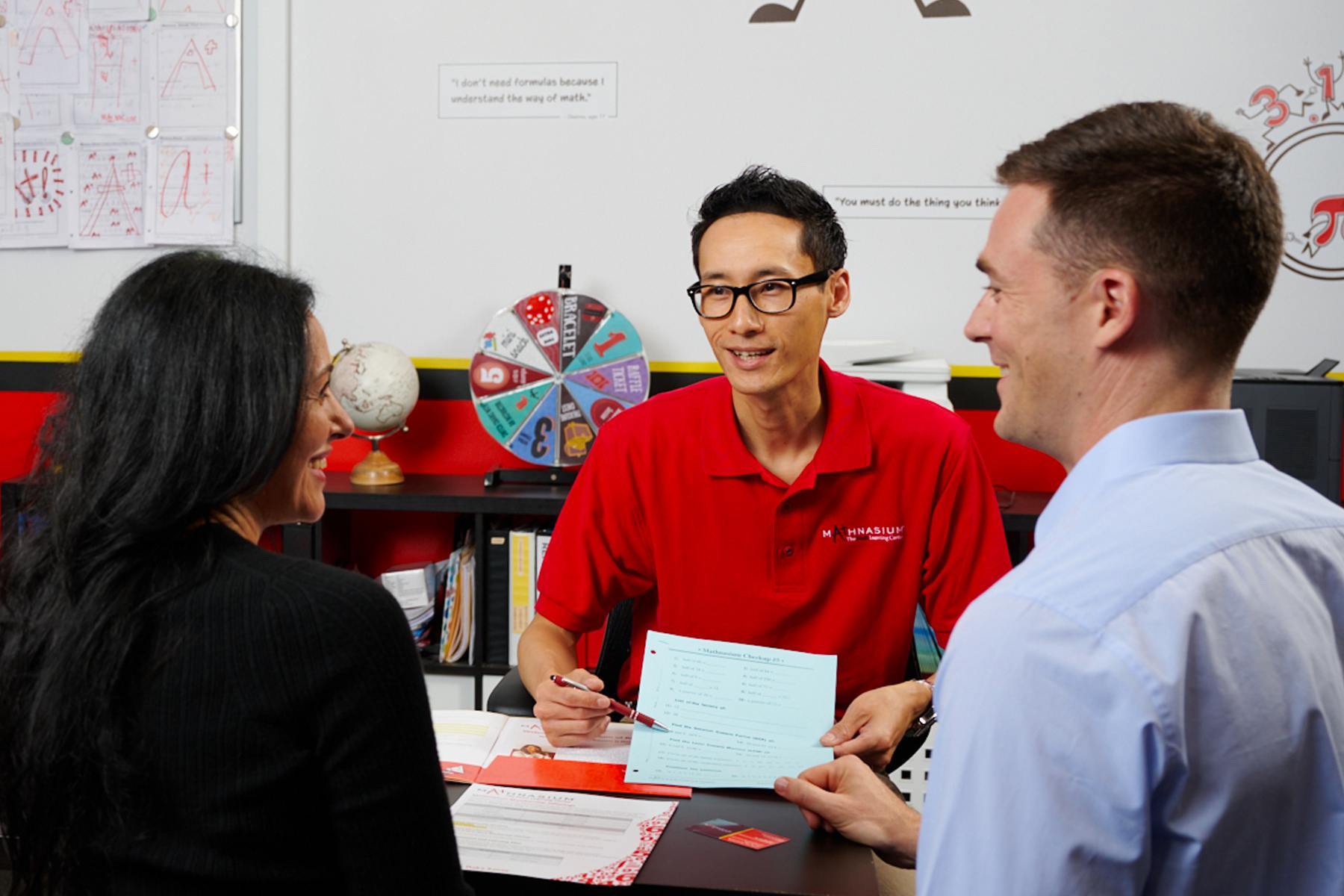
Over 1,000,000 parents across the U.S. trust Mathnasium to build their children's math skills and confidence.
How Mathnasium Fosters All Learning Styles, Including Kinesthetic
Whether it's how a student naturally connects with math or simply a tool that makes abstract concepts click, kinesthetic or tactile instruction is an important part of how we teach in our centers.
It's a core pillar of our broader approach to teaching math: the Mathnasium Method™.
Unlike a one-size-fits-all curriculum, the Mathnasium Method™ was designed around the idea that math should make sense for each student and that deep understanding comes from meeting them where they are.
To promote deep learning of math, our approach includes:
-
Diagnostic assessment & personalized learning plans: Each student begins with a diagnostic assessment that helps us identify their current skills, knowledge gaps, and how they naturally think through math. We use those insights to develop a learning plan customized to their needs.
-
Teaching for understanding: We explain math in clear, everyday language, using a mix of verbal, visual, mental, tactile, and written techniques. This allows students to approach each concept in the way that makes the most sense to them.
-
Caring tutors: Our tutors are specially trained in math, but also in the technical and emotional aspects of teaching. They know when to guide, when to challenge, and how to help students regain trust in their thinking.
-
Independent problem-solving and critical thinking: We give students space to work through challenges on their own, then rejoin them to check their reasoning. Instead of just giving them the answer, we help them understand the how and why behind it. This helps them develop problem-solving skills and critical thinking tools they can use in math and beyond.
-
A singular focus on math: We specialize in math and math only. Our personalized learning plans are built around how students absorb, learn, and retain math skills.
-
A supportive, fun environment: A lot of our activities are hands-on or game-based. We use reward systems and consistent encouragement to keep students engaged. And we celebrate progress because every win matters.
And it works. Results are real and measurable.
-
94% of parents report improvement in their child's math skills and understanding
-
93% of parents notice a more positive attitude toward math
-
90% of students see higher grades in school
Mathnasium operates over 1,100 learning centers nationwide, bringing our top-rated math instruction close to your home.
For families in or near Plano, TX, Mathnasium of Plano Legacy West is a local center with years of experience transforming how students think and feel about math. With over 100 glowing Google reviews from families across the community, it's become a trusted resource for building real math skills that last.
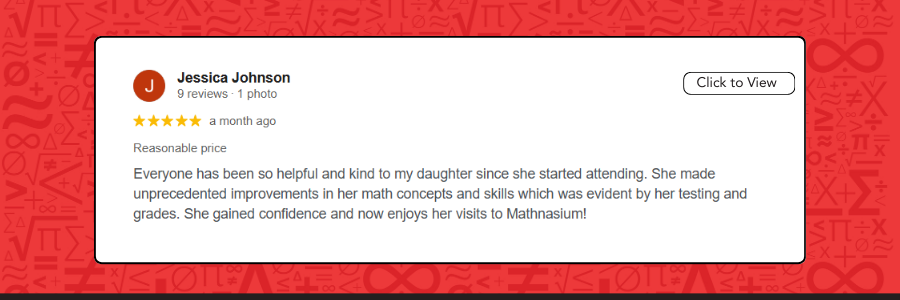
Here’s what one parent had to share about our center:
Whether your child needs support catching up, keeping up, or getting ahead in math, we’re here for you.
📅 Schedule a Free Diagnostic Assessment at Mathnasium of Plano Legacy West
Not located near Plano?
📍 Find a Mathnasium Learning Center Near You


 (214) 618-0558
 (214) 618-0558