Fractions can feel tricky, particularly when the numbers start getting bigger. As topics advance and if homework time turns into struggle time, one of the easiest ways to restore motivation is to learn how to simplify fractions.
Mathnasium tutors have helped thousands of students master this skill, and they've put together these quick, straightforward steps along with plenty of real examples and simple exercises you can try together at home.

Quick Recap: What Does It Mean to Simplify Fractions?
When we simplify (or “reduce”) a fraction, we're making it smaller and easier to work with without changing its value. Think of it like this: \(\Large\frac{4}{8}\) and \(\Large\frac{1}{2}\) are the same amount (half of something), but \(\Large\frac{1}{2}\) is much simpler to say, write, and understand.
To simplify a fraction, we divide both the top number (numerator) and bottom number (denominator) by the same number until we can't divide evenly anymore. It's like cleaning up a messy room. The room is still the room, but now it's organized and easier to navigate!
Here's why fraction simplification matters for your child:
-
Makes numbers easier to understand: Would you rather work with \(\Large\frac{1}{2}\) or \(\Large\frac{16}{32}\)? Simplified fractions are cleaner and less intimidating.
-
Helps with comparing fractions: It's much easier to see that \(\Large\frac{2}{3}\) is larger than \(\Large\frac{1}{2}\) when fractions are in their simplest form.
-
Prepares students for higher-level math: Algebra, geometry, and even calculus all require students to work with fractions comfortably. Simplifying is a foundational skill that shows up everywhere.
📕 You May Also Like: How to Reduce Fractions - A Kid-Friendly Guide
The Quickest Way to Simplify Fractions
The fastest way to simplify any fraction is to use something called the Greatest Common Factor, or GCF.
Don't let the fancy term scare you. It's just the biggest number that divides evenly into both the numerator and denominator. Here's the three-step method your child can use every single time:
-
Find the Greatest Common Factor (GCF) of the numerator and denominator
-
Divide both numbers by that GCF
-
Write the simplified fraction
Finding the GCF might sound complicated, but there are a couple of simple strategies that work great for kids.
The easiest approach is to list out the factors (the numbers they can be divided by evenly) of each number and find the biggest one they have in common.
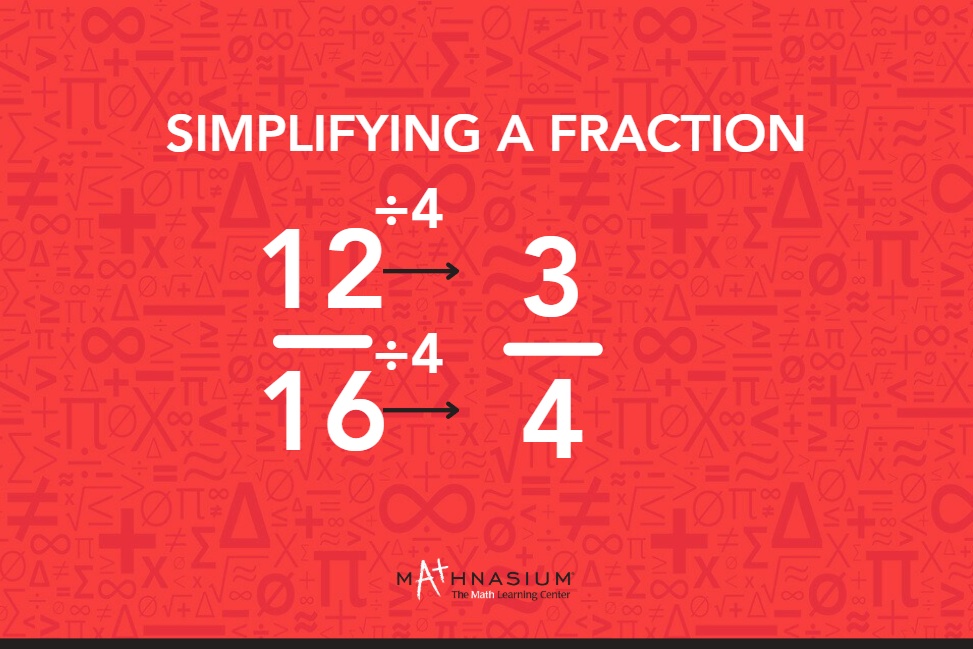
For example, if you're working with 12 and 16, the factors of 12 are 1, 2, 3, 4, 6, and 12. The factors of 16 are 1, 2, 4, 8, and 16. The largest number that appears in both lists is 4, so that's your GCF.
Another quick trick is to ask, "Can both numbers be divided by a common small number like 2, 3, or 5?" If the answer is yes, start there and see if you can go bigger.
For instance, if both numbers are even, you know at least 2 is a common factor. Check if a larger even number like 4, 6, or 8 works too. With a little practice, your child will start recognizing these patterns automatically.
Let's see this method in action with a few examples:
Example 1: Simplify \(\Large\frac{12}{16}\)
-
The GCF of 12 and 16 is 4 (since 4 is the largest number that divides evenly into both)
-
Divide both numbers: 12 ÷ 4 = 3 and 16 ÷ 4 = 4
-
Simplified fraction: \(\Large\frac{3}{4}\)
Example 2: Simplify \(\Large\frac{15}{25}\)
-
The GCF of 15 and 25 is 5
-
Divide both numbers: 15 ÷ 5 = 3 and 25 ÷ 5 = 5
-
Simplified fraction: \(\Large\frac{3}{5}\)
Example 3: Simplify \(\Large\frac{8}{12}\)
See how quick that is? Your child will find that reducing fractions becomes second nature with practice.
📕 You May Also Like: What Is the Greatest Common Factor? A Step-by-Step Guide
Tip for Younger Learners: Divide Until You Can't
If your child isn't quite ready to find the GCF (and that's perfectly okay!), there's a gentler approach that works just as well. It just takes a few more steps.
Instead of finding the biggest common factor right away, you can simplify in stages by dividing by smaller numbers like 2, 3, or 5. Keep going until both the numerator and denominator can't be divided by the same number anymore.
Let's walk through an example together.
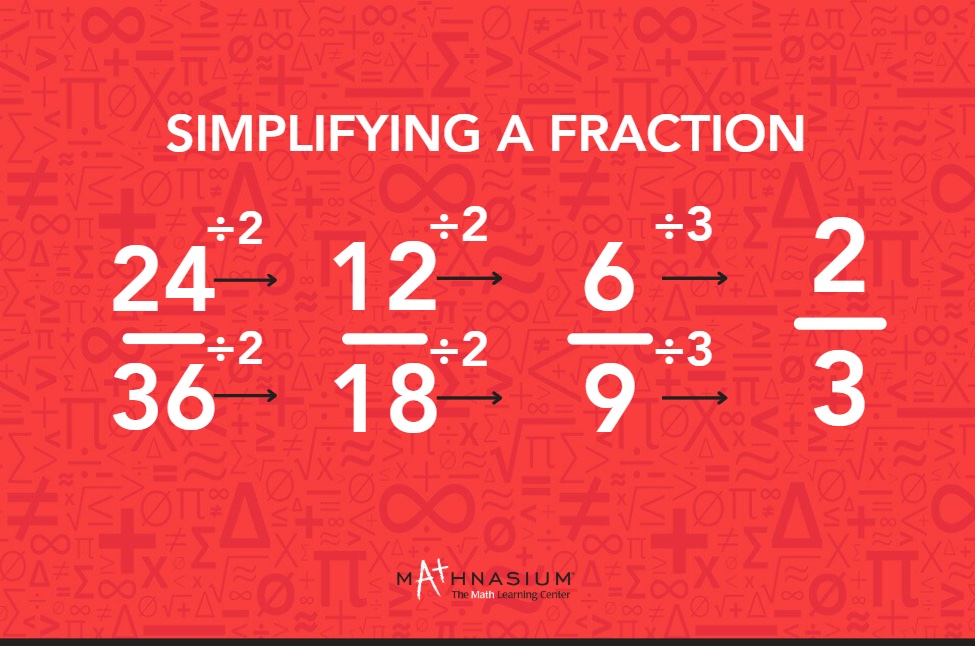
Simplify \(\Large\frac{24}{36}\) using the step-by-step method:
-
Step 1: Can both numbers be divided by 2? Yes! 24 ÷ 2 = 12 and 36 ÷ 2 = 18, so now we have \(\Large\frac{12}{18}\).
-
Step 2: Can both numbers be divided by 2 again? Yes! 12 ÷ 2 = 6 and 18 ÷ 2 = 9, so now we have \(\Large\frac{6}{9}\).
-
Step 3: Can both numbers be divided by 3? Yes! 6 ÷ 3 = 2 and 9 ÷ 3 = 3, so now we have \(\Large\frac{2}{3}\).
-
Step 4: Can we divide both 2 and 3 by the same number? No, so we're done!
This method might take a little longer, but it builds understanding and helps younger students see what's actually happening when they simplify. Plus, it reinforces division skills along the way!
As an added tip, have your child combine all the steps they’ve taken to figure out the GCF. Just have them use multiplication instead of division. In our example, that would be 2x2x3 = 12. And 12 is the GCF for 24 and 36!
📕 You May Also Like: Why Kids Need to Understand Divisibility Rules (Before Learning Fractions)
The Quickest Way to Compare Fractions After Simplifying
Your child will find that simplified fractions make comparisons so much easier. When fractions are in their simplest form, it's often clearer which one is larger or if they're equal. Let's look at a real example to see why simplifying first is such a helpful strategy.
Compare \(\Large\frac{4}{6}\) and \(\Large\frac{6}{9}\). Which fraction is larger?
At first glance, these fractions look completely different, and it's hard to tell which is bigger. But watch what happens when we simplify both:
-
Simplify \(\Large\frac{4}{6}\): The GCF of 4 and 6 is 2, so 4 ÷ 2 = 2 and 6 ÷ 2 = 3. Simplified: \(\Large\frac{2}{3}\)
-
Simplify \(\Large\frac{6}{9}\): The GCF of 6 and 9 is 3, so 6 ÷ 3 = 2 and 9 ÷ 3 = 3. Simplified: \(\Large\frac{2}{3}\)
Surprise! They're the same fraction. \(\Large\frac{4}{6}\) and \(\Large\frac{6}{9}\) both equal \(\Large\frac{2}{3}\), so they're equal in value. Without simplifying, that wasn't obvious at all.
Practice Time! Try Simplifying & Comparing These Fractions
Now it's your turn! Grab a pencil and paper and work through these practice problems together. Remember, there's no rush. Take your time and talk through each step out loud. That's where the real learning happens.
A. Simplify These Fractions:
-
\(\Large\frac{18}{24}\)
-
\(\Large\frac{16}{20}\)
-
\(\Large\frac{21}{28}\)
-
\(\Large\frac{36}{60}\)
B. Compare These Pairs After Simplifying:
-
\(\Large\frac{18}{30}\) vs. \(\Large\frac{15}{25}\)
-
\(\Large\frac{21}{35}\) vs. \(\Large\frac{32}{40}\)
Encourage your child to show their work. Writing down the GCF and each division step helps reinforce the process. And if they get stuck, that's a great opportunity to work through it together and ask questions like "What's a number that divides into both?" or "Can we try dividing by 2?"
If your child needs more support with fractions or wants to build stronger foundational math skills, working with an expert tutor can make all the difference.

Mathnasium tutors use hands-on techniques and personalized instruction to help students truly understand fractions.
How Mathnasium Helps Kids Learn to Simplify Fractions
Mathnasium is a math-only learning center dedicated to helping K–12 students of all levels excel in math.
In our centers, we've worked with many students who struggle with fractions. Whether your child is just being introduced to fraction simplification or needs extra support to solidify their skills, our elementary and middle school programs are designed to meet them where they are and guide them forward.
Behind each of our programs is not a one-size-fits-all curriculum, but a proprietary teaching approach called the Mathnasium Method™. Beyond rote drills or shortcuts, our method is built to help students truly make sense of what they're learning.
When it comes to simplifying fractions, we don't just show students the steps. We help them understand why finding the GCF works, what it means to reduce a fraction, and how this skill connects to everything else they'll encounter in math. We use visual models, hands-on manipulatives, and clear explanations so the concept clicks in a way that sticks.
We support math mastery through:
-
Personalized learning: Each student begins with a diagnostic assessment that helps us identify their current skills, knowledge gaps, and how they naturally think through math. We use those insights to build a custom learning plan tailored to their needs.
-
Teaching for understanding: We explain math in clear, everyday language, using a mix of verbal, visual, mental, tactile, and written techniques. This allows students to approach each concept in the way that makes the most sense to them.
-
Caring, responsive tutors: Our tutors are specially trained in both the technical and emotional aspects of teaching. They know when to guide, when to challenge, and how to help students regain trust in their thinking.
-
Independent problem-solving and critical thinking: We give students space to work through challenges on their own, then rejoin them to check their reasoning. Instead of just giving them the answer, we help them understand the how and why. This helps them develop problem-solving skills and critical thinking tools they can use in math and life.
-
A singular focus on math: We specialize in math and math only. Our learning plans are built around how students actually learn and retain math skills.
-
A supportive, fun environment: Many of our activities are hands-on or game-based. We use reward systems and consistent encouragement to keep students engaged. And we celebrate progress because every win matters.
The result? Real, measurable progress.
-
94% of parents report improvement in their child's math skills and understanding
-
93% of parents notice a more positive attitude toward math
-
90% of students see higher grades in school
Mathnasium operates over 1,100 learning centers across the U.S., bringing our proven approach close to your community.
For families in or near Plano, TX, Mathnasium of Plano Legacy West is a trusted local center with years of experience transforming how students think and feel about math. With positive reviews from families in the community, it's been recognized as a go-to resource for students who want to strengthen their math foundation.
If your child is ready to master fractions and build essential math skills, our team is here to help.
📅 Schedule a Free Diagnostic Assessment at Mathnasium of Plano Legacy West
Not located near Plano?
📍 Find a Mathnasium Learning Center Near You
Answers to Practice Problems
Check to see whether your child has mastered simplifying fractions or whether they need a bit more practice.
A. Simplify These Fractions:
-
\(\Large\frac{18}{24}\) = \(\Large\frac{3}{4}\) (GCF is 6: 18 ÷ 6 = 3, 24 ÷ 6 = 4)
-
\(\Large\frac{16}{20}\) = \(\Large\frac{4}{5}\) (GCF is 4: 16 ÷ 4 = 4, 20 ÷ 4 = 5)
-
\(\Large\frac{21}{28}\) = \(\Large\frac{3}{4}\) (GCF is 7: 21 ÷ 7 = 3, 28 ÷ 7 = 4)
-
\(\Large\frac{36}{60}\) = \(\Large\frac{3}{5}\) (GCF is 12: 36 ÷ 12 = 3, 60 ÷ 12 = 5)
B. Compare These Pairs After Simplifying:
-
\(\Large\frac{18}{30}\) vs. \(\Large\frac{15}{25}\): Both simplify to \(\Large\frac{3}{5}\), so they are equal
-
\(\Large\frac{21}{35}\) vs. \(\Large\frac{32}{40}\): \(\Large\frac{21}{35}\)simplifies to \(\Large\frac{3}{5}\) and \(\Large\frac{32}{40}\) simplifies to \(\Large\frac{4}{5}\) so \(\Large\frac{32}{40}\) is the larger fraction.


 (214) 618-0558
 (214) 618-0558