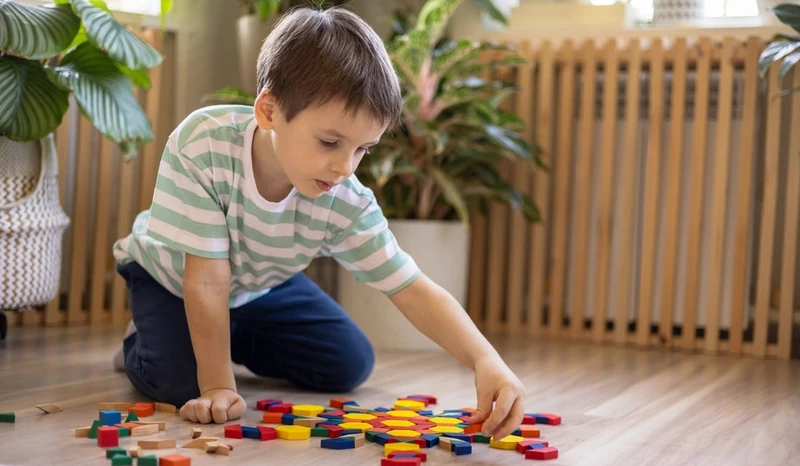
From stacking blocks to solving equations, patterns shape how children come to understand math.
Before they ever multiply or divide, kids naturally notice how things repeat or change. These early observations lay the groundwork for mathematical thinking.
Read on to learn why patterns matter so much in math, what skills they build, and how you can explore them at home with your child, no extra worksheets required.

Why Patterns Matter in Math
Patterns are all around us, and in math, they do more than decorate.
They help children make sense of numbers, operations, and relationships by providing structure and predictability.
When we talk about patterns with young learners, we often start with simple sequences: red-blue-red-blue, triangle-square-triangle-square, or clap-snap-clap-snap.
These are fun, easy ways for children to begin recognizing order and change. But the benefits go far deeper.
Recognizing patterns is one of the earliest predictors of later success in math. A 2017 study found that children’s ability to spot and complete patterns was significantly linked to their calculation skills, even after accounting for age and working memory.
Other studies have also shown that children who can visualize and describe patterns tend to perform better in math overall, because these skills support number sense and problem-solving.
Math is often described as the “science of patterns.” Whether it’s counting by twos, identifying a function’s growth, or simplifying an algebraic expression, math relies on recognizing how things repeat, grow, or relate.
Patterns help students transition from concrete experiences like stacking blocks or clapping rhythms to abstract thinking, laying the groundwork for higher-level math such as algebra and geometry.
At Mathnasium, we help children build this foundation by teaching them to see math as connected, meaningful, and, above all, intuitive. And it starts with patterns.

From prediction to problem-solving, pattern recognition builds essential math thinking skills.
What Math Skills Do Patterns Build
When children play with patterns, arranging blocks, clapping rhythms, or spotting number sequences, they’re building important and concrete math skills in the background. Specifically:
1. Sequencing and Prediction
When kids recognize a pattern, they learn to predict what comes next. This builds their understanding of order, logic, and cause-and-effect.
For example, if your child notices a number pattern like 2, 4, 6, 8..., they’re actually practicing skip counting, an important foundation for learning multiplication.
This kind of thinking also shows up in real life, like planning steps in a recipe or organizing their day.
2. Number Sense and Relationships
Patterns reveal how numbers connect and interact. Children start to grasp that 10 can be composed of 4 and 6, or that doubling leads naturally into multiplication.
Understanding these relationships strengthens place value, supports the development of fractional thinking, and lays the groundwork for more abstract ideas like decimals and percentages, turning math into something that makes sense, rather than a set of isolated facts.
3. Problem-Solving and Critical Thinking
Working with patterns helps children develop a strategic mindset. They learn to break down challenges, identify efficient approaches, and search for underlying structure—skills that will serve them in algebra and beyond.
Mathnasium tutors and parents often note that encouraging students to search for patterns builds both skill and resilience and confidence in their problem-solving abilities.
📕You May Also Like: Math for Life: Why Math Skills Matter Beyond School
4. Visual and Spatial Reasoning
Patterns also appear in shapes, symmetry, and design. Activities like drawing, folding, or building allow students to strengthen spatial awareness and learn how parts fit into a larger whole.
This kind of visual reasoning prepares students for geometric concepts, measurement, and spatially-oriented topics like area, volume, and transformation.
5. Real-World Connections
From beats in music to stripes on clothing or rows in a garden, patterns help children connect math to everyday life. Seeing structure in the world around them makes math more relatable, and when learning feels relevant, students are more likely to stay engaged and curious.
At Mathnasium, we use pattern recognition as a bridge to deeper understanding, guiding students through lessons that connect meaning with skill-building.

Discover fun, everyday ways to grow your child’s pattern skills.
How to Encourage Play with Patterns at Home
Some of the most meaningful math learning comes from noticing and playing with patterns, and that can happen anytime at home. No matter if your child is in elementary school or preparing for college, exploring patterns builds skills in problem-solving and reasoning.
Here’s how you can support your child at each stage, using simple ideas that fit into your everyday life.
Elementary School (Grades K–5)
At this age, kids are naturally curious. They’re learning to count, recognize shapes, and spot repetition. Patterns give them a way to organize what they see and build early math confidence.
What to do, 5–10 minutes a day:
-
Play with building toys: Use building blocks or beads to create repeating color or size patterns. Start with something simple like red-blue-red-blue and ask, “What comes next?” Then let your child create their own.
-
Make snack time math time: Arrange fruit pieces or crackers in repeating shapes or colors. Have your child extend the pattern or create a new one.
-
Dance or clap to patterns: Create a movement pattern like clap-jump-clap-jump and ask your child to repeat it. Then switch it up and challenge them to create their own sequence.
-
Use routines to teach sequencing: While brushing teeth or setting the table, describe the steps in order. Then ask your child to predict what comes next or create a new routine.
These simple activities help children understand how numbers grow, how shapes repeat, and how to predict outcomes, all core skills for success in math.
📕You May Also Like: Must-Know Math Skills: Preparing for the Next Grade (K-12 Guide)
Middle School (Grades 6–8)
Middle schoolers start encountering more abstract math concepts like variables, ratios, and algebra. Recognizing patterns helps them make sense of these ideas by showing how numbers behave and change.
What to do in everyday moments:
-
Play pattern-based games together: Sudoku, card games, or math puzzle apps like DragonBox are fun ways to practice logic and sequencing without making it feel like homework.
-
Use skip counting with purpose: Count by 5s or 10s while walking up stairs or waiting in line. Then flip the pattern, count backward, or count by odd numbers to stretch their thinking.
-
Spot patterns in real life: At dinner, ask questions like “Why do you think the grocery receipt totals up that way?” or “What’s the pattern in how we use water/electricity each month?”
-
Ask for their logic: If your child solves a homework problem or explains a rule, ask “How did you know?” or “Did you see a pattern?” This encourages reflection and builds reasoning skills.
-
Get creative with math art: Show them how to use graph paper to create designs using rotations, reflections, or symmetry. This builds geometric intuition while tapping into creativity.
As students face more complex math, patterns help them connect what they’ve learned to new concepts. Instead of memorizing steps, they start thinking like mathematicians.
📕You May Also Like: Math and Creativity: Encouraging Your Child to Think Outside the Box
High School (Grades 9–12)
High school students deal with advanced math, including algebra, functions, geometry, and calculus. These topics are all built on patterns.
What to do, without turning it into a lecture:
-
Connect math to real decisions: Talk about patterns in everyday finances, budgeting, interest, or saving up for a goal. Ask your teen to estimate costs or analyze trends. This builds real-world math fluency.
-
Explore data they care about: Look at sports stats, music streaming charts, or even social media algorithms. Ask questions like “What’s the trend here?” or “Can we predict what comes next?”
-
Have them teach you something: Ask them to explain a math problem they solved in school. Ask what patterns they noticed or if they found a shortcut. Teaching reinforces their understanding.
-
Celebrate logic: If your teen approaches a problem in a unique way, highlight the thinking behind it. “That’s a smart pattern you saw,” goes a long way in reinforcing their reasoning.
By seeing math as patterns and relationships, not just rules to memorize, teens build the critical thinking skills they need for college and life beyond the classroom.
At Mathnasium, we build on what you start at home. Our math tutors help students recognize and understand patterns, strengthen problem-solving skills, and truly enjoy math.

At Mathnasium, we use pattern recognition to help students make sense of math.
How Mathnasium Helps Children Build Math Confidence Through Patterns
At Mathnasium, we understand that early pattern recognition lays the groundwork for lifelong math success. That’s why our approach helps students connect the dots between what they see, what they understand, and how they apply it in problem-solving.
Our specially trained tutors utilize the Mathnasium Method™, a proprietary teaching approach that is built around personalized learning plans and interactive teaching techniques.
Every student starts with a diagnostic assessment that pinpoints exactly what they know and what they’re ready to learn next. This allows us to meet each child at their level and build their skills step-by-step, starting with what makes sense to them.
We help students truly understand why patterns matter in math. Whether it's recognizing skip-counting sequences, building number relationships, or exploring symmetry and shapes, we guide students to discover math’s structure for themselves.
This prepares them for advanced topics like algebra and geometry, and it also boosts their confidence and critical thinking.
We provide face-to-face math tutoring in a caring and fun group environment, either in-center or live online. In every session, our especially trained math tutors build meaningful connections, encourage curiosity, and celebrate progress.
The results speak for themselves:
-
94% of parents report an improvement in their child’s math skills and understanding.
-
90% of students see better grades in school.
-
93% of parents say their child has a more positive attitude toward math after enrolling at Mathnasium.
Whether your child is just beginning to notice patterns or already exploring advanced math concepts, Mathnasium is here to help them catch up, keep up, and get ahead.
It all starts with one step: scheduling a free assessment at your nearest learning center and discovering what your child is ready to learn next.


 (214) 618-0558
 (214) 618-0558