Thinking like a mathematician, what do you think that means?
If you're picturing a human calculator who can multiply three-digit numbers in their head, you're wrong. If you're imagining someone born with a rare "math gene" that most of us simply don't have, you're wrong again.
Neither of those describes mathematical thinking.
Mathematical thinking is a skill (yes, you read that right) built through practice just like any other. It doesn't have to do with speed or being naturally smart, but with how you approach problems, how you handle uncertainty, and how you see patterns in the world around you.
With that in mind, seasoned Mathnasium tutors have put together seven strategies to help you nurture a mathematician's mindset at home.
1. Prioritize "Why" Over "How"
We're starting off with something that's a core principle of how we teach math concepts at Mathnasium. To put math thinking on a higher level, a student has to look beyond just how a math concept works and into why it works.
When multiplying, it's not enough to memorize that 5 × 3 = 15. A child who understands why, because it means "5 groups of 3" or "3 groups of 5," can visualize what multiplication actually does.
Why is this so important?
Children who learn procedures by heart hit a wall when problems change format.
Imagine a student who calculates the area of a 6-by-5 rectangle with ease, then freezes on "Area is 30 square feet, one side is 6 feet, what's the other side?" The formula was memorized. But when the question was reversed, the understanding wasn't there.
Students who understand why can adapt, transfer knowledge, and self-correct. Reasoning builds durability that lasts well beyond the test.
To support this shift at home, slow the moment down:
-
When your child solves a problem correctly, don’t rush to the next one. Pause and ask, “How do you know that’s right?”
-
Encourage them to explain their thinking aloud, even for simple problems like 25 x 4.
-
You might say, “Can you convince me this works?” or “Teach me your strategy.”
-
Welcome responses that begin with “I think…” or “Because…” Those openings signal reasoning in action.
📕 You May Also Like: Why Prioritize Critical Thinking Over Memorizing in Math
2. Encourage Multiple Pathways to the Same Solution
Math often gets labeled as rigid. Rules. Steps. One correct way.
That's not true, and it's a misconception worth dismantling.
After your child learns a method, help them see it as a tool, not a commandment.
Because here's the reality: there's rarely just one right way to solve a problem. There are multiple valid approaches, each revealing something different about how numbers work.
Take a simple addition example: 8 + 6.
-
One student might count up from 8: "9, 10, 11, 12, 13, 14."
-
Another might "make a ten" by splitting the 6 into 2 and 4, turning the problem into 10 + 4.
-
A third might notice 8 + 8 = 16, so 8 + 6 must be 14.
All three are correct. All three are useful. Math is built on these choices.
Flexibility in math is important for a number of reasons:
-
Math anxiety often takes root when children believe there's only one right way and they don't see it immediately.
-
Strategic flexibility builds confidence: if one approach stalls, they know they can pivot.
-
It transforms math from memorizing steps to making decisions.
To encourage this flexibility at home, show them different representations:
-
15 - 7 can be solved by counting back, using a number line, or thinking "7 + ___ = 15"
-
Finding the perimeter of a rectangle might mean adding all four sides or using the formula 2(length + width)
-
Comparing fractions like \(\Large\frac{1}{2}\) and \(\Large\frac{1}{3}\) could use drawings, finding common denominators, or simply knowing which piece of the same pie is bigger
-
A word problem about sharing 12 cookies among 3 friends might be solved with division, repeated subtraction, or drawing it out
📕 You May Also Like: 4 Related Fact Strategies to Help Build Your Child’s Math Flexibility
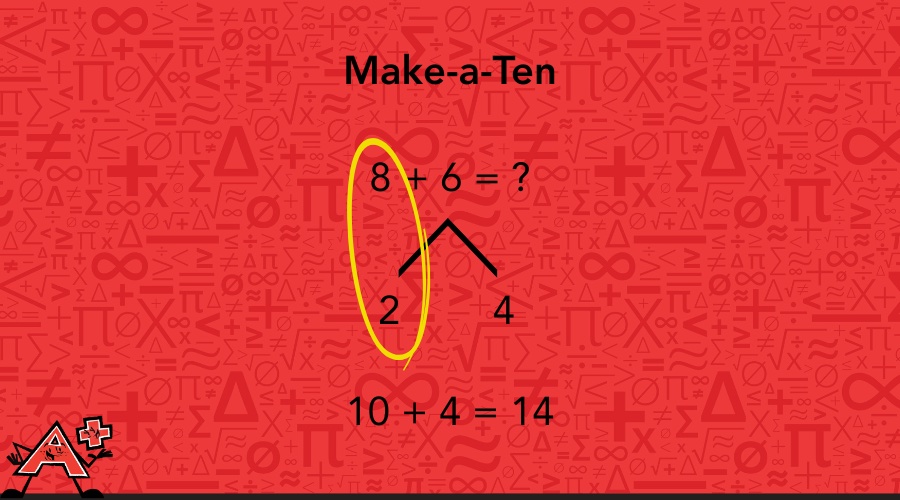
Make-a-Ten is one of several valid ways to think through the same addition problem.
3. Treat "Wrong" as Data, Not Failure
We’ve found that young math learners tend to fear mistakes because they view math as a "performance" subject where speed and accuracy equate to intelligence.
Our job, as tutors and parents, is to show them the opposite.
In her book Mathematical Mindsets, Jo Boaler, a professor of mathematics education at Stanford University, points to neuroscientific research showing that when students make mistakes in math, their brains actually grow.
Synapses fire more actively during struggle than during effortless correct answers.
Beyond brain science, mistakes:
-
Reveal thinking patterns: Errors often point to misconceptions. Addressing why a mistake happened builds real understanding.
-
Build resilience: When students aren't afraid to be wrong, they tackle harder problems. Normalizing mistakes directly reduces math anxiety.
-
Develop self-correction skills: Analyzing what went wrong requires students to think about their own thinking, which is a critical skill for advanced math.
To support mistake-friendly learning at home, you can:
-
Reframe the language around errors: Instead of "That's wrong" or "Try again," say "This didn't work, let's figure out why" or "Your answer is telling us something. What do you think happened here?" Language shapes whether mistakes feel like failure or information.
-
Give space before stepping in: When you see your child struggling, resist the urge to immediately correct or rescue. Productive struggle builds problem-solving stamina, and children often self-correct when given time to think.
-
Praise the process, not the result: "You got it right!" teaches kids that correct answers are the goal. Instead, try "I noticed you tried two different strategies" or "You really worked through that step by step." This builds a math growth mindset where effort and strategy matter more than speed.
-
Use questions to guide reflection: Rather than explaining what went wrong, ask "Where did your thinking change?" "What step feels confusing?" "If you were teaching this to someone else, what would you tell them?" Questions put your child in the driver's seat of their own learning.

Our job is to help children see mistakes as valuable clues, not reasons for shame.
4. Ask "What If?" to Build Curiosity and Generalization
Mathematicians don't stop at one answer; they ask "What if?" They change variables, test limits, and look for patterns that hold across different scenarios.
"What if" questions transform homework or practice from a chore into discovery. Instead of just getting the answer, your child learns to see the structure underneath, and that's what prepares them for higher-level math.
So what can this look like at home?
-
After solving 12 ÷ 4 = 3, ask: "What if we divided 12 by 3 instead? What pattern do you notice?"
-
When working with shapes: "You found the area of this rectangle. What if one side doubled? What happens to the area?"
-
During word problems: "The answer is 15. Could you write a different problem that also equals 15?"
-
Encourage prediction: "Before we calculate, what do you think will happen if we make this number negative?"
-
When your child learns a rule like "an even number times an even number is always even," ask: "Would this rule apply to odd numbers? What about even times odd?"
📕 You May Also Like: How to Identify Budding Math Thinkers & Nurture Their Curiosity
5. Help Your Child See Math as a Connected Web
Many students might not realize it, but math isn't a collection of separate topics you master one at a time.
In fact, it is a deeply interconnected web where every concept supports and builds on others. What looks like "new material" is often just a familiar idea wearing a different outfit.
You can see this everywhere.
Fractions, division, decimals, ratios, and percentages? They're all describing the same relationship in different forms. Understanding that \(\Large\frac{3}{4}\) is the same as 3 ÷ 4, which equals 0.75, which is 75%, which represents a ratio of 3:4. Basically, that’s like seeing one idea from five angles.
When children develop this structural thinking:
-
They stop feeling overwhelmed by what seems like 100 disconnected skills to learn.
-
Cognitive load drops: "Oh, this is just division written differently."
-
Retention improves because ideas link to what they already know.
-
Math anxiety decreases when the subject feels navigable instead of chaotic.
To help your child build these connections:
-
Ask bridging questions: "Does this remind you of something we learned before?"
-
Draw explicit links: "Remember when we worked with fractions? This is the same idea with different numbers."
-
Highlight patterns across grades: "You used this strategy in third grade; it still works here."
-
Celebrate recognition: "Good eye, you saw the connection!"
6. Find Math in the "Non-Math"
To a mathematician, math isn't confined to classrooms, worksheets, or test day. It's the hidden skeletal structure of the world, and once you learn to see it, it's everywhere.
Mathematicians spot Fibonacci spirals in pinecones, symmetry in music, probability in playground games,and optimization in your grocery shopping route.
You don't need to be a mathematician yourself to help your child see this. Start small. Point out patterns during everyday moments, and watch their math mindset expand beyond the textbook.
Real-world math examples can be found:
-
In the kitchen: Doubling a recipe (ratios), timing multiple dishes (coordinate different cook times), measuring ingredients (fractions and conversions)
-
At the store: Comparing unit prices ("Which is the better deal 3 for $5 or 2 for $4?"), estimating totals, calculating discounts
-
In nature: Counting petals on flowers (often Fibonacci numbers), noticing symmetry in leaves and butterflies, observing patterns in tree branches
-
During games: Discussing probability in dice games ("What are the odds of rolling doubles?"), recognizing patterns in card games, strategizing based on likely outcomes
-
In sports: Analyzing batting averages, shooting percentages, calculating speed and distance
-
Through music: Identifying rhythm patterns (fractions!), recognizing that time signatures like 3/4 or 4/4 are mathematical expressions
📕 You May Also Like: 9 Examples of the Golden Ratio in Nature + Definitions
7. Make the Abstract Visible
Math is typically seen and sometimes even taught as a series of "recipes" to follow: memorize the steps, get the result, and move on.
That's not mathematical thinking.
Visualizing isn’t just a "helpful extra" but how our brains are wired to handle high-level logic.
Here’s why we consider it a non-negotiable component of a math mindset:
-
Your child's brain is wired for visual math: Education experts highlight that five brain areas activate during problem-solving, two of which are visual pathways. Even for symbolic calculations like 2 + 2, the brain searches for a visual representation. Working with that biology, not against it, builds true understanding.
-
Visuals reveal the "why," not just the "what": When your child sees \(\Large\frac{1}{4}\) as a symbol, it's abstract. When they see a circle sliced into four equal parts, they understand what "one-fourth" actually means and why \(\Large\frac{1}{4}\)+\(\Large\frac{1}{4}\)=\(\Large\frac{1}{2}\).
-
Drawing unlocks creative problem-solving: A rigid mindset says "I don't know the formula, so I'm stuck." A mathematician's mindset says "Let me sketch what's happening." Diagrams reveal patterns, expose relationships, and often show the path forward when formulas don't.
If you need inspiration for how to bring this to life at home, we recommend:
-
Drawing before calculating: Before your child writes a single number, ask "Can you sketch what's happening in this problem?" A word problem about sharing 12 apples among 3 friends becomes clearer when they draw it.
-
Using manipulatives for younger learners: Blocks for addition, coins for money problems, measuring cups for fractions. Concrete manipulation builds the foundation for abstract thinking.
-
Creating visual models together: Number lines for operations, area models for multiplication, bar diagrams for comparing quantities. Keep graph paper handy, it's a mathematician's best friend.
📕 You May Also Like: How to Teach Math to Visual Learners

Using personalized learning plans and multi-sensory teaching techniques, Mathnasium helps students grow into flexible math thinkers.
How Mathnasium Helps Students Grow Into Flexible Mathematical Thinkers
Mathnasium is a math-only learning center dedicated to helping K-12 students of all skill levels learn and master math.
When we say “master math,” we don’t mean memorizing isolated topics. We mean developing a deep understanding of how math works and building flexible thinking skills along the way. These are skills students can rely on during tests, in the classroom, and in everyday life.
To foster that level of understanding, we don’t rely on one-size-fits-all systems. We rely on our proprietary teaching approach, the Mathnasium Method™.
Designed to unlock each student’s true math potential, the Mathnasium Method™ includes:
-
Personalized learning plans: Each student begins with a diagnostic assessment that reveals their strengths, gaps, and how they think through problems. Using these insights, we build a customized plan that meets them exactly where they are.
-
Teaching for understanding: Our instructors use everyday language and face-to-face instruction, supported by a mix of verbal, visual, mental, tactile, and written techniques. This helps students truly make sense of the math concepts they are learning.
-
Caring, specially trained tutors: Our tutors are skilled in both content and connection. They know how to support students who are struggling and challenge those who are ready for more.
-
Independent thinking and critical problem-solving: Each session includes time for students to work independently before reviewing with their instructor. We teach both the how and the why, helping students build the reasoning and problem-solving tools they’ll use in math and beyond.
-
Singular focus on math: We specialize in math and math only. Our proprietary curriculum is built from thousands of thoughtfully developed pages, continually refined to reflect how students absorb, learn, and retain math best.
-
A confidence-building, fun environment: Parents often tell us Mathnasium sessions don’t feel like lectures. We use game-based activities, small wins, and reward systems to keep students engaged and proud of their progress.
And the results?
-
94% of parents report an improvement in their child’s math skills and understanding
-
93% of parents report improved attitude toward math after attending Mathnasium
-
90% of students saw an improvement in their school grades
With over 1,100 Mathnasium centers nationwide, families across the U.S. trust us to help their children excel in math.
In Goodyear, AZ, Mathnasium of Litchfield Park & Goodyear works closely with students across a wide range of ages and ability levels. The center has earned over 100 glowing Google reviews and has been recognized as a multi-year winner of Best of the Desert in the Tutoring / Learning Center category.
Whether your child is looking to catch up, keep up, or get ahead in math, we’re delighted to assist!
📅 Schedule a Free Diagnostic Assessment at Mathnasium of Litchfield Park & Goodyear
Not near Goodyear?
📍 Find a Mathnasium Learning Center Near You


 (623) 213-8653
 (623) 213-8653