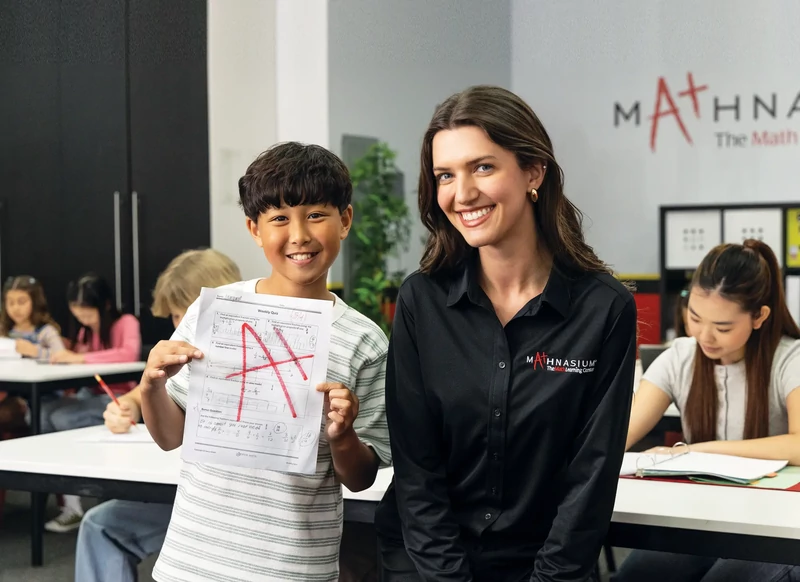
Grades and test scores are meant to give us an insight into our child’s progress and skills, but they don’t always tell the full story, especially in math.
Some students seem to be doing fine…until new material suddenly becomes frustrating or confusing.
This usually happens when students learn how to get through math using guessing strategies and memorizing steps, rather than truly understanding the underlying concepts, and it’s especially common in the early grades.
Let’s discuss how you can check whether your child is truly understanding the material and not just guessing their way through.
5 Signs Your Child Is Guessing in Math
Students who struggle to keep up in math are likely to develop habits like guessing and memorizing patterns to “get by” in class.
They’re not always obvious, so if you suspect your child needs more stable math foundations, here are the signs to look out for:
1. They Struggle to Explain How They Got the Answer
If your child solves a problem correctly but can’t tell you how they did it, it’s worth paying attention.
When asked, they might say, “I just knew,” or give you a blank stare.
A student who understands the math should be able to walk you through their process, even if it’s simple. Inability to do so can signal that they’re relying on intuition or memorized answers.
Try asking, “Can you walk me through your thinking?” and observe their answer to understand their approach.
📕You May Also Like: Is My Child Bad at Math or Just Missing Foundational Skills?
2. They Rely on Finger Counting or Visual Clues
Finger counting well into third or fourth grade or guessing based on what “looks right” (for example, picking the longest answer) are usually signals that the student hasn’t developed their number sense—what we define as “intuitive understanding of numbers.”
These strategies might help them through simple problems, but they won’t support them as math becomes more abstract.
You might hear them say things like “this one sounds right” or “I picked B because it hasn’t come up yet.” These are your queues to work on (re)building their number sense.
📕 You May Also Like: Finger Counting: A Great Tool or a Hindering Habit?
3. Their Performance is Inconsistent
Working with thousands of students in our center, it is pretty clear that those who rely on guesswork and memorization tend to have good days and bad days with no clear pattern.
For example, they might ace flash cards but freeze on similar problems in a word problem. Or they might get something wrong on paper and immediately say the correct answer out loud.
These are just some of the potential signs of shaky understanding that doesn’t transfer well.
Inconsistent performance is one of the biggest clues that a student is relying on surface-level familiarity rather than deep comprehension.
4. They Struggle to Use Math in Everyday Situations
Some students perform well with written problems but hit a wall when the same math shows up in a real-world scenario.
For example, a child might solve 12 – 5 on paper but struggle to answer, “If you had 12 apples and gave away 5, how many would you have left?”
This shows that they haven’t been able to bridge the gap between the concept and what it represents.
5. They Avoid Math or Say “I’m Just Not Good at It”
In our experience, when a student refuses to engage with math, it’s often because they don’t understand it. Rather than ask for help or work through confusion, some find it easier to start guessing.
They fill in answers quickly to get it over with. They may shut down during problem-solving or rely on pattern-matching without understanding what the numbers actually mean.
This kind of guessing tends to grow when students feel stuck. If they say things like “I hate math” or “I’m just not a math person,” it’s often because they’ve learned to expect confusion and frustration.
Math anxiety plays a major role here.
A recent study suggests that math anxiety doesn't just distract a student; it can actually 'block' the brain's ability to process numerical information. That disruption makes it harder to learn new material and easier to fall further behind.
The longer a child relies on guessing, the more difficult it becomes to build real understanding. Recognizing this early can help parents address the root problem and stop the cycle before it becomes harder to reverse.

A supportive environment is crucial for tackling such mental blocks.
Why Getting the Right Answer Isn’t the Same as Understanding Math
It’s natural to feel reassured when your child brings home good grades or completes their homework quickly. However, true math understanding means your child can explain their reasoning, adapt to new problem types, and apply what they know in different situations.
For example, a student who understands multiplication can solve 4 × 3 on a worksheet, explain that it means “four groups of three,” and also use that idea to figure out how many wheels there are on four tricycles.
This flexibility is what allows students to move forward in math with confidence and build up the foundation they need to learn more complex concepts later on.
The Real Problem with Guessing
Cognitive research shows that guessing often leads to increased cognitive load and error rates. This type of learning doesn’t stick, and it can drain a student’s mental energy quickly.
On the other hand, conceptual understanding activates long-term memory and builds mental models that students can rely on and expand.
Without the right support, math learning gaps will only grow and make later topics much more difficult.
As we mentioned, math is cumulative; concepts like fractions, algebra, and word problems all build on earlier lessons. Students who never fully grasped place value or number relationships may suddenly find themselves lost.
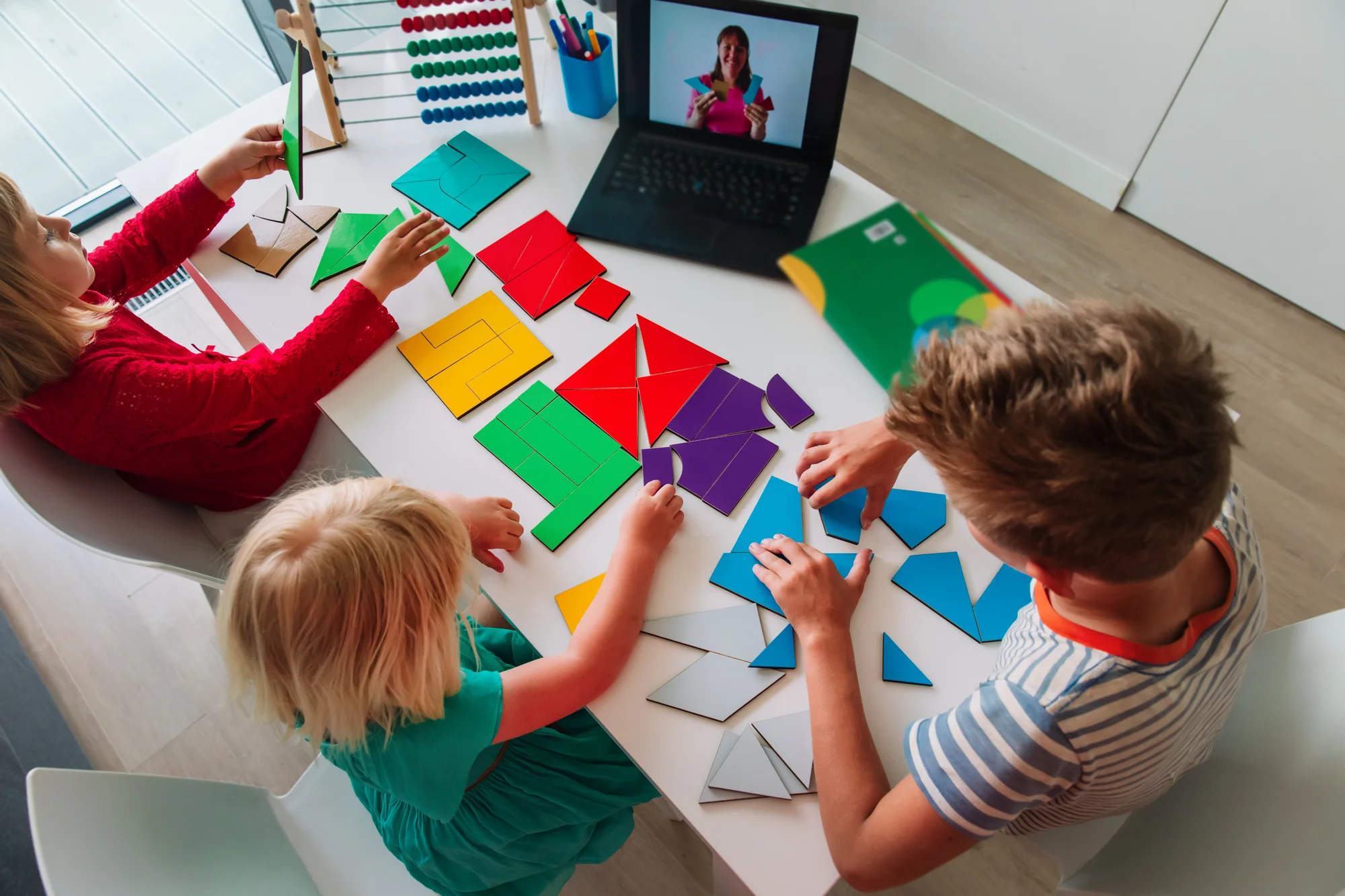
Making concepts tangible can make them less abstract and easier to understand.
How to Build Real Understanding at Home
Helping your child move from guessing to genuine understanding doesn’t require hours of drills or endless repetition.
In fact, if kids don’t understand what they’re practicing, repetition can backfire.
While practice is important for mastery, research suggests that repetitive drills can sometimes be counterproductive if a child hasn't first grasped the underlying concept. In these cases, repetition may increase frustration and math anxiety rather than building lasting skills.
Here’s what truly supports long-term learning, especially when you’re working with your child at home:
1. Focus on Concepts First
Before jumping into practice problems, talk through what the math means.
For example, when learning multiplication, ask: “What does 3 × 4 really mean?” Help your child see it as “three groups of four” and draw it out or use real objects.
If your child struggles with counting, you can make a game out of counting the steps when going upstairs or counting their toys as they put them away.
2. Use Visual Reasoning
Many students guess because they can’t visualize what’s happening in a problem. Use tools like number lines, blocks, videos, or drawings to show how math works.
Even for older students, visualizing equations or expressions can reveal patterns they didn’t notice before.
This can also help alleviate some of their math anxiety, as it can feel more like a game than a task.
📕 You May Also Like: How to Teach Math to Visual Learners with Pictures and Manipulatives.
3. Start From the Ground Up
Math concepts stack on top of each other.
If your child struggles with fractions, the root problem might be a weak grasp of division or number lines. Go back as far as needed to help them rebuild missing skills in the right sequence.
Trying to move forward without fixing gaps can feel like building on sand; the structure won’t hold.
4. Support Confidence and Emotional Safety
One of the most overlooked aspects of math learning is emotional safety. A child who feels judged or rushed is more likely to freeze or guess. Celebrate effort, not just correctness.
Praise them for making follow-up questions or trying to work out underlying concepts in a different way, as these behaviors show deeper understanding.
When kids feel safe and supported, they’re more willing to try, make mistakes, and ultimately learn.

Our specially trained math tutors make mathematical concepts more tangible and easier to understand.
How Mathnasium Helps Kids Stop Guessing and Build Stronger Math Foundations
If you’re looking for extra support as your child shifts from guessing to true math understanding, Mathnasium is here to help.
Mathnasium is a math-only learning center for K-12 students of all skill levels. Specially trained tutors work face-to-face with students in a caring and fun group environment, using personalized learning plans that meet them exactly where they are.
The focus stays on teaching math in a way that makes sense, starting with what your child already knows and building new knowledge step by step. Techniques range from visual aids and manipulatives to verbal explanations, helping kids grasp foundational concepts like number sense and reasoning instead of relying on guesses.
-
94% of parents report an improvement in their child’s math skills and understanding
-
90% of students see better grades in school
-
93% of parents notice a more positive attitude toward math
If you're in the Littleton, CO, area, you're in great hands. With 100+ glowing Google reviews, Mathnasium of Littleton has earned the trust of families throughout the community, serving as your local partner to rebuild math confidence.
To get started, schedule a free assessment at Mathnasium of Littleton or your nearest learning center. Our team is here to help your child unlock their full math potential all year long.


 (303) 979-9077
 (303) 979-9077