If your child's fraction homework looks unfamiliar, there is a reason for that.
Since Common Core standards came into effect in 2010, the approach to teaching fractions has changed.
The focus is now on genuine understanding of what a fraction is, rather than memorizing procedures for working with them, and that makes the homework look very different from what most parents remember.
Mathnasium tutors have put together a practical guide to what changed, why it works, and how you can use the same visual tools at home to support your child.
How Common Core Fractions Are Different
The traditional approach treated fractions as a set of rules to follow.
Common Core treats fractions as something to understand.
That single difference changes almost everything about how they are taught.
Rather than jumping straight to procedures, the Common Core approach asks children to build a mental picture of what a fraction looks like before they calculate anything.
Children are expected to explain their reasoning, compare fractions visually, and connect what they see to the symbols on the page. The goal above all is to build number sense and understanding.
This is also why fraction homework often involves drawing, shading, and number lines rather than columns of calculations.
These are not busywork. They are the foundation.
And the tool at the center of all of it is the fraction model.
📕 You May Also Like: What Parents Need to Know About Common Core Math Standards
Why Fraction Models Are at the Heart of the Common Core Approach
Most children learn to read numbers before they truly understand what those numbers mean.
With whole numbers, that gap is small enough that it rarely causes problems.
With fractions, it becomes a real obstacle.
A child can memorize that \(\Large\frac{1}{2}\) means "one out of two" without having any sense of what that actually looks like or how big it is.
Fraction models serve to bridge that gap.
They give children a concrete, visual reference to connect to the symbols on the page. Rather than asking a child to hold an abstract idea in their head, a model gives them something to point to.
There are three types of fraction models used in Common Core fractions teaching, each suited to a different stage of understanding.
Used in sequence, they build on each other naturally.
📕 You May Also Like: How to Teach Math to Visual Learners with Pictures & Manipulatives
1. Set Models
Set models are the most intuitive starting point because they use real, countable objects rather than drawn shapes.
A set model represents a fraction by dividing a group of objects into equal parts.
Put twelve grapes on a plate and ask your child to divide them into four equal groups.
Each group represents \(\Large\frac{1}{4}\) of the total.
If they eat one group, they have eaten \(\Large\frac{1}{4}\) of the grapes.
Set models work well early on because they connect directly to the counting skills children already have.
They also make the denominator feel concrete: the denominator is not just a number at the bottom of a fraction, it is the number of equal groups the whole has been split into.
Best of all, it requires no paper, no drawing, and no setup beyond what is already on the table.
📕 You May Also Like: Key Counting Strategies for Preschoolers and Kindergartners
2. Area Models
Area models take the idea introduced by set models and move it into shapes, which allows children to see fractions as portions of a whole rather than just groups of objects.
To show that \(\Large\frac{1}{4}\) is larger than \(\Large\frac{1}{8}\) via an area model, you can:
-
Draw a rectangle and divide it into four equal parts. Shade one. That is \(\Large\frac{1}{4}\).
-
Draw another rectangle of the same size, divide it into eight equal parts, and shade one. That is \(\Large\frac{1}{8}\).
-
Place both rectangles side by side and ask your child which shaded area covers more space.
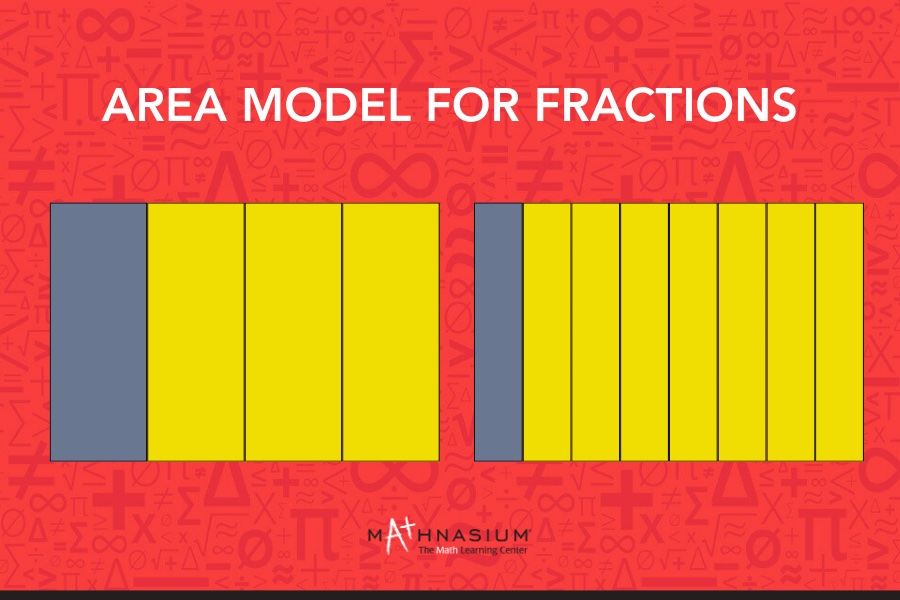
They will see immediately that \(\Large\frac{1}{4}\) is larger.
No rule needs to be stated. The picture does the explaining.
Once your child is comfortable comparing fractions visually, you can use the same approach to show why two fractions can look different but mean the same thing:
-
Draw a circle divided into four equal parts. Shade one section.
-
Draw the same circle divided into eight equal parts. Shade two sections.
-
Ask your child whether both shaded regions cover the same amount of space.
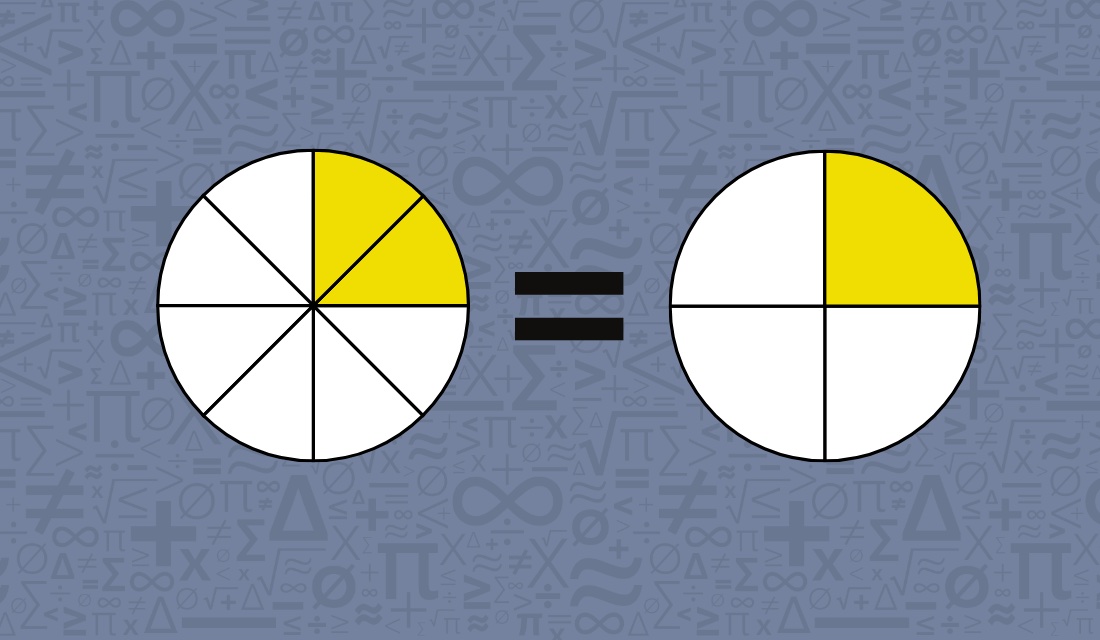
They do. That means \(\Large\frac{1}{4}\) and \(\Large\frac{2}{8}\) are equal.
At this point, there’s no need to explain that you can multiply the numerator and denominator by the same number to finish the problem. The child can see the end result.
The total area does not change. Only the number of equal parts does.
That is a much more satisfying answer than "because the rule says so."
📕 You May Also Like: What Is a Bar Model in Math? A Complete Overview
3. Number Lines
Fractions are not only pieces of shapes or groups of items.
The final step in the evolution of understanding fractions is showing them as numbers with positions. For this breakthrough, we’re going to use a number line.
To explain a fraction through a number line, here’s what you need to do:
-
Draw a line from 0 to 1 and divide it into four equal segments.
-
Ask your child where \(\Large\frac{1}{4}\) belongs (one segment from zero) and where \(\Large\frac{3}{4}\) belongs (three segments from zero).
-
Now ask: is \(\Large\frac{3}{4}\) closer to 0 or closer to 1? There is no trick. It is just a question that gets children thinking about fractions as real values with size and position.
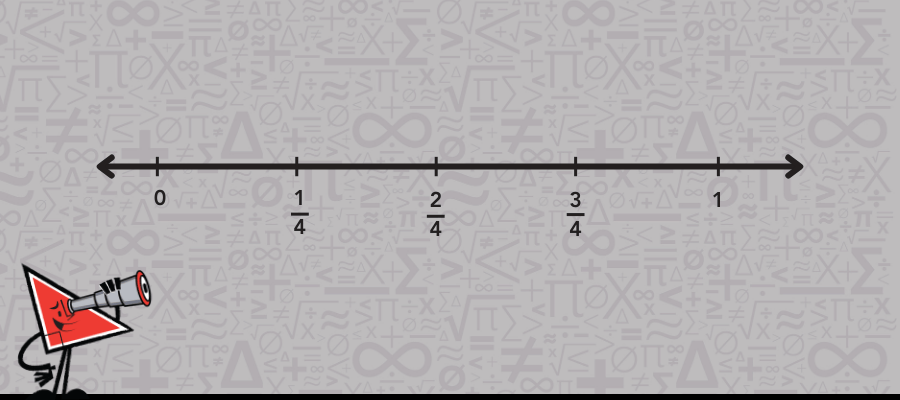
Number lines are particularly useful for showing that fractions live between whole numbers. In our experience, this is a surprisingly tricky idea for many children to accept at first.
📕 You May Also Like: How Number Lines Improve Math Understanding in Grades 1 Through 5
How to Use Fraction Models at Home
You do not need a classroom or special materials to effectively use fraction models.
The best approach is to keep it casual and connected to what is already happening around you.
Here are a few easy starting points:
-
Group snacks into equal sets. Put twelve grapes, crackers, or raisins on a plate and ask your child to divide them into equal groups. Ask which fraction of the total each group represents. A simple set model that doubles as a snack.
-
Fold a piece of paper into equal sections, color one in, and ask your child what fraction is colored. A quick, hands-on area model that takes thirty seconds.
-
Use a chocolate bar. A bar of twelve equal squares is a ready-made area model. Ask your child to break off \(\Large\frac{1}{3}\) and count the squares, then ask what \(\Large\frac{2}{3}\) would look like.
-
Draw a number line on a notepad, mark 0 and 1 at either end, and ask your child to place \(\Large\frac{1}{2}\) and then \(\Large\frac{1}{4}\) on the line.
A small habit that goes a long way is pointing out fractions during everyday moments.
These moments show children that fractions exist in the real world and have genuine meaning.
Why Fraction Understanding Matters in the Long Run
Fractions do not stay isolated in elementary school. They connect forward to almost every area of math your child will encounter later:
-
Decimals and percentages: \(\Large\frac{3}{4}\) is the same as 0.75 and the same as 75%. A child who understands what \(\Large\frac{3}{4}\) actually represents will find that connection intuitive.
-
Algebra: Equations often include fractions alongside unknown values. If the concept of \(\Large\frac{3}{4}\) is unclear, those equations become far harder than they need to be.
-
Ratios and proportional reasoning: These topics, central to middle school math, are built directly on fractional thinking.
Children who develop a genuine understanding of fractions, rather than a set of steps to follow, will have a much easier time learning the mathematics that builds on top of them.

Mathnasium tutors ensure that children have a strong foundation so that later concepts are intuitive and approachable.
How Mathnasium Helps Kids Build a Real Understanding of Fractions
Mathnasium is a math-only learning center dedicated to helping students truly understand how math works, not just memorize procedures.
When it comes to fractions, that distinction is everything. Rather than drilling steps, we build understanding from the ground up using visual, hands-on methods that align directly with how fraction models are taught in schools today.
Our approach, the Mathnasium Method™, is proprietary, personalized, and built around six core principles:
-
Personalization on a granular level: Every student begins with a diagnostic assessment that identifies their strengths, their gaps, and exactly where their understanding of fractions breaks down. From there, tutors follow a personalized learning plan designed to close those gaps systematically.
-
Teaching for understanding: We explain math using clear, everyday language and reinforce each concept through visual, verbal, written, mental, and hands-on techniques, including the fraction models covered above.
-
Caring instruction: Our tutors provide patient, encouraging guidance in a fun group environment where students feel supported as they work through material that has felt confusing or frustrating.
-
Independent problem solving and critical thinking: Each session includes time for students to work through problems on their own, building the reasoning skills to understand not just how to get an answer, but why it works.
-
Singular focus on math: Our program spans thousands of pages and has been refined over more than 20 years, allowing us to take a genuinely deep look at how students absorb and retain mathematical concepts like fractions.
-
Empowering, fun learning environment: Our materials are game-based and reward-driven, designed to keep students motivated as they advance.
The results speak for themselves:
-
94% of parents report an improvement in their child's math skills and understanding
-
93% of parents report an improved attitude towards math after attending Mathnasium
-
90% of students saw an improvement in their school grades
With a network of more than 1,100 centers, Mathnasium brings top-rated instruction close to your home.
For families in Mason, you’re in good hands!
Mathnasium of Mason has earned recognition from the community it serves:
If your child is in or near Mason, Ohio, our team is ready to help them go from confused to capable.
📅 Schedule a Free Diagnostic Assessment at Mathnasium of Mason
Not located near Mason?
📍 Find a Mathnasium Learning Center Near You


 (513) 683-9800
 (513) 683-9800