Fraction multiplication shows up around 4th or 5th grade, usually right after students get comfortable with what fractions are and just before things start to feel more abstract.
Today, Mathnasium tutors cover:
-
What fractions and whole numbers actually are
-
How to multiply a fraction by a whole number, step by step
-
How to handle mixed numbers
-
How to check and simplify your answer
And by the end, you will be able to solve these problems confidently and understand both why the method works and how.

A Quick Refresher: What Are Whole Numbers and Fractions?
Before we get into multiplication, let's make sure we're on the same page about what these terms are.
Whole numbers are complete, unbroken amounts, no fractions, no decimals. Think of them as counting numbers: 1, 2, 3, and so on.
Imagine you and two friends each bring a full water bottle to soccer practice. Those three bottles represent three whole numbers.
Fractions represent a part of a whole, so part of the bottle. Every fraction has two parts:
Let’s use a more solid (pun intended) example. Say your coach cuts the post-practice orange into 8 equal slices and you grab 3. You ate \(\Large\frac{3}{8}\) of the orange.
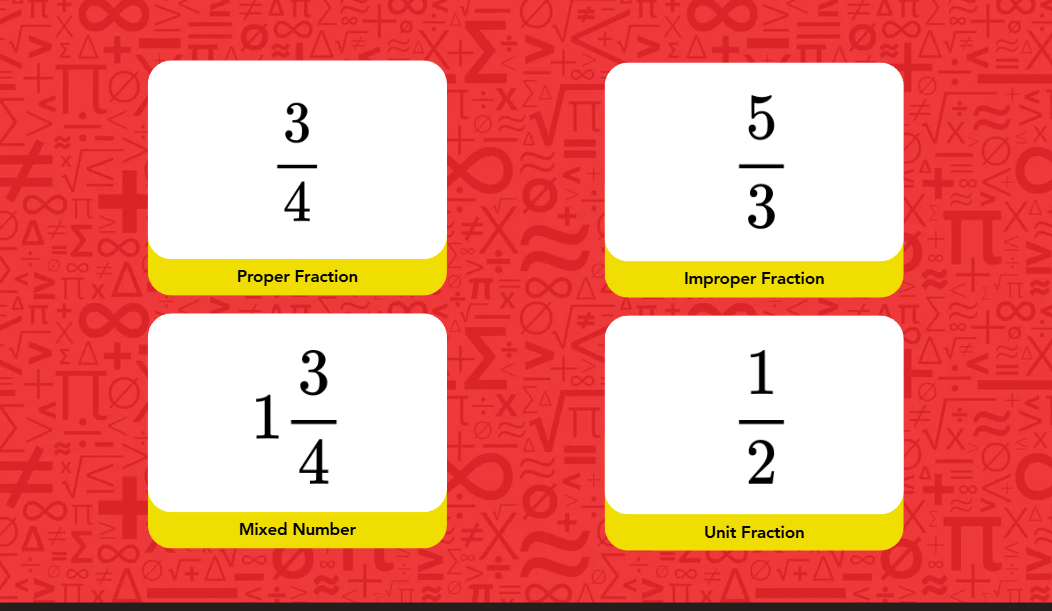
There are four types of fractions to memorize before we proceed to multiply:
-
Proper fractions: numerator is smaller than the denominator (e.g., \(\Large\frac{3}{4}\))
-
Improper fractions: numerator is equal to or greater than the denominator (e.g., \(\Large\frac{5}{3}\))
-
Mixed numbers: a whole number combined with a fraction (e.g., 1\(\Large\frac{3}{4}\))
-
Unit fractions: numerator is always 1 (e.g., \(\Large\frac{1}{2}\), \(\Large\frac{1}{3}\))
📕 You May Also Like: How to Compare Fractions? A Kid-Friendly Guide
Before the Steps: What This Operation Actually Does
Most guides jump straight into the steps. Before we do that, let’s understand what's happening when we multiply a fraction by a whole number, because the steps will make much more sense when you know what you're calculating.
If we multiply a whole number by another whole number, the result gets bigger. Multiply 3 by 4, and the result we get is 12.
Let’s now multiply a fraction by a whole number. Something different happens. We are taking a fraction of a quantity multiple times. Let’s think of it this way:
Imagine you walk \(\Large\frac{3}{4}\) of a mile to school every day. After 4 days, how far have you walked in total? You are adding \(\Large\frac{3}{4}\) four times:
\(\Large\frac{3}{4}\) + \(\Large\frac{3}{4}\) + \(\Large\frac{3}{4}\) + \(\Large\frac{3}{4}\) = \(\Large\frac{12}{4}\)
If we use Greatest Common Factor (GCF) 4 here to simplify the fraction, we get 3.
\(\Large\frac{12}{4}\) = 3
So \(\Large\frac{3}{4}\) × 4 = 3.
Multiplication is just a faster way to add the same number repeatedly.
Let’s keep this in mind as we work through the steps below.
How to Multiply a Fraction by a Whole Number
Let's work through this together using a simple example: \(\Large\frac{2}{3}\) × 3.
Step 1: Rewrite the Whole Number as a Fraction
We write the whole number over 1:
3 = \(\Large\frac{3}{1}\)
This makes it easier to follow the next steps. Dividing any number by 1 does not change its value, so 3 and \(\Large\frac{3}{1}\) mean exactly the same thing.
Now we are multiplying:
\(\Large\frac{2}{3}\) × \(\Large\frac{3}{1}\)
Step 2: Multiply the Numerators
Let’s multiply the top numbers together:
2 × 3 = 6
Step 3: Multiply the Denominators
What we need to do now is multiply the bottom numbers together:
3 × 1 = 3
The fraction is now \(\Large\frac{6}{3}\).
Step 4: Simplify the Fraction
Now, we divide the numerator by the denominator:
6 ÷ 3 = 2
So \(\Large\frac{2}{3}\) × 3 = 2
📕 You May Also Like: Simplifying Fractions: Quick Steps to Reduce and Compare
How to Multiply a Mixed Number by a Whole Number
Multiplying a mixed number by a whole number follows the same steps, with one extra step at the beginning.
Let's work through 2\(\Large\frac{1}{4}\) × 3.
Step 1: Convert the Mixed Number into an Improper Fraction
A mixed number combines a whole number and a fraction. To multiply it, we first convert it into an improper fraction:
-
Multiply the whole number (2) by the denominator (4): 2 × 4 = 8
-
Add the numerator (1) to the result: 8 + 1 = 9
-
Write 9 over the denominator (4): 2\(\Large\frac{1}{4}\) = \(\Large\frac{9}{4}\)
Now we are multiplying: \(\Large\frac{9}{4}\) × 3
Step 2: Rewrite the Whole Number as a Fraction
3 = \(\Large\frac{3}{1}\)
Now, let’s multiply: \(\Large\frac{9}{4}\) × \(\Large\frac{3}{1}\)
Step 3: Multiply the Numerators
9 × 3 = 27
Step 4: Multiply the Denominators
4 × 1 = 4
Our fraction is now \(\Large\frac{27}{4}\).
Step 5: Simplify the Fraction
27 ÷ 4 = 6 remainder 3, so \(\Large\frac{27}{4}\) = 6\(\Large\frac{3}{4}\)
The final answer is: 2\(\Large\frac{1}{4}\) × 3 = 6\(\Large\frac{3}{4}\)
📕 You May Also Like: How to Convert Mixed Numbers to Improper Fractions (& Vice Versa)
Solved Examples: Multiplying Fractions by Whole Numbers
Practice makes perfect. Let’s work through a few more examples together and nail this down!
Example 1: Fraction by Whole Number
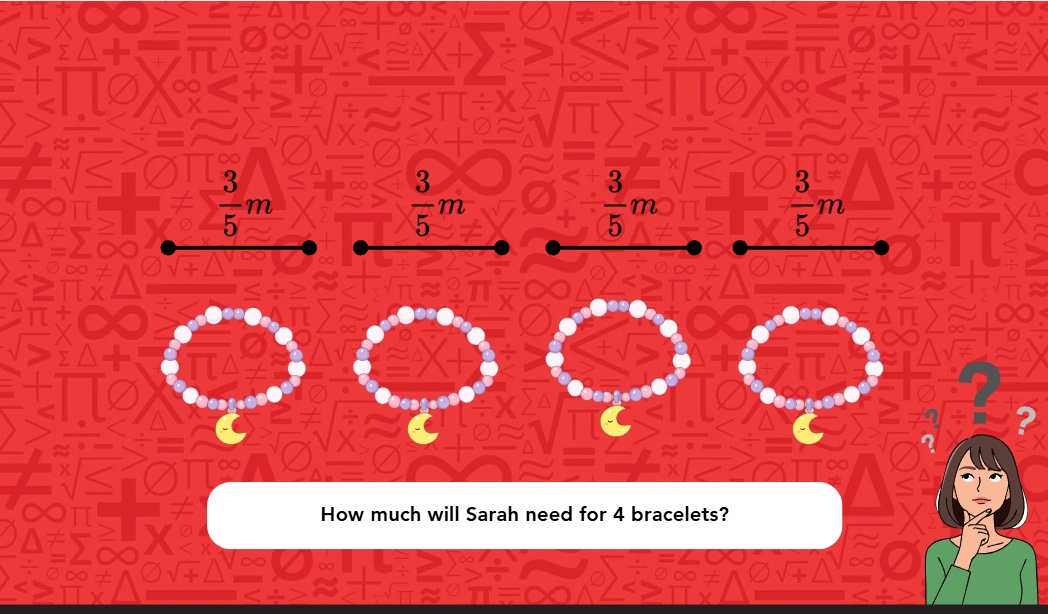
Sarah is making friendship bracelets. Each bracelet uses \(\Large\frac{3}{5}\) of a meter of string. How much string does she need for 4 bracelets?
Let's solve \(\Large\frac{3}{5}\) × 4.
Step 1: Rewrite the Whole Number as a Fraction
4 = \(\Large\frac{4}{1}\)
Now we are multiplying: \(\Large\frac{3}{5}\) × \(\Large\frac{4}{1}\) × \(\Large\frac{4}{1}\)
Step 2: Multiply the Numerators
3 × 4 = 12
Step 3: Multiply the Denominators
5 × 1 = 5
The fraction is now \(\Large\frac{12}{5}\).
Step 4: Simplify the Fraction
12 ÷ 5 = 2 remainder 2, so \(\Large\frac{12}{5}\) = 2\(\Large\frac{2}{5}\)
Sarah needs 2\(\Large\frac{2}{5}\) meters of string.
Example 2: Mixed Number by Whole Number
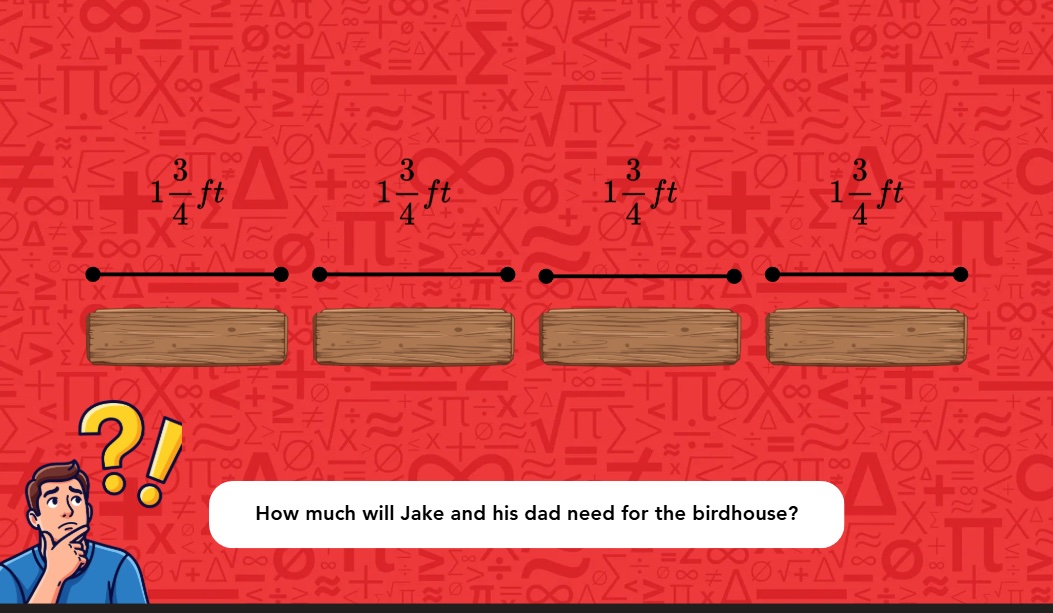
Jake and his dad are building a birdhouse. Each wooden plank they need is 1\(\Large\frac{3}{4}\) feet long. They need 4 planks. How much wood do they need in total?
Let's solve 1\(\Large\frac{3}{4}\) × 4.
Step 1: Convert the Mixed Number into an Improper Fraction
-
We multiply the whole number (1) by the denominator (4): 1 × 4 = 4
-
Add the numerator (3): 4 + 3 = 7
-
Write 7 over the denominator (4): 1\(\Large\frac{3}{4}\) = \(\Large\frac{7}{4}\)
Now, let’s multiply: \(\Large\frac{7}{4}\) × 4
Step 2: Rewrite the Whole Number as a Fraction
4 = \(\Large\frac{4}{1}\)
Again, we are multiplying: \(\Large\frac{7}{4}\) × \(\Large\frac{4}{1}\)
Step 3: Multiply the Numerators
7 × 4 = 28
Step 4: Multiply the Denominators
4 × 1 = 4
The fraction is now \(\Large\frac{28}{4}\).
Step 5: Simplify the Fraction
28 ÷ 4 = 7
Jake and his dad need 7 feet of wood.
Your Turn! Try These Problems
Ready to practice? Work through these problems on your own and check your answers at the bottom of the page.
Task 1
Maya is pouring lemonade into glasses. Each glass holds \(\Large\frac{3}{4}\) of a cup. How much lemonade does she need to fill 5 glasses?
Solve: \(\Large\frac{3}{4}\) × 5
Task 2
A recipe calls for \(\Large\frac{2}{5}\) of a cup of sugar. Tom wants to make 4 batches. How much sugar does he need in total?
Solve: \(\Large\frac{2}{5}\) × 4
Task 3
Emma is training for a 5K. She runs 2\(\Large\frac{1}{3}\) miles every morning. How far does she run in 3 days?
Solve: 2\(\Large\frac{1}{3}\) × 3
Frequently Asked Questions About Multiplying Fractions by Whole Numbers
Here are some of the most common follow-up questions we hear from our students.
1. Does the order of multiplication matter?
No, it does not. Multiplication is commutative, meaning we can switch the order of the numbers and still get the same result. So \(\Large\frac{3}{5}\) × 4 gives us the same answer as 4 × \(\Large\frac{3}{5}\). Some students find it easier to always write the fraction first, but either way works perfectly fine.
2. What do I do if I get a very large numerator or denominator after multiplying?
We check if the fraction can be simplified. Find the greatest common factor (GCF) of the numerator and denominator and divide both by it. For example, \(\Large\frac{8}{12}\) simplifies to \(\Large\frac{2}{3}\) because both 8 and 12 divide evenly by 4.
3. What if my fraction includes a negative number?
The steps stay exactly the same. The only extra thing to figure out is the sign of your answer:
For example: (-\(\Large\frac{3}{5}\)) × 4 = -\(\Large\frac{12}{5}\) = -2\(\Large\frac{2}{5}\)
4. Does fraction multiplication come up anywhere outside of math class?
Fraction multiplication shows up in many areas of math you will encounter later, including algebra, ratios, and percentages. A solid grasp of it now sets you up well for those topics.
It also appears constantly in real life, from recipes and building projects to distances and split costs.
5. Why does multiplying by a fraction sometimes give a smaller answer than the whole number I started with?
When we multiply by a fraction smaller than 1, we are taking a part of the whole number rather than adding to it. For example, \(\Large\frac{1}{2}\) × 6 = 3. We took half of 6, so the result is smaller. This is different from multiplying two whole numbers, where the result always gets bigger.

Mathnasium's specially trained instructors guide students through fraction multiplication in a supportive, engaging environment.
How Mathnasium Helps Students Master Fractions
Mathnasium is a math-only learning center that helps K-12 students of all skill levels catch up, keep up, and get ahead in math.
Now that you know how to multiply fractions by whole numbers, the next step is making sure the concept truly sticks and connects to everything else in your math journey.
At Mathnasium, our specially trained tutors use the Mathnasium Method™, a proprietary teaching approach that starts with a diagnostic assessment to identify each student's knowledge gaps and strengths. From there, we build a personalized learning plan tailored to their needs and pace.
With the plan in place, our tutors follow it closely, teaching math face-to-face in a supportive and fun setting.
We use natural language to explain concepts and draw on a mix of verbal, visual, mental, tactile, and written techniques, so students can approach math from different angles and concepts truly land.
When students get stuck, we break problems down into manageable parts, always showing both the how and the why behind the answer. Over time, that builds the problem-solving skills and critical thinking tools students carry into math and beyond.
Fun is embedded in the approach. Sessions are often game-based and hands-on, keeping students engaged and enjoying the process. We track their progress, celebrate every win, big or small, and that consistent encouragement grows confidence with each session.
The results speak for themselves:
-
94% of parents report an improvement in their child's math skills and understanding
-
93% of parents report their child's improved attitude toward math
-
90% of students saw an improvement in their school grades
With over 1,100 centers, we bring the Mathnasium Method™ close to your community.
For families in and around Midlothian, VA, Mathnasium of Midlothian is a trusted local center with a strong track record of helping students grow their skills and change how they approach math with confidence.
Whether your student needs support to catch up, stay on track, or move ahead, we're here to help.
📅 Schedule a Free Diagnostic Assessment at Mathnasium of Midlothian
Not near Midlothian?
📍Find Mathnasium Learning Centers Near You
Pssst! Check Your Answers Here
If you worked through the practice problems, here are your answers:
How did you do?


 (804) 378-2211