(301) 468-6284
 (301) 468-6284










Halfway Through Summer: Is Your Child Forgetting Their Math?
Jul 14, 2026 | North Bethesda
Halfway Through Summer: Is Your Child Forgetting Their Math?

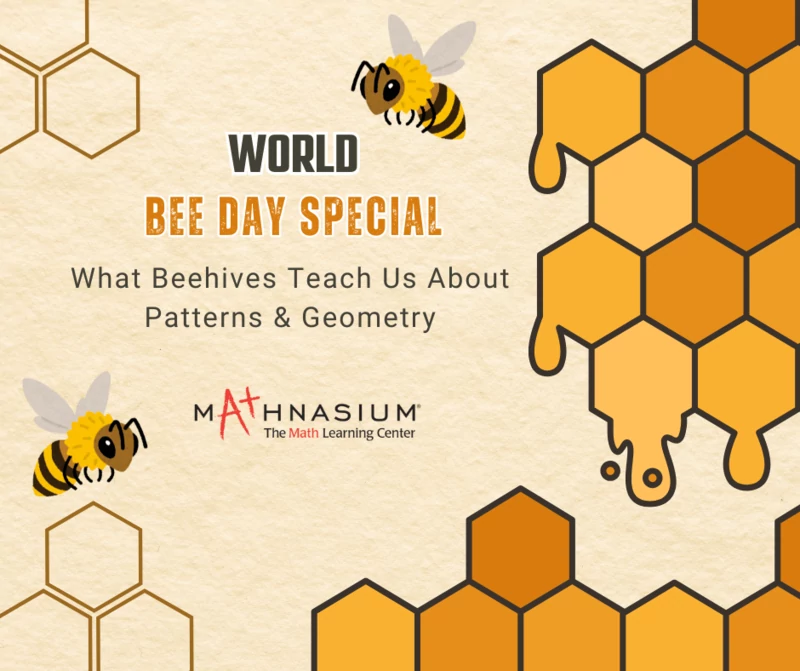
When we think about math, we often imagine numbers, equations, and homework sheets. But what if we told you that one of the best math teachers in the world is… a tiny bee?
Yes, bees are amazing mathematicians! This World Bee Day, let’s explore how beehives can teach kids important concepts like patterns, shapes, and efficiency all in a fun and natural way.
The Magic Shape: Why Hexagons?
Take a close look at a beehive, and you’ll notice something interesting. The honeycomb is made up of repeating shapes called hexagons a six-sided figure.
But why hexagons? Why not circles or squares?
Here’s where math comes in.
Hexagons are one of the most efficient shapes in geometry. They:
Fit together perfectly without leaving gaps
Use less material to build
Hold more honey compared to other shapes
In simple terms, bees use hexagons because they can store the most honey using the least wax. That’s smart problem-solving!
Easy Example Kids Can Relate To
Imagine you are packing snacks in a lunchbox.
If you use round containers, there will be empty spaces between them.
If you use square containers, they fit better but still may not use space perfectly.
But if you use hexagon-shaped containers, they fit tightly together, leaving almost no wasted space.
That’s exactly what bees do! Without learning geometry in school, they naturally choose the best shape.
Patterns Everywhere
Bees don’t just use hexagons they repeat them in a perfect pattern across the hive. This is called a tessellation, which means shapes fit together without gaps or overlaps.
You can see tessellations in:
Floor tiles
Wall designs
Puzzle patterns
Bees create one of the most perfect tessellations found in nature.
What Kids Can Learn From Bees
Bees show us that math is not just about solving problems on paper, it’s about solving real-life challenges.
Here are a few key lessons:
1. Efficiency Matters
Bees teach us how to get the best result using the least effort. This is an important math and life skill.
2. Patterns Help Us Understand the World
Recognizing patterns makes it easier to predict, organize, and solve problems.
3. Geometry Is Everywhere
From nature to buildings to games, shapes play a big role in how things work.
Try This Fun Activity at Home
Turn this into a hands-on learning moment.
Hexagon Challenge:
Ask your child to draw different shapes (circle, square, triangle, hexagon).
Try fitting them together on paper without gaps.
See which shape works best!
Or try building a honeycomb using paper cutouts. Kids will quickly see why hexagons win.
Connecting It to Everyday Life
Once kids start noticing, they’ll see math everywhere:
Football patterns and angles
Tiles in the kitchen
Arranging books on a shelf
Even video game design uses patterns and shapes
Math becomes more exciting when it feels real and useful.
Why This Matters for Your Child
Understanding concepts like patterns and geometry early helps kids:
Build strong problem-solving skills
Improve logical thinking
Gain confidence in math
And when learning feels fun and connected to the real world, kids are more likely to enjoy it.
How Mathnasium Helps
At Mathnasium, we believe math should make sense to kids not feel confusing or boring.
We use real-life examples (just like bees!) to help children:
Understand concepts clearly
Build confidence step by step
Develop a love for learning math
Whether your child needs help catching up or wants to get ahead, the right guidance can make all the difference.
Next time you see a beehive, remember it’s not just a home for bees. It’s a perfect example of how math works beautifully in nature.
And who knows? Your child might just start seeing math in a whole new way.
Ready to help your child build strong math skills in a fun way?
Visit Mathnasium and discover how we make math click!