If second grade was about building comfort with numbers, third grade is about putting them to work in entirely new ways.
Multiplication, division, and fractions arrive all at once, and the thinking they demand is categorically different from anything that came before.
If your child has been less sure of themselves in math lately, that is likely why.
We work with third graders regularly at our California centers, and drawing from that experience, we put together a breakdown of why confidence dips at this stage, the signs to watch for, and the steps to take when you spot them.

What California's 3rd Grade Math Standards Expect
Here in California, third-grade math follows the California Common Core State Standards, a framework that represents a significant step up from what Grade 2 asked of your child.
By the end of the year, your child is expected to:
-
Fluently multiply and divide within 100 and understand the relationship between the two operations
-
Understand fractions as numbers and place them on a number line
-
Solve two-step word problems using addition, subtraction, multiplication, and division
-
Understand the concept of area and relate it to multiplication
-
Describe and analyze two-dimensional shapes by their properties
-
Tell and write time to the nearest minute and solve elapsed time problems
📕 You May Also Like: Must-Know Math Skills: Preparing for the Next Grade (K-12 Guide)
Why Math Confidence May Dip in 3rd Grade
Though reasons for dips in confidence vary from student to student, our specialists have identified the patterns that come up most often. Here is what they shared.
A. Multiplication Struggles
Multiplication is the big arrival of third grade, and for many children, it is the first time math asks them to do something that does not feel intuitive straight away.
Understanding the concept and recalling facts fluently are two different things, and third grade expects both at the same time.
This shows up in a few ways:
-
Understanding that 4 × 3 means four groups of three, but freezing when asked to recall 7 × 8 under pressure
-
Getting the right answer slowly during calm practice, but going blank during a timed drill
-
Feeling embarrassed when called on in class before the fact is fully automatic
If we don't help our young learners work through their multiplication challenges early, what starts as a small stumble can quietly grow into a bigger loss of confidence in math.
📕 You May Also Like: 9 Tips to Help Your Child Master Multiplication Facts
B. Multi-Step Problems
Third grade is also when word problems get longer and more layered.
Your child is asked to read a scenario, identify what is being asked, decide which operations to use, and carry out multiple steps in the right order, all while holding the earlier parts of the problem in their head.
A typical third-grade example might look like this: "A farmer has 4 baskets, each with 6 apples. He sells 12 apples from one basket and gives 5 apples to a neighbor. How many apples does he have left in all?"
That requires multiplication, then subtraction twice, in sequence. Losing track of any one step produces a wrong answer, even when your child understands each operation on its own.
When errors like this pile up, the frustration can run deeper than the math itself. The mental juggling act that multi-step problems demand is genuinely taxing at this age.
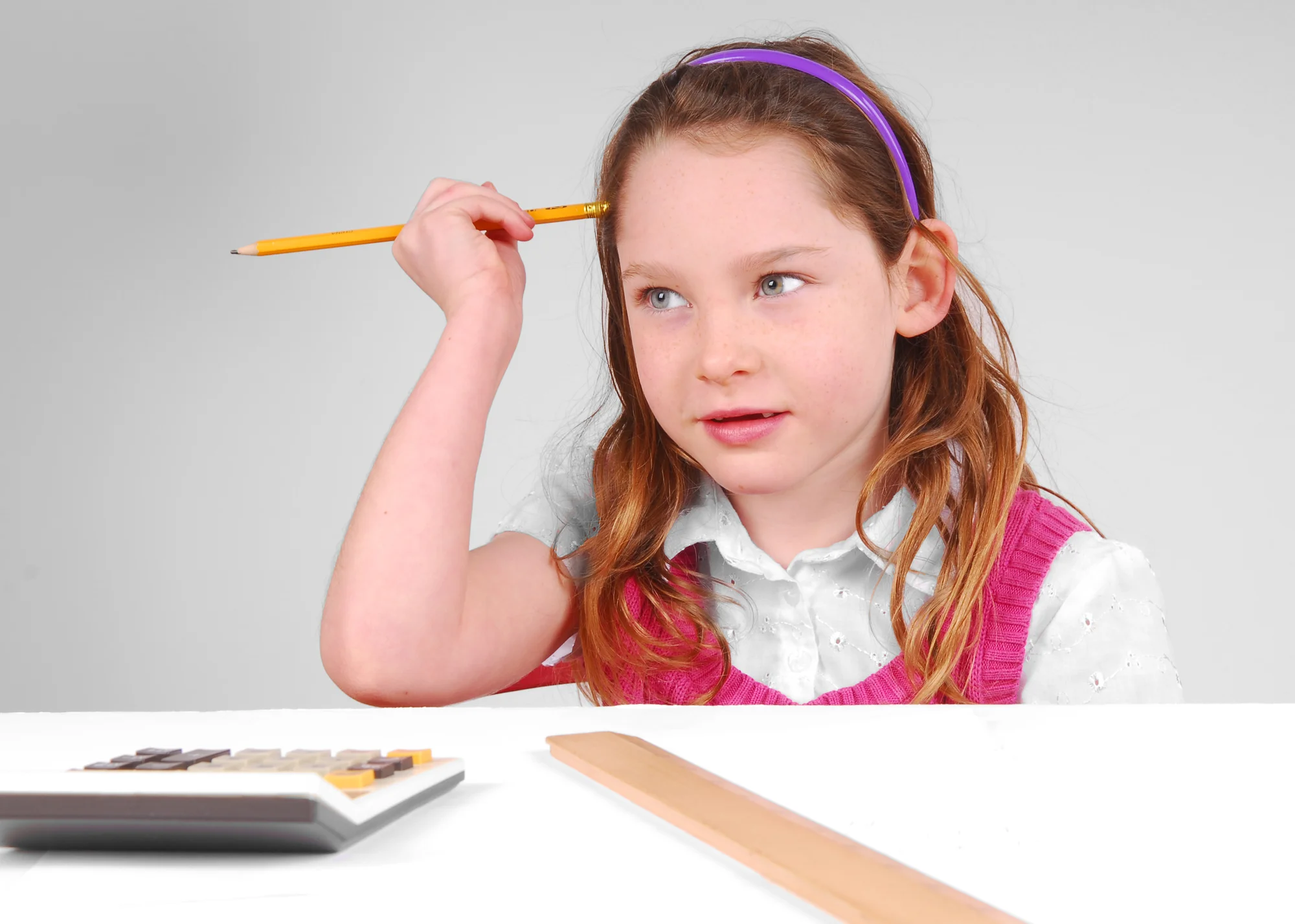
Multi-step problems ask third graders to hold several things in their heads at once, and that mental load is harder than it looks.
C. Fraction Misconceptions
Fractions are another major arrival in third grade, and they come with a built-in trap.
Children at this stage are asked to grasp that a fraction represents a part of a whole, that fractions have their own place on a number line, and that a larger denominator does not mean a larger value.
That last point catches many third graders out. It feels logical that \(\Large\frac{1}{6}\) should be bigger than \(\Large\frac{1}{4}\) because 6 is bigger than 4.
And helping a learner see why that reasoning is backwards takes patience. It is a conceptual leap that does not happen overnight, and that is completely normal at this age.
📕 You May Also Like: How to Help Your Child Make Sense of Wholes and Fractions
D. Unfilled Knowledge Gaps
Third-grade math builds directly on what came before it. If your child's addition or subtraction fluency from Grade 2 was not fully consolidated, or if their number sense was a little shaky, those gaps do not stay in the past.
When those earlier foundations are incomplete, new content lands on unsteady ground, and math starts to feel unpredictable in a way that is hard for your child to explain and hard for you to see from the outside.
E. Math Anxiety Takes Root
Third grade is also when math anxiety tends to appear for the first time, and it does not only affect children who are struggling.
A 2012 study of second and third-graders found that math anxiety significantly and negatively correlated with math proficiency, even among children performing at or above grade level.
What our tutors see in practice aligns with that finding.
The pressure of timed multiplication drills or working through a multi-step word problem in front of the class can cause a child to freeze, even when they understand the concept.
The anxiety gets in the way before the knowledge has a chance to show up.
The encouraging part is that the same research confirms early intervention works, and third grade is precisely the right time to step in.
Signs to Watch For in Your 3rd Grader
Some signs of a confidence dip are easy to spot. Others surface more gradually. All of them deserve attention if they are new or getting worse.
-
Reluctance before math homework that was not there before. If your child used to sit down without complaint but now stalls, finds reasons to delay, or gets upset specifically around math, that resistance is telling you something. It is an emotional response, and it is best met with curiosity rather than frustration.
-
Saying "I'm just not good at math" for the first time. This is not a passing comment. At this age, it is the beginning of a math identity forming, and left unchallenged, your child will invest less effort, avoid difficulty, and gradually confirm that belief through their own behavior.
-
Knowing the facts in practice but freezing under pressure. If your child can recall multiplication facts calmly at home but goes blank during a timed drill or when called on in class, that is anxiety getting in the way of retrieval. So, no, it’s not a gap in knowledge. The two require very different responses.
-
Getting the right answer, but unable to explain how. Students who get the right answer but cannot explain their reasoning are working from procedure rather than understanding. This sign is easy to miss because the grade still looks fine.

Staying close to how your child approaches math homework can reveal signs that are easy to miss from a distance.
Steps Parents Can Take to Help
A confidence dip in third grade is a signal, not a verdict. Caught early and responded to well, most third graders can get their footing back before fourth grade arrives. Here is where to start.
1. Build multiplication understanding before drilling facts
Make sure your child understands what multiplication means before asking them to memorize tables. Knowing that 4 × 3 means four groups of three means a forgotten fact can be reconstructed through reasoning rather than panic. Fluency built on understanding holds up under pressure.
📕 You May Also Like: 7 Strategies to Help Your Child Move Beyond Memorization in Multiplication
2. Use everyday contexts for fractions
Sharing food, splitting objects into equal parts, and dividing things up in daily life give fractions a concrete foundation before the abstract notation arrives. A pizza cut into four equal pieces and named one-fourth is an anchor no worksheet can replicate.
3. Respond to errors with curiosity
If your child makes a mistake, ask what they were thinking before correcting. This gives them a chance to catch the error themselves and signals that mistakes are part of thinking, not evidence of failure.
📕 You May Also Like: Why Parents Should Teach Kids to Embrace Math Mistakes
4. Keep practice short and calm
Ten to fifteen minutes of focused practice four times a week produces better results than long sessions under pressure. End on something your child can do successfully. The emotional quality of practice matters at this age.
5. Praise effort and reasoning, not correct answers
Your child rebuilding confidence needs to hear that trying hard and thinking carefully count.
Specific praise lands better than general encouragement. Instead of "good job," try "I noticed you went back and checked your work when something felt off" or "I liked how you broke that problem into smaller parts."
That kind of feedback tells your child exactly what they did well and makes them more likely to do it again.

Each student's Mathnasium journey starts with a diagnostic assessment that pinpoints exactly where they need support.
How Mathnasium Helps 3rd Graders Build Lasting Skills and Confidence
Mathnasium is a math-only learning center empowering K-12 students of all skill levels to excel in math.
We've supported thousands of third graders not just to keep up with the increased demands of the curriculum but to build solid foundations and lasting confidence for the years ahead.
At the heart of how we work is the Mathnasium Method™, our proprietary teaching approach designed to help each student truly understand math.
Every student begins with a diagnostic assessment, a relaxed, low-pressure interaction where we pinpoint what your third grader already knows and where they could use support. From there, we build a personalized learning plan tailored to their specific needs and goals.
With the plan in place, our specially trained, caring tutors work with students face-to-face in a warm and engaging setting, following each student's plan closely and adapting as they grow.
When a third grader gets stuck on a concept like fractions or multi-step problems, we break it down into manageable steps and explain both the how and the why. That understanding is what builds the critical thinking skills students carry with them into fourth grade and beyond.
Fun is a core part of the approach. Our activities are often game-based and hands-on, keeping students genuinely engaged. We celebrate and reward progress at every level, building confidence session by session.
Results speak volumes:
-
94% of parents report an improvement in their child's math skills and understanding
-
93% of parents report an improved attitude toward math after attending Mathnasium
-
90% of students saw an improvement in their school grades
With over 1,100 learning centers, Mathnasium brings top-rated instruction close to you.
For families in and around Northwood in Irvine, CA, Mathnasium of Northwood is a trusted local center with years of experience building confident math thinkers.
If your third grader needs to catch up, keep up, or even get ahead in math, we’re here.
📅 Schedule a Free Assessment at Mathnasium of Northwood
Not in Irvine?
📍 Find a Mathnasium Learning Center Near You


 (949) 688-6284