Word problems ask students to do several things at once: read carefully, figure out what is actually being asked, translate the language into math, and then execute the solution.
Each of those steps is its own potential stumbling block, and a breakdown at any one of them produces a wrong answer regardless of how well your child knows the underlying math.
Word problems are something our tutors work on with students across every grade, and certain patterns tend to surface again and again. We rounded up the 7 most common ones, along with practical tips to correct them.

1. Rushing Into Calculations Before Understanding the Problem
We start here because this mistake sits at the root of most word problem errors.
Let’s say your child reads, "A baker made 48 cookies and gave some to three friends equally. How many did each friend get?" and immediately writes 48 ÷ 3 without stopping to notice that the problem never actually says how many were given away.
The calculation looks right, but the answer is wrong.
The rush students feel usually comes from treating word problems as number-extraction exercises rather than stories that need to be understood first.
Anxiety plays a role, too. Under pressure, your child may write something down that feels like progress, even when understanding has not caught up yet.
Our tutors use a Read, Retell, Plan routine before any calculation begins.
How does that work?
-
Read: go through the problem fully before touching a pencil. No highlighting, no writing, just reading.
-
Retell: put the problem into your own words in one sentence. "A baker made cookies and gave some to friends, and I need to find out how many each friend got."
-
Plan: identify the question and the numbers that actually matter before deciding on an operation. In this case, the number of cookies given away is missing, which means the problem cannot be solved as written.

Slowing down to understand the problem before reaching for a calculation is the habit that changes everything on word problems.
2. Relying on Keywords Instead of Context
Students are sometimes taught to scan for trigger words: "altogether" means add, "difference" means subtract, and "left" means subtract.
It works on simple problems and subtly unravels on harder ones. A problem using "more than" in a comparison does not always call for addition. A problem with "altogether" can require subtraction if a missing part needs to be found.
The keyword becomes a trap precisely when the problems get more demanding.
To address this, set the keyword list aside and focus on the story instead.
Who has what, what is happening, and what is changing?
Once an operation is chosen, run a quick sense check: does this actually describe what the problem is asking?
Phrase-switch practice helps build this habit: take the same numbers and the same scenario, change the wording, and show that the operation stays the same regardless of how the language is framed.
That is contextual understanding, and it holds up where keyword hunting does not.
📕 You May Also Like: 8 Common Mistakes Kids Make with Decimals & How to Fix Them
3. Misapplying Fractions in Context
Fraction word problems have a particular way of catching students out. It usually comes down to one thing: the reference point changes mid-problem, and the student does not notice.
Take this example: "Maya had 12 marbles. She gave 4 to a friend. Her brother took half of what was left. How many does her brother have?" A student reading quickly will calculate half of 12 rather than half of the 8 remaining.
The fraction calculation was applied to the wrong number.
The fix for this is quite simple.
Before calculating with any fraction, ask "fraction of what?" and fill in the answer explicitly.
Bar models and tape diagrams make this visible: draw the whole, remove the first portion, then apply the fraction to what remains.
Seeing the reference point drawn out makes the comprehension error almost impossible. Comparison pairs help too: "half of the cookies" versus "half of the cookies left after her sister took some" makes the distinction concrete before it appears on a test.
📕 You May Also Like: How to Help Your Child Make Sense of Wholes and Fractions
4. Skipping the Representation Step
This one surprises parents because it has nothing to do with math ability.
If your student jumps straight from reading to calculating without a drawing or diagram in between, it means they are without a map.
On simple problems like finding the total of two quantities, skipping the drawing is manageable. On complex ones like multi-step ratio problems or fraction comparisons, it is where errors creep in.
Make representation a non-negotiable step.
Every problem gets a drawing, bar model, tape diagram, or number line before a single number goes into an equation.
A simple scaffold helps: draw what the problem is describing, label the important parts, then write the math.
Explain to your student that this is not an extra step but the one that makes the structure of the problem visible and cuts operation errors significantly.
The students most resistant to drawing are usually the ones who need it most.
📕 You May Also Like: How to Use Model Drawing for Word Problems
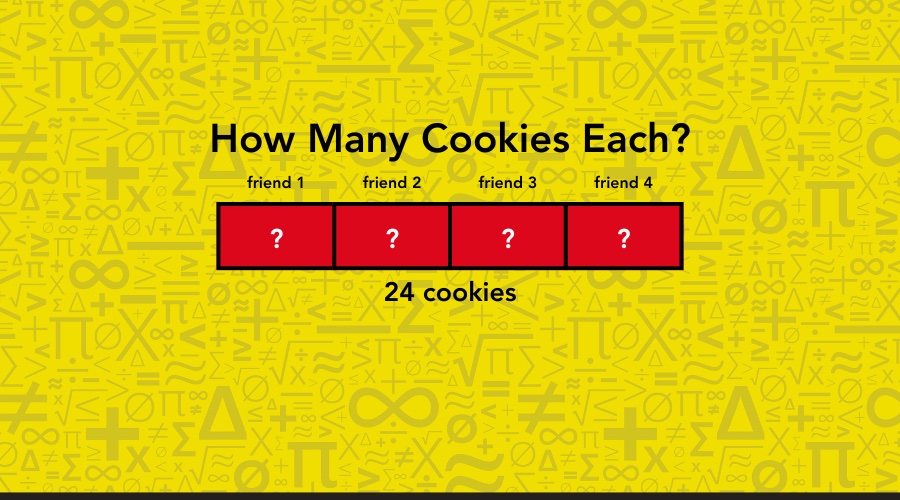
A bar model turns an abstract word problem into a visual structure your child can reason from.
5. Losing Track of Multi-Step Logic
In our experience, multi-step word problems are where organizational skills matter as much as math skills.
The error we see most often has nothing to do with calculation. It is about losing the logical thread. Working memory has its limits, and as problems grow longer, our students feel those limits.
A step-by-step box keeps the thread intact. Take this problem: "A bag has 36 apples. Maria takes 12 and divides the rest equally among 4 friends. How many does each friend get?" Map it out before calculating anything:
-
Step 1: Find how many apples are left after Maria takes hers. 36 − 12 = 24.
-
Step 2: Divide what remains equally among 4 friends. 24 ÷ 4 = 6.
-
Step 3: Each friend gets 6 apples.
Quite simple, right?
6. Ignoring Units and Labels
Your student can execute the arithmetic perfectly and still produce a meaningless answer. Adding 30 minutes to 2 hours and writing 32 as the answer is mathematically performed, but contextually wrong.
If their focus narrows to the numbers, what those numbers represent gets lost.
The solution?
Remind them that every number in the work carries its unit, and so does the final answer.
Two prompts build this as a habit: "Are these the same unit?" before any operation, and "Does my answer have the right label?" at the end.
Unit-check practice, where students are shown problems with mismatched units and asked what the first step would be, makes this feel automatic rather than like an additional task.
📕 You May Also Like: Measurement Conversions: A Kid-Friendly Guide
7. Not Checking Whether the Answer Makes Sense
To round off our list, this mistake is arguably the easiest to fix and the most consistently skipped.
Say your student calculates that a shirt on sale for 20% off costs $240 when the original price was $30, and moves on.
The arithmetic ran. The thinking stopped short of asking whether the result describes something real.
How do you turn this around?
Add a mandatory sense check at the end of every problem, spoken aloud or written in one sentence:
A fun way to build this instinct is crazy-answer practice, where students are given obviously impossible answers and asked to explain why they cannot be right.
It is engaging, it works, and it trains the internal filter that catches errors before they get submitted.

Mathnasium uses personalized learning plans and interactive instruction to help students work through any math concept, word problems included.
How Mathnasium Helps Students Learn and Master Any Math Concepts
Mathnasium is a math-only learning center empowering students of all skill levels to excel in math.
Whether your child needs support with word problems, foundational operations, or more advanced concepts, we offer a personalized path to mastery powered by the Mathnasium Method™, a proprietary teaching approach designed to help each student truly make sense of math.
It begins the moment your child walks through our door with a diagnostic assessment, a relaxed interaction that helps us pinpoint where they already excel and where they need support. From those insights, we build a learning plan customized to their needs and goals.
With the plan in place, our specially trained tutors follow it closely, delivering face-to-face instruction with flexible options both in the center and online.
We teach for understanding, phrasing concepts in everyday language and using a mix of verbal, visual, mental, tactile, and written techniques to make math click for each student.
When students get stuck on word problems or anything else, our tutors break concepts down into manageable parts, reducing the cognitive load and building confidence step by step.
Fun is a core part of how we work. Sessions are often game-based or hands-on, and we celebrate every bit of progress, big and small, keeping students aware of how far they have come and motivated to keep going.
The results speak for themselves:
-
94% of parents report an improvement in their child's math skills and understanding
-
93% of parents report an improved attitude towards math after attending Mathnasium
-
90% of students saw an improvement in their school grades
With a network of over 1,100 centers, Mathnasium brings top-rated instruction close to your community.
If you’re based in or near Phoenix, AZ, Mathnasium of Paradise Valley is a local center families trust to help their students thrive in math and enjoy it along the way.
Whether your child is looking to catch up, keep up, or get ahead in math, our team is ready to assist!
📅 Schedule a Free Diagnostic Assessment at Mathnasium of Paradise Valley
Not near Phoenix?
📍 Find Mathnasium Learning Centers Near You


 (602) 494-2076