Long before students hear the words estimation or rounding in class, they’re already doing both in daily life. A child might glance at two plates of snacks and say, “You have more than me,” without counting. They round the time when they say, “It’s almost 4 o’clock,” even if the clock reads 3:52.
Despite how often students rely on these skills, estimation and rounding rarely get much attention in math instruction. They’re introduced briefly, practiced mechanically, and then pushed aside in favor of topics that feel more concrete or test-driven.
It’s time to give these unsung heroes their moment in the spotlight.
Today, our tutors explain what estimation and rounding look like as mathematical skills, why they belong in the same conversation, and how working with them together helps students build lasting number sense.
What Is Estimation? (The Crown Skill)
Estimation is the ability to make a reasoned, close-enough judgment about a quantity, value, or outcome, without relying on exact calculations.
However, one should not think of it as guessing but rather as an intentional mental shortcut, grounded in logic and informed by experience.
What makes estimation so powerful is that it reflects a deeper kind of thinking.
To estimate well, students need to understand roughly how big numbers are, how they relate to one another, and what level of precision makes sense in a given situation.
That’s why we call it the crown skill: it draws on multiple layers of math understanding and puts them to use in the real world.
📕You May Also Like: What Is Subitizing and How It Builds Math Skills
How Estimation Develops
Most young children begin estimating before they realize it. They know one pile of blocks is bigger than another. They can tell whether five minutes will be “a short time” or “forever” depending on the context. Such early estimations are rooted in visual, spatial, and emotional cues.
But as students progress, we help them move from those instinctive judgments to more strategic ones. That transition often starts in the early grades with informal number comparisons, grows into estimating sums and measurements, and later expands to areas like probability, scale, and rate of change.
By the time they reach middle school, students should be able to look at a problem and estimate not just an answer, but also whether that answer makes sense, and whether it needs to be exact.
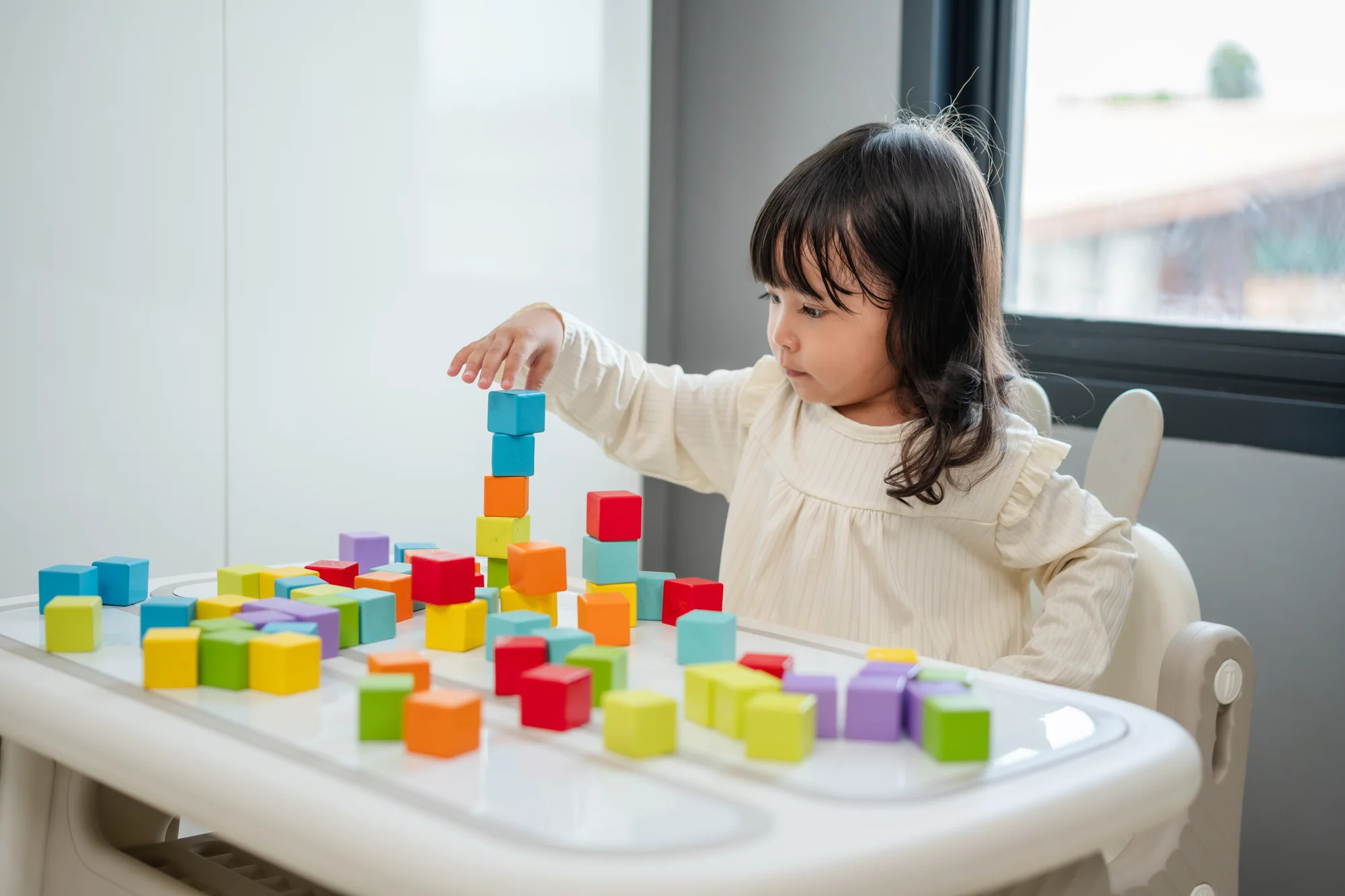
Estimation starts with instinct, like spotting the bigger pile, then grows into a strategic skill.
Estimation Strategies Students Learn to Use
Different situations call for different estimation tools. A few of the most common include:
-
Rounding: Adjusting numbers to the nearest 10, 100, or other place value to simplify a calculation. For example, estimating 438 + 167 by rounding to 440 + 170.
-
Front-end estimation: Using only the leading digits to estimate sums or differences. For instance, 347 + 286 becomes 300 + 200.
-
Compatible numbers: Choosing or adjusting numbers to make mental math more efficient. For example, estimating 39 ÷ 5 by thinking of it as 40 ÷ 5.
-
Clustering: Averaging a group of numbers that are close in value. For example, estimating the mean of 48, 50, and 52 as about 50.
-
Benchmarking: Comparing quantities to known reference points like 0, \(\Large\frac{1}{2}\), or 1. For example, seeing that 4 out of 10 is close to \(\Large\frac{1}{2}\) or 40%.
What Estimation Looks Like Across Grades
Estimation isn’t a single topic or grade-level skill. It grows with students, and it looks different at each stage:
-
Grades 1–2: “About how many jellybeans are in the jar?” “Is 23 + 41 closer to 60 or 70?” Students begin to round informally and make size comparisons.
-
Grades 3–5: Estimating sums, differences, lengths, and times. “About how long would it take to walk a mile?” or “Is this answer reasonable?”
-
Grades 6–8: Students estimate more abstractly: percent of a number, square roots, scale in geometry, or distance on a graph. They begin to set their own expectations for precision.
As confidence in estimation grows, it becomes a habit of thinking.
📕You May Also Like: How to Track Your Child's Math Progress in Grades 1-8
What Is Rounding? (An Essential Estimation Tool)
At Mathnasium, we define rounding as the process of expressing a number to the nearest specified place, usually to the nearest 10, 100, or whole number, so it’s easier to work with.
It’s one of the first formal tools students learn to support estimation. Unlike open-ended strategies, rounding follows a predictable set of steps:
-
Identify the place value
-
Check the next digit
-
Decide whether to round up or down.
That structure builds early confidence.
Rounding simplifies complex numbers, making them faster to add, subtract, multiply, or divide in your head. It reduces cognitive load and clears a path to a ballpark answer, fast.
Students typically learn to round:
-
To the nearest 10 or 100: 346 becomes 350; 1,174 becomes 1,200.
-
To whole numbers: 8.7 becomes 9.
-
To significant figures: In upper grades, 4.7291 might round to 4.73.
Used well, rounding helps students simplify mental math, make faster decisions, and spot unreasonable answers in multi-step problems. For example:
-
A student rounds 48 to 50 before mentally adding it to 32.
-
To check 119 × 6, they round to 120 and estimate 120 × 6 = 720.
-
If an answer feels off, they round to verify whether it’s in the right range.
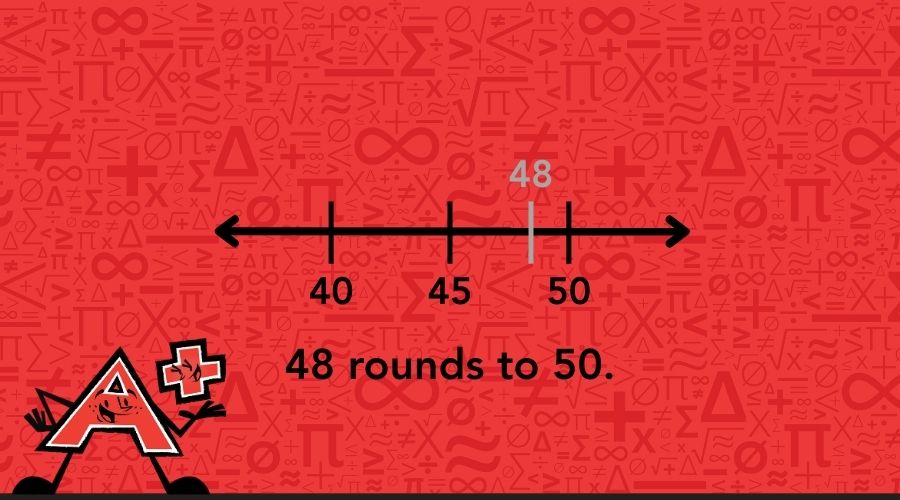
Rounding helps students simplify numbers to make mental math easier.
Why Are Estimation and Rounding Often Linked?
Estimation and rounding are often mentioned in the same breath, and it’s easy to see why. In assignments and class discussions, they tend to show up side by side. Students tend to use the terms interchangeably.
But they’re not the same.
-
Estimation is a flexible skill. It’s the ability to judge an approximate value without calculating an exact answer.
-
Rounding is a formal method, a specific strategy used to estimate more efficiently.
In other words, rounding is one way to estimate, but it isn’t the only way.
Think of estimation as a full toolbox, and rounding as one of the tools inside. The broader skill involves choosing the right tool for the situation, whether that’s rounding, using compatible numbers, or making a visual judgment.
Both estimation and rounding rely on similar thinking: simplifying, judging precision, and deciding how exact an answer needs to be. Used together, they help students reason faster, spot errors, and stay confident, even when the math gets messy.
How They Support Number Sense Together
Estimation, as a crown skill, and rounding, as one of its key methods, both play a role in building number sense. Together, they help students develop a more intuitive and practical understanding of how numbers work.
Let’s take a closer look at what they bring to the table.
1. Understanding Magnitude and Relationships
Estimation and rounding both build a sense of how big numbers are, but in different ways.
Estimation helps students compare quantities and judge scale. If a student says, “This looks close to 500,” or “That’s way more than half,” they’re placing numbers in context without calculating.
Rounding, on the other hand, reinforces place value. It teaches students to focus on the most significant digits and ask, “Is this number closer to 300 or 400?” That habit strengthens their understanding of number size and spacing.
Together, these strategies help students move beyond surface-level digits. They start to think about numbers in relation to each other, and that’s where number sense begins.
2. Developing Computational Fluency
Computational fluency is about solving problems efficiently and accurately, whether mentally or on paper. Beyond just speed, this is about working with numbers in ways that make sense and reduce the chance of error.
Estimation helps students predict outcomes and check their results. If they expect an answer near 1,200 but land on 960, they know to pause and rework it.
Rounding supports fluency by simplifying the numbers themselves. It makes multi-digit problems easier to calculate, particularly when students are developing mental math skills.
Used regularly, these strategies strengthen a student’s control over numbers. Instead of hesitating or reworking the same problem, they solve it with more clarity.
3. Creating Flexible Thinkers
Estimation and rounding help students understand that there isn’t just one “right way” to work with numbers.
With rounding, they learn to adjust based on context, rounding to the nearest 10 for mental math, to the nearest dollar at the store, or to the nearest thousand when comparing populations.
Sometimes they use standard place values; other times, they choose “friendly numbers” like 297 to 300, depending on what makes the problem easier to solve.
With estimation, they develop multiple strategies: front-end estimation, clustering, compatible numbers, and benchmarks. Each one offers a different way to simplify and judge values without calculating exactly.
As a combination, these strategies teach students to ask better questions: How close is close enough? What level of precision matters here?
That flexibility is what turns students into thinkers, not just answer-getters.
📕You May Also Like: How to Nurture Math Thinkers, Not Just Answer-Getters
4. Building Reasoning and Self-Correction Skills
This is where estimation does its best work.
When students pause to ask, Does this answer make sense?—that’s estimation in action. It gives them a way to check for reasonableness before accepting a result.
Say a student multiplies 42 × 6 and gets 142. That might not raise a red flag, until they estimate 40 × 6 and realize the answer should be somewhere around 240. Estimation doesn’t give the exact fix, but it tells them they need to stop and check their steps.
Rounding supports this process. It’s not the goal—it’s a method that helps students estimate more efficiently. The thinking, the judgment, the correction—that’s estimation.
With practice, this habit builds sharper reasoning and greater confidence. Students learn to trust their sense of what’s reasonable and rely on it when they need to self-correct.
📕 You May Also Like: 5 Ways Reflection Improves Math Retention + Parent Tips

At Mathnasium, students become flexible math thinkers, learning when and how to use tools like estimation and rounding to solve problems with confidence.
How Mathnasium Builds Flexible Math Thinkers
At Mathnasium, we treat estimation and rounding as more than just isolated skills. They’re part of a broader process and tools that help us build flexible math thinkers.
This process is powered by our approach: the Mathnasium Method™. Rather than a one-size-fits-all system, this is a proprietary method designed to help students learn math in a way that makes sense to them.
Our method builds flexible math thinkers through:
-
Personalized learning: Each student begins with a diagnostic assessment that helps us identify their current skills, potential knowledge gaps, and how they naturally approach math. We use these insights to create a custom learning plan tailored to their needs.
-
Teaching for understanding: Our instructors explain math in clear, natural language and use a blend of verbal, visual, mental, tactile, and written techniques. This helps students truly connect with what they’re learning.
-
Caring, responsive tutors: Our tutors are specially trained in both the technical and emotional aspects of teaching. They know when to offer support, when to challenge, and how to help students rebuild trust in their thinking.
-
Independent problem-solving and critical thinking: We allow space for students to work through challenges on their own, then rejoin them to check their reasoning. Instead of just giving the answer, we explore the how and why—so students learn to think through problems independently.
-
A singular focus on math: We specialize in math and only math. Our robust, continually refined curriculum includes thousands of pages designed around how students learn, absorb, and retain mathematical concepts.
-
A supportive, engaging environment: Many of our activities are hands-on or game-based. We use reward systems and consistent encouragement to help students stay focused and enjoy the process. And we celebrate progress, big or small, because confidence grows through every win.
Our approach brings measurable results:
-
94% of parents report an improvement in their child's math skills and understanding
-
93% of parents report an improved attitude toward math after attending Mathnasium
-
90% of students saw an improvement in their school grades
With a network of more than 1,100 centers across the U.S., Mathnasium brings top-rated math tutors close to your community.
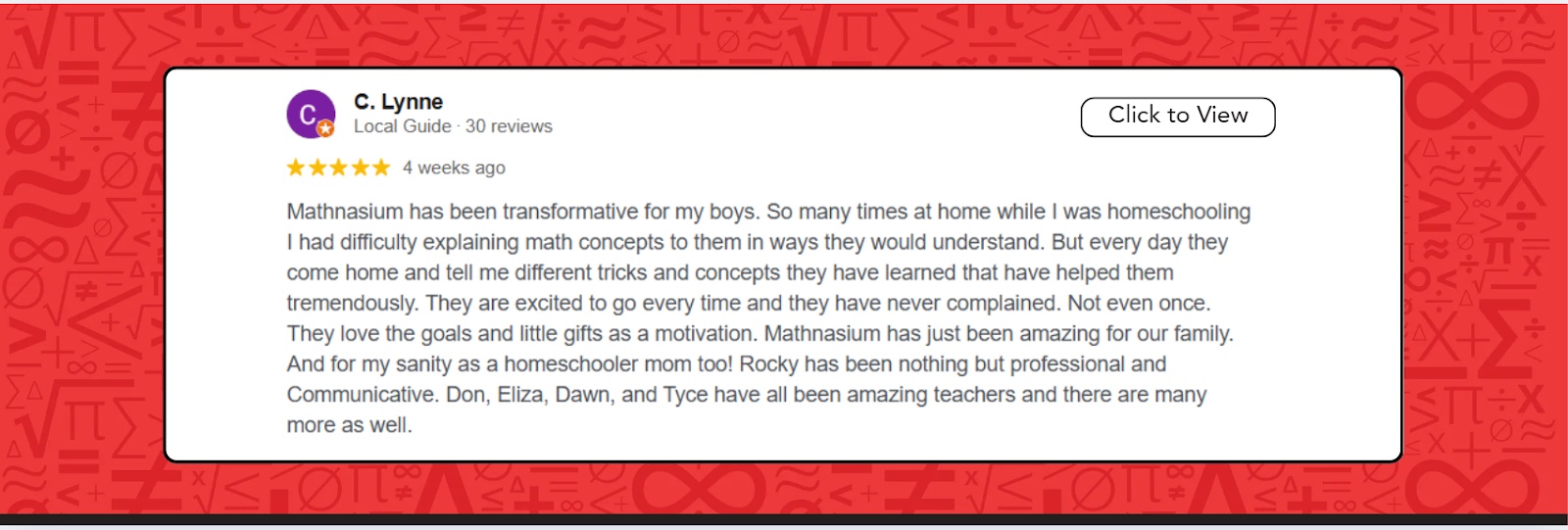
For families located in or near Queen Creek, AZ, Mathnasium of Queen Creek is a trusted local center with years of experience helping students excel in math. With over 200 5-Star Google reviews, our community has consistently recognized the impact of our work, both in student progress and parent confidence.
Here’s how one parent described their experience with our center:
Whether your student is looking to catch up, keep up, or get ahead in math, our team is happy to help!
📅 Schedule a Free Diagnostic Assessment at Mathnasium of Queen Creek!
Not near Queen Creek?
📍 Find Mathnasium Learning Centers Near You


 (480) 279-3122
 (480) 279-3122