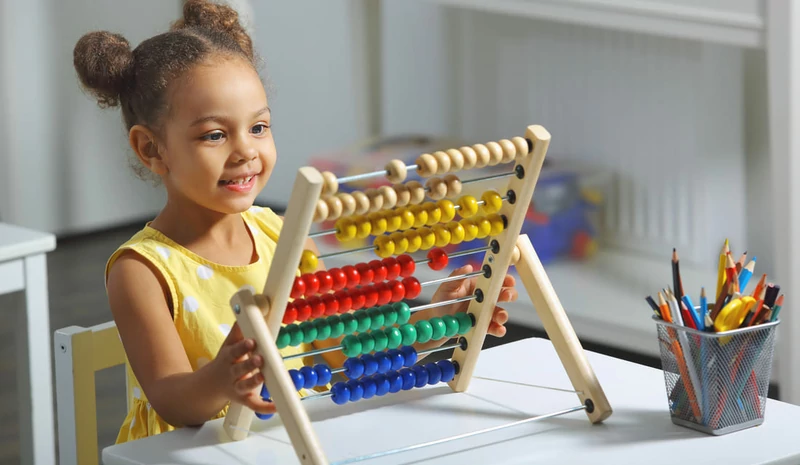
When families go shopping for math supplies, base ten blocks, counting bears, or fraction tiles often end up in the cart alongside pencils, rulers, and notebooks.
But unlike rulers, these tools often get used once, then end up in a drawer or become toys when they don’t seem to help right away.
Still, math manipulatives can do far more than decorate a desk. Used well, they can reshape how a child approaches math.
Let’s take a closer look at what math manipulatives are and how they support learning. Our math tutors will also share tips on how to use them effectively at home by grade level, which skills they help develop, and what to do when they don’t help move the concept forward.

What Are Math Manipulatives?
Math manipulatives are physical objects that help students work through ideas by doing, not just watching or listening. They turn numbers, shapes, and operations into something students can pick up, rearrange, and make sense of, especially when pencil-and-paper explanations fall flat.
Some are familiar, like base ten blocks, counting bears, fraction tiles, number lines, and abacuses. Others are improvised at home, like pennies for counters, strips of paper for measuring, and toothpicks to build arrays.
What matters isn’t what they’re made of. It’s how they’re used.
The right manipulative helps a student see a pattern take shape or understand a process they couldn’t visualize before. For many learners, that moment of clarity doesn’t happen on the page. It happens in their hands.

When math concepts feel out of reach, manipulatives can bring ideas into focus.
Why Do Math Manipulatives Help?
Working with students across grades at Mathnasium, we’ve seen firsthand how learning preferences vary from child to child. Some students understand math by hearing it. Others need to see it, talk through it, or build it before it makes sense.
Math manipulatives make room for all of those learning styles: visual, verbal, tactile, and kinesthetic. They give students something to physically work with while they reason through a concept.
This shift from abstract to concrete matters.
Moving pieces, drawing comparisons, and building patterns help develop number sense, logical thinking, and true conceptual understanding. It also gives students a chance to test ideas, correct themselves, and approach problems with more confidence.
For students who struggle with math anxiety, this tactile process can even reduce stress. Instead of guessing or memorizing steps, they begin to see how the math works and why it works the way it does.
Research supports this approach. The CRA model (Concrete–Representational–Abstract) has shown positive results across a range of learners, particularly those who benefit from a gradual progression from physical tools to mental strategies.
A meta-analysis by educational research, Ewelyn Sowell, found that students who consistently used manipulatives outperformed those who didn’t in both short- and long-term learning.
More recently, Dr. Jo Boaler’s work at Stanford highlights how using multiple senses simultaneously in math learning helps students overcome fixed mindsets and develop a deeper, more confident understanding of math concepts.
This is exactly what we see at Mathnasium: when students have the right tools in front of them and the time to explore, their thinking becomes more flexible and their confidence starts to build.
📕 You May Also Like: What Makes a Successful Math Student? 7 Traits to Cultivate Early
When and How to Use Math Manipulatives at Home
Knowing which math manipulatives to use is only part of the equation. Knowing when to use them and how makes the difference between a passing activity and a meaningful learning experience.
Early Elementary (Grades K–2)
As children build fluency with addition, subtraction, and place value, math manipulatives help them move from counting to reasoning.
Tools like ten frames and number lines turn abstract ideas into something they can see, test, and understand.
1. Ten Frames
A ten frame, or 10 frame, is a simple grid with two rows of five boxes that helps children organize numbers into something they can see and reason about.
Ten frames support skills such as:
-
Subitizing (recognizing quantities without counting)
-
Making and decomposing ten
-
Understanding part–whole relationships
-
Adding and subtracting within 10 and 20
-
Building fluency with number combinations
To use a ten frame at home, start with a small set of counters like coins, buttons, or linking cubes and have your child place them in the frame as they count.
Ask, “How many more to make ten?” or “What do you see without counting?”
Alternatively, try covering part of the frame and asking what’s missing, or use two frames to explore numbers beyond ten.
2. Number Bonds
Number bonds are simple diagrams that show how two parts come together to form a whole. They introduce the idea that numbers aren’t fixed, that they can be broken apart, rearranged, and put back together in different ways.
Number bonds help elementary schoolers build skills like:
-
Understanding part–whole relationships
-
Composing and decomposing numbers
-
Seeing number combinations within 10 and 20
-
Building mental math strategies
-
Preparing for missing addend problems and fact fluency
To try them at home, start with a familiar number like 7. Draw a circle for the total, then two smaller circles for the parts. Ask your child, “What are two numbers that make 7?”
You might prompt with small objects: “If there are five here, how many are missing?” Once they understand the idea, explore different combinations for the same total, or reverse the process: “If one part is 4, what could the total be?”

Using number bonds to explore how parts come together to make a whole.
3. Number Lines
A number line is exactly what it sounds like: a straight line marked with numbers in order. But once children learn to use it as a thinking tool, it becomes much more than that. Number lines help students connect counting to distance, order, and operations.
Number lines support skills such as:
-
Understanding number sequence and magnitude
-
Visualizing addition and subtraction as movement
-
Solving problems by “counting on” or “counting back”
-
Estimating and comparing values
-
Building a foundation for negative numbers and measurement
Try sketching a number line from 0 to 10 or 20, then use a small marker or counter to act out problems. Start at 3 and ask, “What if we move forward 4 spaces?” or “How far is it from 8 back to 5?”
Focus on counting the jumps, not just naming the numbers. You can also leave part of the problem blank: “We started at 2 and ended at 7, how many spaces did we move?”
Upper Elementary (Grades 3–5)
As students move into multiplication, division, and fractions, math becomes more abstract. The right tools help them model ideas clearly and understand how numbers relate, scale, and connect.
📕 You May Also Like: Is Your 5th Grader Ready for Middle School in Colorado?
1. Base Ten Blocks
Base ten blocks represent numbers using ones, tens, and hundreds. At this stage, they help students move from naming digits to understanding what those digits mean.
With base ten blocks, students strengthen skills like:
-
Understanding place value (ones, tens, hundreds)
-
Modeling multi-digit addition and subtraction
-
Regrouping (carrying and borrowing)
-
Comparing and composing large numbers
-
Building a foundation for multiplication and division
Start with a number like 42 and ask your child, “Can you build this with blocks?” They might grab four tens and two ones.
Then try: “What if we had to subtract 9, do we have enough ones?” If not, show how swapping a ten for ten ones helps. That single exchange often does more than a page of written steps.
Try creating two numbers and asking, “What happens when we put these together?” or “How could we break this number apart a different way?”

Modeling place value and regrouping with base ten blocks.
2. Fraction Tiles or Circles
Fractions can feel abstract at first, especially when students try to compare, combine, or visualize parts without something to look at.
Tools like fraction tiles and circles give them a way to see how fractions relate to each other, how they add up, and why they don’t always behave like whole numbers.
Working with them, students gain skills such as:
-
Comparing and ordering fractions
-
Recognizing equivalent fractions
-
Visualizing fraction addition and subtraction
-
Understanding parts of a whole
-
Building a foundation for ratios and decimals
Give your child a set of fraction tiles or paper circles marked into equal parts.
Ask them to show 1/2, then find another piece that’s the same size, like two 1/4 tiles.
Challenge them to line up pieces to compare fractions, or build combinations that equal one whole. You can also try covering part of the whole and asking what’s missing.

Fraction circles help students visualize part-whole relationships and explore equivalencies.
3. Array Cards
Array cards show equal groups arranged in rows and columns. They help students understand what multiplication means, not just how to memorize it.
Array cards support skills like:
-
Understanding multiplication as equal groups
-
Connecting multiplication to area
-
Visualizing factors and products
-
Building fluency with multiplication and division
-
Preparing for area models and multi-step problems
Start with a small array like 3 rows of 4. Ask, “How many groups? How many in each group?” Flip the card and ask the same about 4 rows of 3.
Then build the array with objects like buttons, cubes, or cut paper, and talk about what changes and what stays the same.
Hide part of the array and ask your child to figure out what’s missing or how to complete the full set.
📕 You May Also Like: 5 Fun Math Card Games You Can Play with a Standard Deck
Middle School (Grades 6–8)
As math becomes more abstract, students start working with variables, negative numbers, and multi-step problems. These ideas can be tough to grasp through rules alone.
Hands-on tools give students something to work with as they figure out what’s really happening.
1. Algebra Tiles
Algebra tiles are small, color-coded pieces that represent variables, constants, and their opposites. Students use them to build expressions, rearrange terms, and solve equations in a way they can see and manipulate.
Algebra tiles support different math skills, including:
-
Modeling variables and constants
-
Combining like terms
-
Solving one- and two-step equations
-
Representing expressions with positive and negative terms
-
Understanding the balance in equations
Give your child a small set of tiles or make your own with colored paper. Use one color for x-tiles, another for units, and a third for negatives.
Build an expression like x + 3, then add another tile to show x + 4. Ask, “What happens when we subtract 1?”
You can also model both sides of an equation and talk through what needs to change to make them equal.
📕 You May Also Like: How to Make Sure Your Child Is Ready for Algebra?
2. Integer Chips
Integer chips are simple counters, usually two colors, that represent positive and negative numbers. Students use them to model what it means to combine, compare, and cancel values with different signs.
They support skills such as:
-
Understanding positive and negative values
-
Modeling integer addition and subtraction
-
Recognizing zero pairs
-
Building number sense with signed numbers
-
Preparing for work with rational numbers and equations
To use them at home, choose two colors: one for positives, one for negatives.
Start by asking your child to model a number like –3. Then add three positive chips and see what happens.
They’ll begin to notice how opposite values cancel out. Try different combinations and ask, “How many do we have now?” or “What would we need to add to get back to zero?”
What to Do When the Concept Still Isn’t Sticking
There are times when even well-chosen tools don’t move the needle. Your child might understand how to use a ten frame or fraction tiles, but still misinterpret what the math is asking.
That’s often a sign of something more complex, such as gaps in foundational skills, overloaded working memory, or confusion that’s been carried from earlier years.
Math manipulatives can reveal how a concept works, but they can’t always correct misconceptions on their own. If a child doesn’t fully grasp what a number represents or why a process works the way it does, adding more tools won’t solve the problem.
They need space to revisit the concept and guidance that meets them at the right level.
At Mathnasium, manipulatives are part of a larger strategy. We don’t rely on them in isolation.
Our tutors use them with intent, guided by diagnostic assessments, to pinpoint where a student is struggling and why.
From there, we rebuild the concept, not just to get through the next worksheet, but to change how that student understands the math itself.

At Mathnasium, manipulatives are just a part of a personalized strategy that helps students build deep understanding with expert support.
When It’s Time for More Support: How Mathnasium Helps
Mathnasium is a math-only learning center dedicated to helping K-12 students of all skill levels catch up, keep up, and even get ahead in math.
At the core of our work is the Mathnasium Method™, our proprietary teaching approach designed to be both effective and engaging. It’s built around how each student learns best—not a one-size-fits-all curriculum.
For over 20 years, the Mathnasium Method™ has been transforming how students feel and think about math through a combination of:
-
Personalized Learning Plans: Each student begins with a diagnostic assessment that helps us understand their unique strengths and areas for improvement. Using the assessment-based insights, we create a learning plan tailored to their needs and learning style, putting them on the best path toward mastery.
-
Teaching for Understanding: Our tutors explain concepts using natural language and phrase ideas in a way that makes sense to students. We use a mix of direct instruction and Socratic questioning, along with mental, verbal, visual, tactile, and written techniques, including hands-on tools like manipulatives when they’re the right fit.
-
Caring Instruction: Mathnasium instructors are trained not only in math but also in the emotional and technical aspects of teaching. They know when a student needs extra support, when they need a challenge, and how to respond to both with care and precision.
-
Critical Thinking and Problem Solving: We don’t rely on memorization. Instead, we help students understand the “why” and “how” behind each concept. That way, they build the confidence and reasoning skills to approach problems independently.
-
A Singular Focus on Math: The Mathnasium Method™ is built on thousands of pages of math material, refined over two decades. That allows us to go deeper into how students absorb and retain math
-
A Confidence-Inspiring Environment: Our learning centers are designed to be empowering, dynamic, and fun. Students are motivated by rewards, engaging materials, and steady growth that they can see and feel.
Our approach has earned the trust of over a million families, and the results show:
-
94% of parents report improvement in their child’s math skills and understanding
-
93% report improved attitude toward math
-
90% of students see better grades in school
With over 1,000 centers across the U.S., we bring top-rated tutors and a proven method into communities everywhere.
If you’re located in or near Westminster, CO, Mathnasium of South Westminster is your trusted local resource.
Schedule a free diagnostic assessment to get started. Once enrolled, watch their skills and confidence rise, session by session.
📅 Schedule a Free Diagnostic Assessment at Mathnasium of South Westminster
Not near Westminster?
📍 Find Mathnasium Learning Centers Near You


 (720) 524-4533
 (720) 524-4533