Your child spent a whole week studying for their fractions test. They knew the material and got a grade they were proud of.
But then two months later, they looked completely lost when fractions showed up again in a word problem. What happened?
This is one of the more common and confusing things parents notice about their kids and math. The effort was real, so why didn't it stick? The answer usually has less to do with how hard your child studied and more to do with how they studied.
Mathnasium tutors have prepared this guide to walk you through spaced repetition math, a research-backed approach that helps children hold onto what they learn well past test day.

Why Math Keeps "Disappearing"
Back in the 1880s, psychologist Hermann Ebbinghaus discovered that memory loss follows a measurable curve.
Without any reinforcement after learning something new, people forget the majority of it by the following day. The brain holds on to what it is regularly asked to use and lets go of everything else.
This phenomenon is called the Ebbinghaus Forgetting Curve.
This is why a child can ace a geometry unit in October and draw a blank on the same material in January. It has nothing to do with ability and everything to do with how memory works.
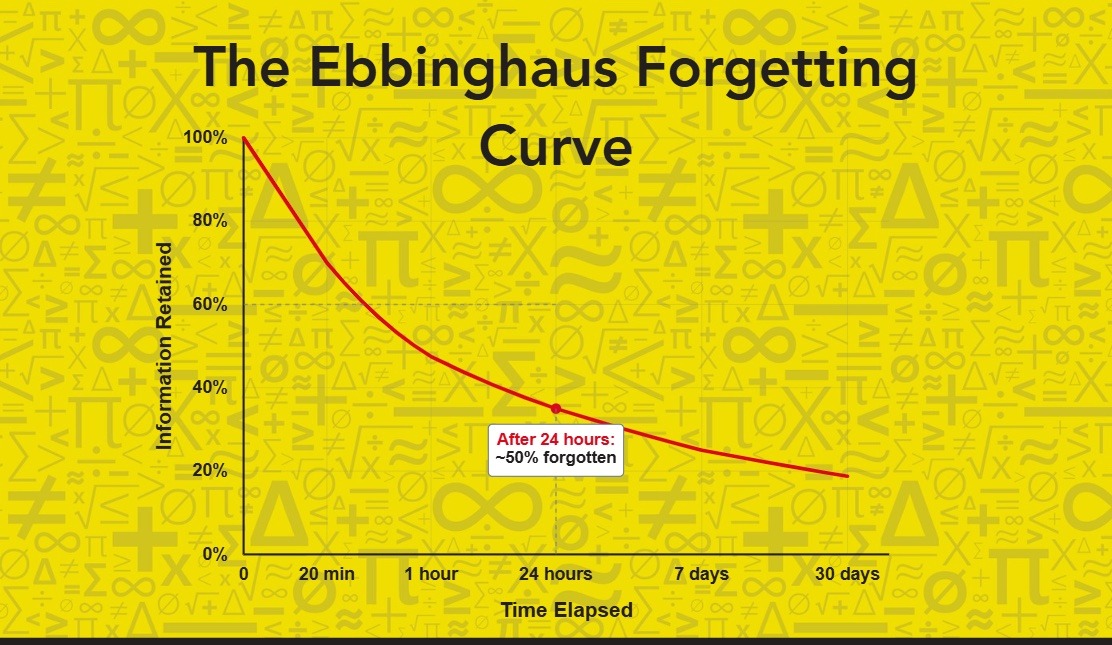
Without reinforcement, about 50% of information is forgotten after just 24 hours.
The Problem with Cramming
Cramming seems productive.
A child sits down with their notes the night before a test, goes through everything, feels prepared, and often performs well enough the next day.
The problem shows up two or three weeks later, when that same material is nowhere to be found.
Researchers Henry Roediger and Jeffrey Karpicke found that short-term performance and long-term retention are two very different outcomes and that heavy last-minute studying tends to serve only the first one.
In their studies, students who relied on repeated re-reading forgot 56% of what they had learned within just two days, while those who used regular retrieval practice forgot only 13%.
Think of short-term memory as a sticky note and long-term memory as a filing cabinet.
Cramming writes the information on the sticky note, which is useful for the next morning but peels off and disappears shortly after.
Repeated retrieval is what moves information into the filing cabinet, where it stays ready to use weeks, months, and years later.
📕 You May Also Like: Critical Thinking vs. Memorizing: What Really Builds Math Skills?
What Is Spaced Repetition?
Spaced repetition math means revisiting material at increasing intervals over time, as opposed to studying it heavily once and moving on.
It’s the same principle as watering a plant: a little water on a regular schedule keeps it alive and growing, while flooding it once and walking away does not.
Every time a child comes back to something they have not practiced in a while and works to retrieve it, that memory gets a little stronger and lasts a little longer.
Going back to the aforementioned study, it consistently showed that students who use spaced review outperform those who cram, not just on the next test, but on assessments given months later.
📕 You May Also Like: Why Math Practice Matters & What Happens When Kids Skip It
What Is Interleaving Practice?
Interleaving practice is a natural companion to spaced repetition. Rather than drilling one topic at a time, such as doing twenty long division problems in a row, interleaving means mixing different types of problems within a single study session.
Consider what happens without it: a child completes an entire worksheet of fraction problems without any trouble, then struggles to apply the same skill on a cumulative test where fractions appear alongside other concepts.
The isolated practice did not prepare them to recognize and respond to a mixed problem set.
Interleaving practice builds the flexible, adaptive thinking that math tests and real-world applications actually require.
How to Use Spaced Practice at Home
You do not need to be a math expert to help your child study this way. Your main goal is simply helping your child build a simple, repeatable habit that keeps older material alive alongside whatever they are currently covering in school.
1. Keep Past Lessons Fresh with a Weekly Review Block
Once a week, set aside 15 to 20 minutes specifically for looking back at older material.
Note that this review session is not for what they’re currently working on at school. This is a separate session geared toward retention.
For example:
-
A child working on decimals could spend ten minutes revisiting problems from the geometry unit they finished six weeks ago.
-
A child currently studying algebra could pull up a few problems from their earlier fractions or percentages work.
The session does not need to be long. What matters far more than duration is consistency, because regular, brief exposure is what keeps previously learned concepts from fading.
2. Try Casual Quizzing
Asking your child to retrieve information is one of the most effective math review techniques available, and it does not have to look like a formal quiz.
Here are a few easy ways to make it part of your routine:
-
Ask your child to explain a concept back to you in their own words over dinner.
-
Talk through a couple of problems from an older unit on the way to school.
-
Ask them to teach you how to solve something, since explaining a concept is one of the best ways to reinforce it.
The retrieval itself is what does the work.
Memory strengthens each time the brain has to go looking for something, so the goal is not a perfect answer but simply the practice of reaching for it.
This is also a great way to practice math if you feel that scheduled math reviews might add pressure for your child.
📕 You May Also Like: 8 Simple Ways to Make Math Fun at Home
3. Keep a “Still in Rotation” List
After a test, most students mentally file that topic away as finished.
Instead, keep a simple list on the fridge or in a notebook titled:
“Still in Rotation.”
Add concepts that should stay fresh:
Every couple of weeks, pick one and revisit it briefly.
This small visual reminder helps move the mindset from “done” to “ongoing.” Math builds layer by layer. Skills that stay in rotation stay usable.
4. Build a “1–7–30” Review Rhythm
Instead of reviewing randomly, you can use a simple timing pattern.
When your child learns a new concept, revisit it:
-
1 day later
-
7 days later
-
30 days later
This creates natural spacing intervals that mirror how memory actually strengthens.
If your child learned multiplying fractions on Monday:
-
Ask one quick question about it on Tuesday.
-
Bring it back the following Monday.
-
Revisit it again about a month later.
Each time, keep it brief. One or two problems is enough.
As review happens at expanding intervals, the brain works harder to recall the information. That extra effort is what makes the memory stick.
What Progress Looks Like
It is worth knowing that spaced practice can feel harder at first, not easier. Your child is being asked to retrieve material they have not seen in a while, and that recall takes effort.
Some parents see this and worry that their child is falling behind.
In reality, that effortful retrieval is the mechanism that makes learning durable. With time, you will notice your child:
-
Recalling older material more readily
-
Making fewer errors on mixed-topic tests
-
Picking up new concepts faster, because the foundational skills underneath them are genuinely solid
For parents who want extra support putting this into practice, a professional math tutor can help structure this kind of review in a consistent, personalized way.

Mathnasium tutors help children build the kind of steady, cumulative math practice that turns short-term understanding into long-term mastery.
How Mathnasium Keeps Math from Fading
Spaced repetition and interleaving practice are most effective when they are built into every study session from the start. That kind of structured, consistent approach is exactly what Mathnasium is designed to deliver.
Mathnasium is a math-only learning center dedicated to helping students build the kind of cumulative, lasting math knowledge that holds up well past test day.
Instead of focusing only on whatever a child is struggling with right now, we assess the full picture of their math knowledge and weave review of foundational concepts into every session alongside their current work.
This is made possible by the Mathnasium Method™, our proprietary approach to math instruction that is personalized, research-informed, and built for lasting understanding.
To prevent knowledge from slipping away, our method relies on:
-
Personalization on a granular level: Every student begins with a thorough diagnostic assessment that identifies their strengths, their gaps, and how they process math. From there, we build a learning plan tailored specifically to them, so review is always targeted and purposeful.
-
Teaching for understanding: We explain math using clear, everyday language and support each concept with a blend of visual, verbal, written, mental, and hands-on techniques. This layered approach helps students genuinely make sense of the material, which is what makes it retrievable later.
-
Caring instruction: Our tutors are trained in both math and in how to connect with students. They know how to support a child who is feeling discouraged and how to challenge one who is ready to move forward.
-
Independent problem-solving and critical thinking: Every session includes dedicated time for students to work through problems on their own, building the retrieval practice that spaced repetition depends on. We guide students to understand both the how and the why behind each concept, so they develop critical thinking tools they can carry with them into every future math topic.
-
Singular focus on math: Our curriculum spans thousands of pages and has been continuously refined over more than 20 years. This singular focus allows us to take a deep dive into how students best absorb, learn, and retain mathematical concepts.
-
Empowering, fun learning environment: Our environment is designed to be both rewarding and enjoyable. Our materials are often game-based, and students have the opportunity to earn rewards as they advance, keeping them motivated to keep going.
The results speak for themselves:
-
94% of parents report an improvement in their child's math skills and understanding
-
93% of parents report an improved attitude towards math after attending Mathnasium
-
90% of students saw an improvement in their school grades
With a network of more than 1,100 centers across the country, Mathnasium brings top-rated instruction close to your home.
For families in Westminster, Mathnasium of South Westminster is a trusted center with years of experience transforming how children think and feel about math.
Here’s how one parent described their child’s experience at Mathnasium:
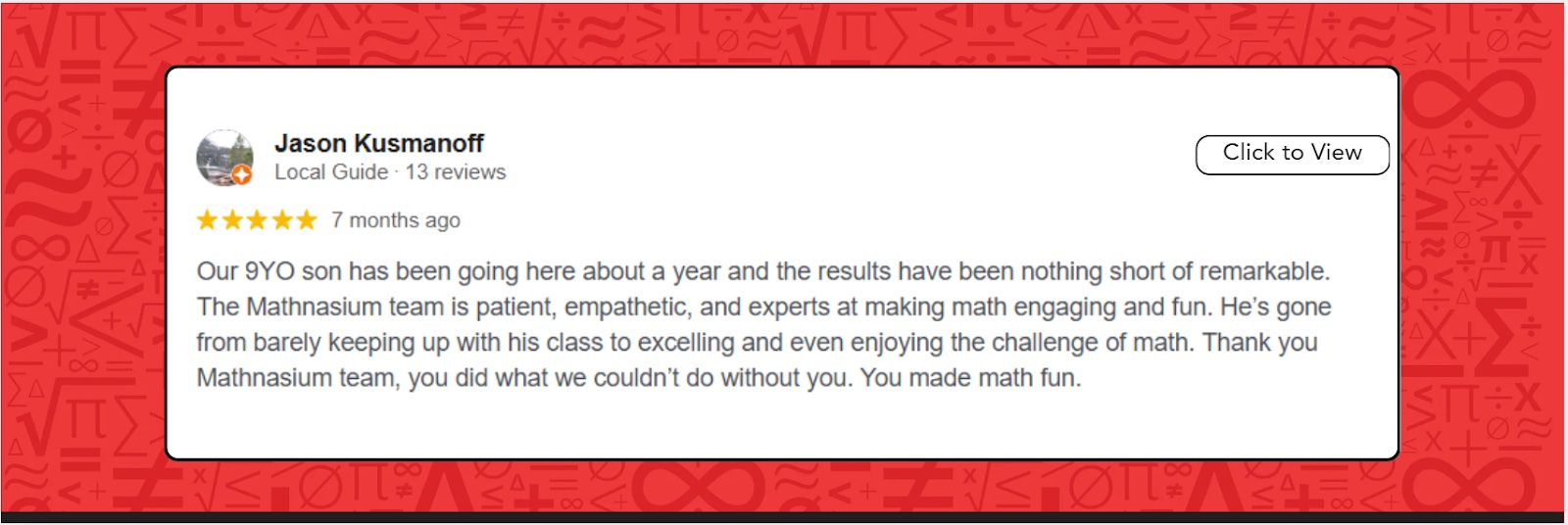
Whether your child needs help catching up, wants to stay on track, or is ready to move ahead, Mathnasium can support their journey.
Ready to get started?
📅 Schedule a Free Diagnostic Assessment at Mathnasium of South Westminster
Not near South Westminster?
📍 Find Mathnasium Learning Centers Near You


 (720) 524-4533
 (720) 524-4533