Do you know that feeling when you are tinkering with a puzzle or putting together a piece of furniture, and it is both frustrating and satisfying trying to figure out how the pieces come together?
That moment of effort, just before things click, is where real learning happens.
Educators call it productive struggle—the kind of challenge that builds problem-solving skills, deeper understanding, and the confidence to try again.
For students, these moments do wonders for developing skills and resilience. But for parents, they can be hard to read: Is your child thinking it through or feeling lost? Should you let them keep going or step in?
Today, our seasoned tutors are sharing tips on how to recognize productive struggle, use activities that encourage it, and support your child’s growth at home so those challenging moments become turning points, not stopping points.

Productive Struggle vs. Getting Stuck—What’s the Difference?
A well-chosen challenge can do remarkable things for a student’s learning.
Problems that sit just beyond what a child can solve invite persistence, strategic thinking, and genuine insight. This kind of effortful engagement is known as productive struggle—the process of grappling with an idea in a way that leads to deeper understanding.
Productive struggle helps students stay mentally active. It sparks curiosity, encourages experimentation, and builds confidence in their ability to figure things out—especially with the right support in place.
By contrast, getting stuck—or shall we call it, unproductive struggle—happens when a student feels overwhelmed, unsure where to begin, or unable to make progress after multiple attempts. The task no longer feels like a puzzle to solve, but a wall they can’t climb. Unless they receive proper guidance, this is where they are likely to lose motivation and even their relationship with math can go sour.
The balance between challenge and support is especially important during the middle-grade years, when students are ready to reason more deeply and make connections across ideas.
Research in education and child development shows that tasks with moderate difficulty, paired with responsive instruction, help students retain concepts longer and apply them more flexibly. Over time, they also build resilience, learning that real understanding often takes effort and time.
Mathnasium tutors are trained to notice these moments as they unfold. Picture a student working through a multi-step fraction problem. Their first attempt makes sense, but the final answer doesn’t quite line up.
Instead of stepping in with a correction, the tutor asks, “Can you walk me through your thinking so far?” That simple invitation keeps the student actively involved, encouraging reflection while preserving momentum.

Productive struggle is welcome at Mathnasium! It empowers our students to become confident problem solvers.
How Our Tutors Use Productive Struggle in Practice
Once students are engaged in productive struggle, we want to offer them support that promotes learning without short-circuiting the process.
Here are a few of the ways our tutors keep students in that productive zone where challenge leads to growth:
1. Asking Thoughtful, Open-Ended Questions
When we detect struggle, we prompt students to pause and think, instead of jumping in with the answer. We use questions like:
“What have you tried so far?”
“Does this answer feel reasonable?”
“Can you show me a different way to solve it?”
These prompts help students clarify their reasoning, identify missteps, and build the habit of reflection.
📕 You May Also Like: 5 Ways Reflection Improves Math Retention & How to Encourage It
2. Encouraging Multiple Solution Paths
Math problems don’t always have one route to the finish. Our tutors give students space to try different approaches, especially when working with concepts like number sense, algebra, or geometry.
This flexibility develops better reasoning skills and helps students become more confident in their own thinking.
📕 You May Also Like: How Multiple Representations Improve Understanding of Math
3. Using Strategic Pauses
When a student hits a roadblock, the instinct might be to step in and fix it. Instead, our tutors will once again pause and ask, “What do you notice?” or “What would happen if we changed this number?”
These moments allow the student to re-engage with the problem rather than retreat from it.
4. Adjusting Support in Real Time
Because instruction happens face-to-face in a small group setting, tutors can respond to each student’s cues, whether that’s focused determination or growing frustration.
The level of support is always adjusted based on the student’s engagement, not just the content.
5. Grounding Instruction in a Personalized Learning Plan
Every student at Mathnasium works from a learning plan based on their own skill profile. This ensures the work they’re doing is appropriately challenging. That balance is what makes productive struggle possible.
Imagine a student learning long division for the first time. You’d be surprised to see how many skip a step and immediately get flustered and start erasing.
The tutor doesn’t correct them. Instead, they ask, “Where do you think things started to feel unclear?” That single moment where the student locates and fixes their own mistake, can do more to build confidence than a dozen right answers.
📕 You May Also Like: Why Personalized Math Tutoring Makes All the Difference
5 Fun Activities That Promote Productive Struggle
There are many ways to invite and leverage productive struggle in math learning, and you may be surprised how fun some of them can be!
Here are some of our favorites:
1. Try-First Problems
“What’s around the riverbend!” (We sing in our best Pocahontas voice). There’s something exciting about jumping into a problem before the “rules” are fully explained.
Tutors often open a lesson with an unfamiliar but approachable question and let students take the first swing. This sparks curiosity and sets the stage for discovery.
Students love the satisfaction that comes from figuring something out on their own, even if it takes a few tries.
2. Pattern Puzzles
Whether building rectangles with square tiles or hunting for patterns in number grids, these visual challenges feel more like games than lessons.
But under the surface, students are developing reasoning skills, practicing spatial thinking, and reinforcing concepts like multiplication, factors, or symmetry, all while having fun exploring.
3. Daily Math Talks
Quick, conversational, and sometimes a little quirky, math talks invite students to think out loud:
There’s no pressure to be right on the first try, just a chance to play with ideas and refine mathematical thinking skills in a collaborative setting.
4. Stretch Problems
These tasks are meant to challenge even the most confident thinkers. Some have multiple steps, others more than one solution.
While they may not be easy, they’re often the most satisfying to solve. In our center, the tutor stays close by, ready with a good question instead of a quick answer, and the student walks away with a deeper sense of accomplishment.
5. Spaced Review Sets
Sometimes the best learning happens through a quiet kind of challenge: a familiar skill, revisited after time away, woven into something new. These short mixed-practice sets strengthen memory and confidence, and they give students the chance to say, “I remember how to do this!”
All of these activities are delivered through personalized learning plans, meaning students get just the right level of challenge at just the right time.

A little struggle can make challenging math problems fun and engaging.
What Parents Can Do to Support Productive Struggle at Home
The way parents respond to a child’s frustration during math can shape how that child approaches challenges for years to come. Supporting productive struggle at home doesn’t require formal training—it starts with mindset and a few key strategies.
First, normalize difficulty. Let your child know it’s okay if something feels hard. Say things like, “This might take a few tries—and that’s part of learning.”
Second, resist the urge to step in too quickly. When a child asks for help, respond with curiosity instead of answers. Try:
These questions support reflection and problem-solving without taking over.
Also, praise the process, not just the result. Acknowledge effort, strategies, and persistence: “I noticed you stuck with that even when it got tricky. That’s how you get stronger.”
One simple way to promote math thinking is through everyday moments. At snack time, ask: “If we split these 12 crackers between three people, how many does each get? What if two more people join?” You’re not quizzing—you’re inviting your child to think, estimate, and explain.
Over time, these habits turn into confidence.
📕 You May Also Like: 5 Proven Tactics to Promote a Math Growth Mindset
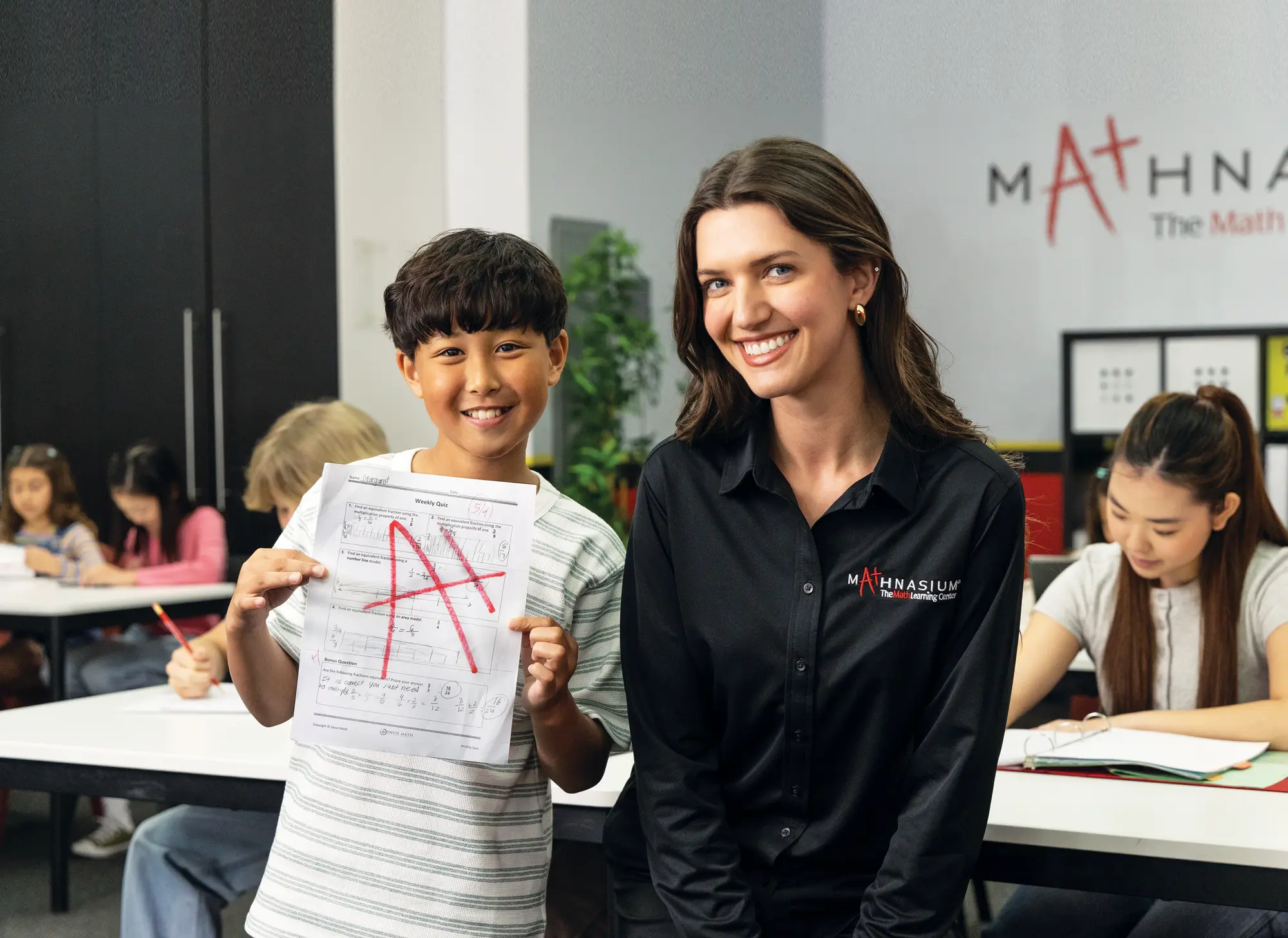
Mathnasium is a math-only learning center for students of all skill levels.
How Mathnasium Uses Productive Struggle to Help Students Become Confident Problem-Solvers
Mathnasium is a math-only learning center for students of all skill levels. Thousands, if not millions, have sat in our chairs over the past two decades, transforming their relationship with math from frustration to a rekindled curiosity and love of learning.
We use productive struggle as a powerful instructional tool, helping students develop the confidence to face challenges, the skills to work through them, and the satisfaction that comes from figuring things out for themselves.
Here’s how we make that happen:
-
We begin with a diagnostic assessment to understand each student’s strengths and uncover their knowledge gaps.
-
We create a personalized learning plan that introduces new concepts at the right level—not too simple, not too overwhelming.
-
Our tutors provide face-to-face instruction in a caring and fun group environment, available both in-center and online.
-
We focus on building deep understanding, helping students move beyond memorization and into true mastery.
This approach delivers measurable growth and lasting mindset shifts. Across our network:
Families in Irvine, CA, and nearby communities trust the local team at Mathnasium of University Irvine to turn challenge into confidence and math into something their child can feel good about.
Schedule a Free Assessment here or call us at (949) 296-6284.


 (949) 296-6284