




What is an Altitude?
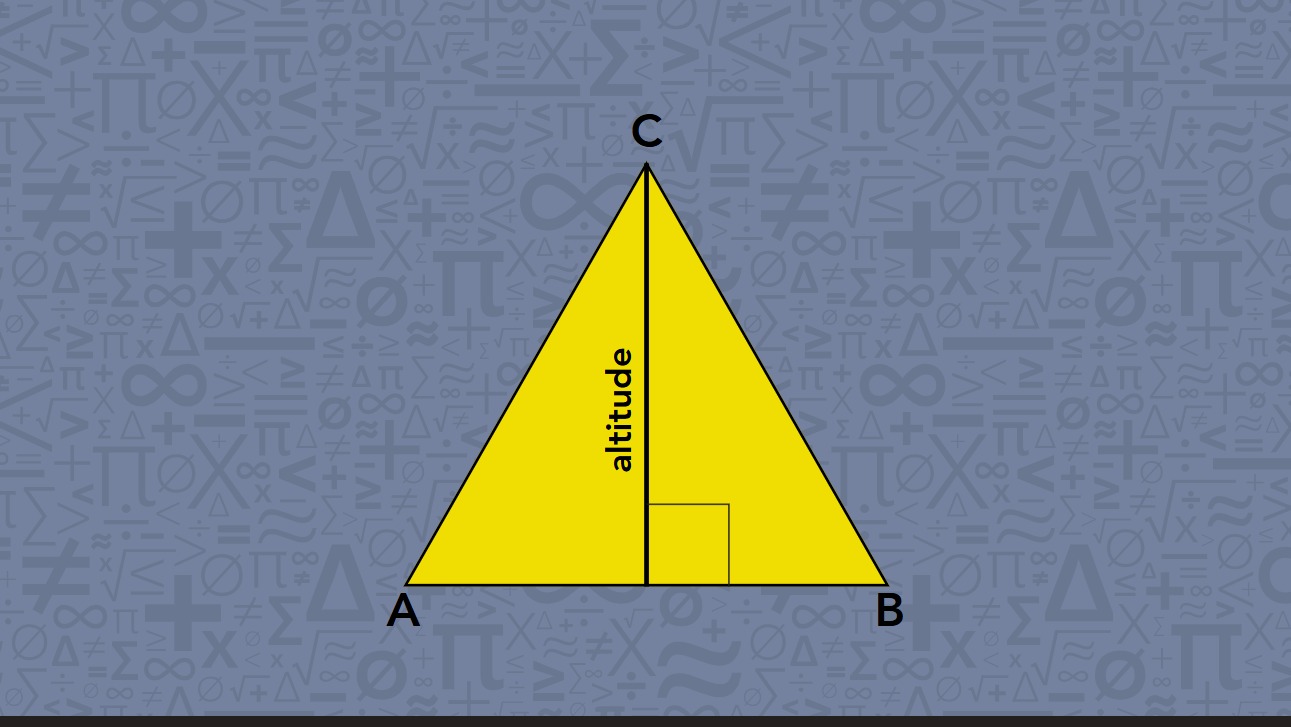
A line from a vertex that is perpendicular to the opposite side. A figure has as many altitudes as it does angles.
In geometry, an altitude is a line segment that starts at the vertex (corner) of a shape and goes straight down to the opposite side (or the line containing the opposite side), forming a right angle. This means the altitude is always perpendicular to that opposite side.
Altitudes are especially important in triangles. Every triangle has three altitudes, one from each vertex. They are often used to calculate area, especially when using the formula:
Area = \(\Large\frac{1}{2}\) × base × height
In this case, the height is the same as the altitude.
Altitudes also show up in more advanced geometry topics like finding orthocenters, or when analyzing slopes and angles in coordinate geometry.
When Do Students Learn About Altitudes?
Students begin learning about altitudes as they explore geometry and measurement, particularly when calculating area or working with perpendicular lines.
Grades 5–6 – Introduction to Altitudes
Students start learning how to identify and draw altitudes, especially in triangles and parallelograms, and use them to find area.
Grades 7+ – Applying Altitudes in Geometry
Students use altitudes in more complex problems involving triangle properties, coordinate geometry, and constructions.