











What is the Associative Property?
The law of mathematics that allows the independent grouping of elements in a problem
The associative property says that in addition and multiplication, you can group numbers in any way and still get the same answer. It doesn’t matter how the numbers are paired together; the result will be the same.
This property is called "associative" because it’s about associating, or grouping, numbers differently.
Let’s see how this works in addition:
The associative property of addition says that (a + b) + c = a + (b + c)
Let’s say that a=1, b=2, and c=3.
(1 + 2) + 3 = 1 + (2 + 3)
3 + 3 = 1 + 4
6 = 6
No matter how we group and the order in which we add these numbers, we arrive at the same sum: 6.
It’s the same with multiplication!
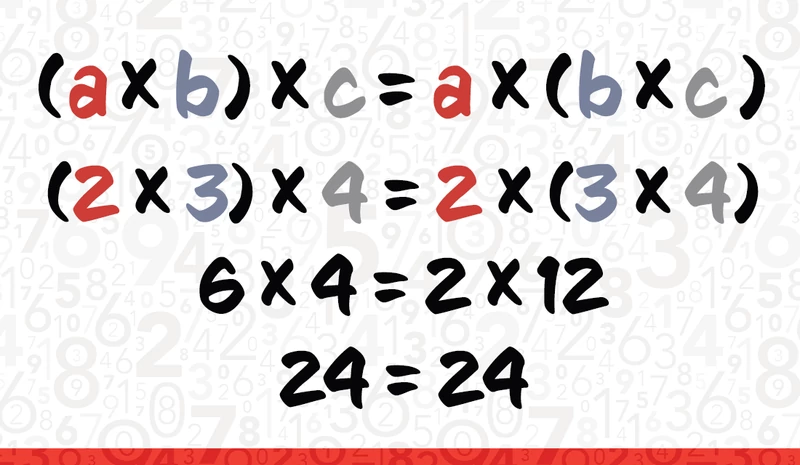
The associative property of multiplication says that (a × b) × c = a × (b × c).
Let’s say that a = 2, b = 4, and c = 6.
(2 × 4) × 6 = 2 × (4 × 6)
8 × 6 = 2 × 24
48 = 48
Again, no matter how we group these numbers, we arrive at the same product: 48.
Important: Subtraction and division are not associative. Grouping does matter in these operations.
When Do Students Learn About the Associative Property?
Students first learn the associative property when exploring addition, then apply it to multiplication and later to algebraic expressions.
Grades 2–3 – Associative Property of Addition
Students practice grouping numbers differently in addition (normally without using the grouping symbols) to see that the sum stays the same.
Grades 4–5 – Associative Property of Multiplication
Students use the associative property to simplify multiplication problems and understand patterns in number operations.
Grades 6+ – Associative Property in Algebra
Students apply the associative property to variables and algebraic expressions to rearrange and simplify equations.