











What is a Decimal Fraction?
A base 10 number written with a decimal point to separate the whole numbers on the left from the fractions on the right. All decimal fractions either terminate, repeat, or continue to infinity without terminating or repeating.
A decimal fraction is a special kind of fraction written in base 10 using a decimal point. For example:
- 0.5 is a decimal fraction equal to one-half (\(\Large\frac{1}{2}\))
- 2.75 means 2 whole units and 75 hundredths
- 0.333… (which we write as ) is a repeating decimal that keeps going forever
The digits to the left of the decimal point show whole numbers, and the digits to the right represent fractional parts, like tenths, hundredths, or thousandths.
All decimal fractions do one of three things:
- They terminate (end), like 0.25
- They repeat a digit or group of digits, like 0.666… (or, )
- Or they continue without a pattern, like the decimal for π (3.14159…)
Decimal fractions help us compare and calculate with numbers in real life, such as:
- Money (like $1.50)
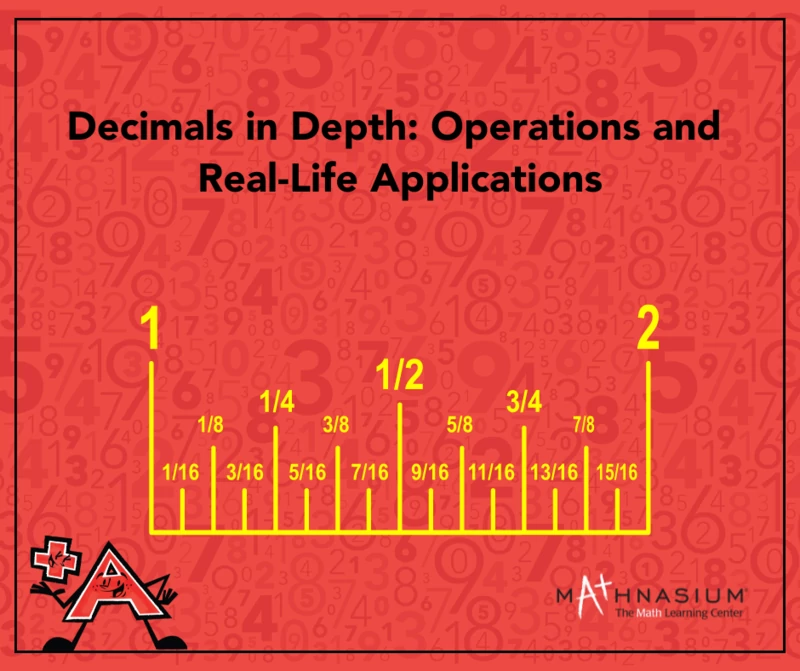
- Measurements (like 2.75 inches)
- Test scores and statistics ((like scoring 18.5 out of 20 on a quiz)
When Do Students Learn About Decimal Fractions?
Grades 4–5 – Introduction to Decimals
Students learn to read and write decimals, connect them to fractions, and use them in measurement and money.
Grades 6+ – Operations with Decimals
Students add, subtract, multiply, and divide decimals and convert between fractions and decimals in more complex problems.