





A structure consisting of vertices and edges, where the edges indicate a mapping among the vertices.
A finite graph is a mathematical structure made up of a limited number of points, called vertices, connected by lines or curves, called edges. Each edge shows a relationship or connection between two vertices.
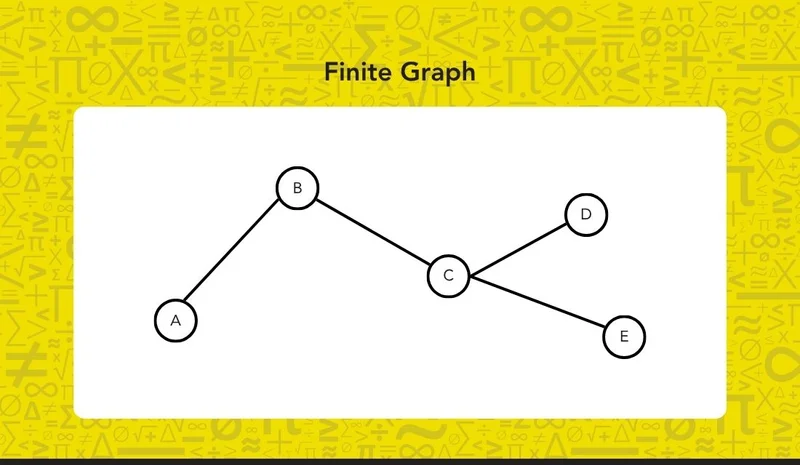
A simple example: imagine four cities on a map, each represented by a dot (vertex). The roads connecting them are the edges. The entire map — dots and roads together — is a finite graph. It is finite because there is a countable, limited number of cities and roads.
The key ideas in a finite graph are:
-
Vertices (also called nodes): the points in the graph, representing objects or locations
-
Edges: the connections between vertices, representing relationships or paths between them
-
Mapping: each edge tells us which vertices are linked
Finite graphs are studied in a branch of mathematics called graph theory, which has applications in computer networks, social connections, route planning, and scheduling.
The word “finite” simply means the graph has a specific, countable number of vertices and edges, as opposed to an infinite graph, which would have no such limit.
When Do Students Learn About Finite Graphs?
Students build toward finite graphs through their work with diagrams, networks, and logical relationships.
Grades 6–8 – Introduction to Networks and Relationships
Students explore mapping diagrams and network-style representations, developing intuition for how vertices and edges describe connections between objects.
Grades 9+ – Graph Theory and Advanced Applications
Students encounter finite graphs formally in discrete mathematics and advanced coursework, studying properties like connectivity, paths, and traversal algorithms.