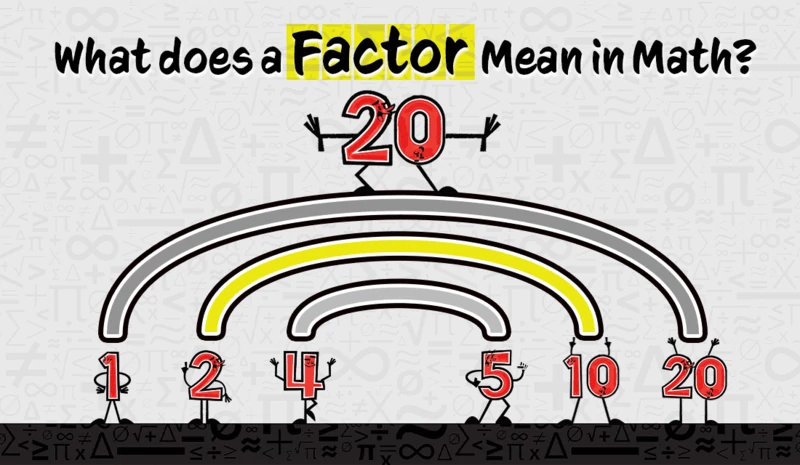












A number that has exactly two distinct factors, namely, 1 and itself.
A prime number is a whole number greater than 1 that can only be divided evenly by 1 and itself.
That means it has exactly two distinct factors.
For example:
- 2 is prime because its only factors are 1 and 2.
- 3 is prime because its only factors are 1 and 3.
- 5, 7, 11, and 13 are also prime numbers.
Let’s compare:
- 6 is not prime because it has more than two factors: 1, 2, 3, and 6.
- 9 is not prime because it can be divided by 1, 3, and 9.
A quick note: 1 is not a prime number because it only has one factor (itself).
Prime numbers are important because:
- They are the building blocks of whole numbers.
- Every whole number greater than 1 can be written as a product of prime numbers (this is called prime factorization).
When Do Students Learn About Prime Numbers?
Students begin learning about prime numbers once they understand multiplication and factors.
Grades 4–5 – Introduction to Prime and Composite Numbers
Students learn how to find factors and identify whether a number is prime or composite.
Grades 6+ – Using Prime Factorization
Students use prime numbers to factor larger numbers and solve problems involving greatest common factor (GCF) and least common multiple (LCM).