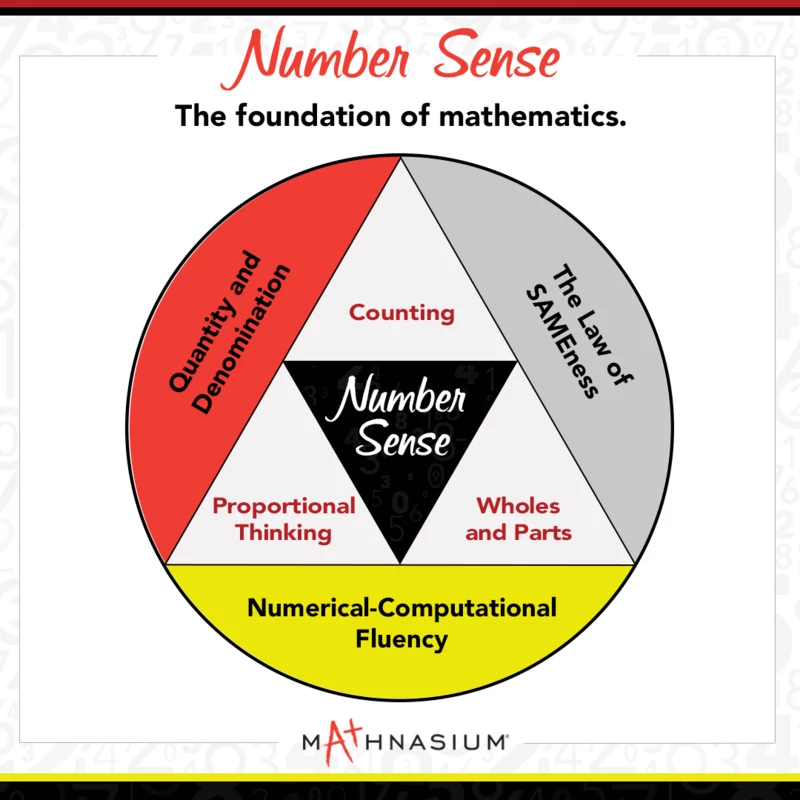












Reasoning in groups.
Proportional thinking is the ability to reason about quantities in relation to each other, understanding how one quantity scales when another changes. At its core, it means thinking in groups: if one group has a certain value, what does two groups have? Three groups? Half a group?
For example, if one box of crayons holds 8 crayons, proportional thinking lets us reason that 3 boxes hold 24, half a box holds 4, and 5 boxes hold 40, without needing to start from scratch each time. We scale the group up or down by the same factor.
Proportional thinking underlies a wide range of mathematical ideas:
-
Ratios and rates (miles per hour, price per item)
-
Fractions and percentages
-
Scale drawings and maps
-
Similar figures in geometry
-
Direct variation in algebra
Students who think proportionally can move fluidly between representations — tables, graphs, equations, and real-world contexts — because they understand the relationship between quantities, not just the numbers themselves.
When Do Students Learn About Proportional Thinking?
Proportional thinking develops gradually, beginning with early grouping and multiplication and deepening through middle school.
Grades 3–5 – Multiplication and Equal Groups
Students build proportional thinking through multiplication, skip counting, and working with equal groups, the foundational idea that quantities scale together.
Grades 6–8 – Ratios, Rates, and Proportions
Students formalize proportional thinking through ratios, unit rates, proportions, and percent problems, applying it across a wide range of contexts.
Grades 9+ – Proportional Thinking in Advanced Mathematics
Students apply proportional reasoning in algebra, geometry, statistics, and trigonometry, where scaling relationships appear in functions, similar figures, and data analysis.