










An angle whose measure equals 0°.
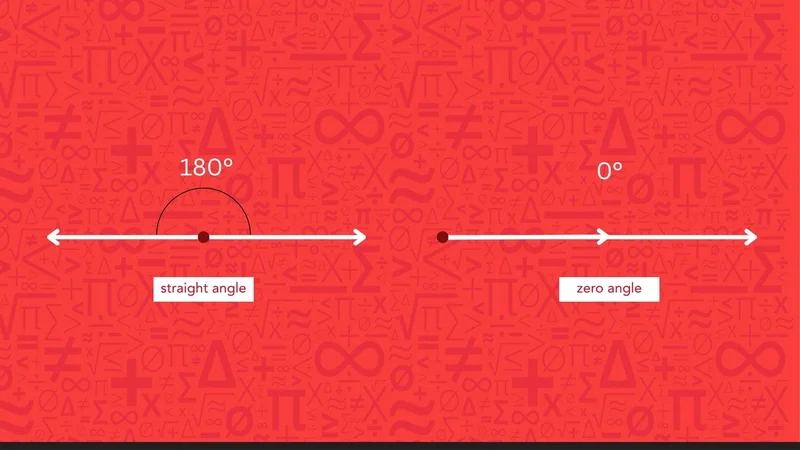
A zero angle is an angle that measures exactly 0 degrees. It is formed when two rays share the same starting point and point in exactly the same direction, with no opening between them.
Most angles describe some amount of turning or opening between two rays. A zero angle describes no turning at all; the two rays lie completely on top of each other, so there is nothing between them to measure.
We can picture a clock hand. When both hands point to 12, the angle between them is 0°. The moment one hand begins to move, the angle grows above zero.
A zero angle sits at one end of the full range of angle measures:
-
Zero angle: 0°
-
Acute angle: greater than 0° and less than 90°
-
Right angle: exactly 90°
-
Obtuse angle: greater than 90° and less than 180°
-
Straight angle: exactly 180°
-
Reflex angle: greater than 180° and less than 360°
-
Full angle: exactly 360°
Understanding zero angles helps students see angle measurement as a complete, continuous system with clearly defined boundaries at both ends.
When Do Students Learn About Zero Angles?
Students encounter zero angles as part of their broader study of angle types and measurement.
Grades 3–5 – Angle Types and Measurement
Students learn to identify and classify angles by their measure, including right, acute, obtuse, and straight angles. Zero angles are introduced as part of the full range of possibilities.
Grades 6+ – Angles in Geometry and Trigonometry
Students work with the full spectrum of angle measures in geometry and trigonometry, applying their understanding of zero and full angles in more complex contexts.