Ever wondered what the “.99” in a $9.99 price tag means? Or the “.5” in a 8.5 shoe size?
All of those numbers use decimals, and every digit in a decimal has a special meaning depending on where it sits. That’s called decimal place value.
In this guide, you’ll not only learn what decimal place value is and how to read it, but you’ll also explore why it can be confusing at first and what you can do to fix common mistakes. With fun examples, real-life connections, and expert tips from Mathnasium, you’ll be reading decimals like a pro in no time!

What Is Decimal Place Value?
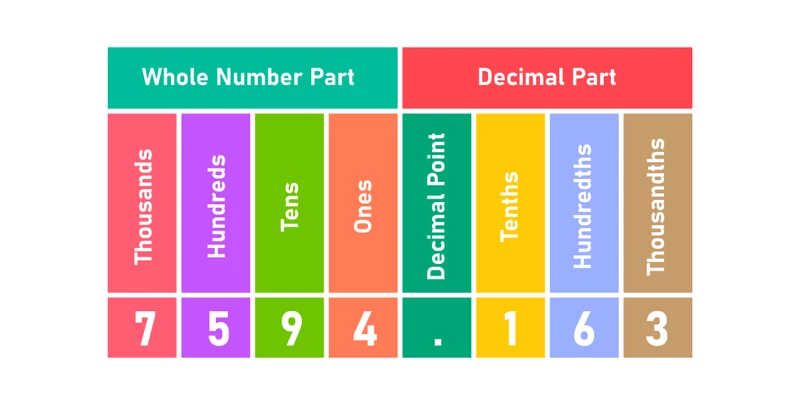
Just like whole numbers have place values like ones, tens, and hundreds, decimals follow the same pattern, but they name parts of a whole, just like fractions.
The place value of any digit depends on where it sits in the number.
-
As we move left, each place is 10 times bigger than the one before it.
-
This means that as we go the opposite way, to the right, each place is 10 times smaller than the one before it.
For example, in the number 345, the digits stand for:
-
3 hundreds (300)
-
4 tens (40)
-
5 ones (5)
How about the same number, only after the decimal point: 0.345?
We said that the place value decreases as we go from left to right, and that decimal place values name fractions instead of ones, tens, and so on.
In a decimal like 0.345, our place values are:
-
3 tenths (0.3)
-
4 hundredths (0.04)
-
5 thousandths (0.005)
Here’s another example:

So when you see a number like 9.5, you're seeing 9 ones and 5 tenths, which is just like saying “nine and a half.”
The pattern of place value doesn't change; only the names do, depending on which side of the decimal you’re looking at.
Understanding the Decimal Place Value Positions
Let’s take a closer look at how decimal places work, and what better way to do that than with one of the most famous decimals in the world?
Have you heard of Pi (π)?
It’s a number that helps us measure circles, and it starts like this:
3.1415926535…
The fun part?
It never ends and never repeats, but every single digit after the decimal still has a name and a place!
Let’s look at just the first few digits of Pi:

So:
-
The 1 right after the decimal is in the tenths place, which is 1/10
-
The 4 is in the hundredths place, which is 4/100
-
The 1 after that is in the thousandths place, which is 1/1000
-
And it keeps going…
Even though Pi’s decimal part goes on forever, every digit still follows the same pattern. That’s the power of place value: it helps us make sense of even the longest decimals.
Let’s ask ourselves:
-
Which digit is in the hundredths place in 3.14?
-
What’s the value of the 5 in 3.1415?
-
How many decimal places do you need to reach the 9 in Pi?
Thinking through these helps us see that no matter how long a decimal is, every digit has its own place and purpose.
You May Also Like: 7 Amazing Facts About PI Every Math Student Should Know
What Makes Decimal Place Value Tricky for Some Students?
Decimal place value may look simple at first, but it can be a little confusing, especially when you’re used to working with whole numbers.
Let’s look at what students at Mathnasium often find tricky and how we can make those challenges easier to understand.
1. Mixing Up Tenths, Hundredths, and Thousandths
Let’s say you’re comparing 0.5 and 0.05. Which one is bigger?
Some students may conclude that 0.05 is bigger because it has more digits, but that’s not true.
Solution: Use a decimal place value chart or real-life examples like money:
-
$0.5 = 50 cents
-
$0.05 = 5 cents
And you can always remind yourself that the first digit after the decimal point is 1/10 (tenths place) and the second 1/100 (hundredths place).
Is one-tenth of a cake larger than one-hundredth?
The slice out of a cake cut into 10 pieces (one-tenth) is much larger than a slice out of a cake cut into 100 pieces (one-hundredth), correct?
So, five-tenths is way more than five-hundredths!
2. Reading Decimals Incorrectly
Students often read 0.75 as “seventy-five” instead of “seventy-five hundredths.”
Solution: Practice saying decimals out loud and use place value names:
Try this: “How would you say 0.47?” (Hint: forty-seven hundredths)
3. Lining Up Decimal Numbers Wrong in Math Problems
When adding or subtracting decimals, students sometimes line up the digits like whole numbers and forget about the decimal point.
Solution: Always line up the decimal points!
This keeps digits in their correct place value columns: tenths with tenths, hundredths with hundredths.
4. Thinking 0.4 and 0.40 Are Different Numbers
What’s the difference between 0.4 and 0.40?
Trick question; they’re the same!
Solution: Show decimals on a number line or compare them using money:
-
0.4 = 40 cents
-
0.40 = also 40 cents
Trailing zeros don’t change the value. They just show place value more clearly.
5. Not Connecting Decimals and Fractions
Understanding that 0.25 = ¼ isn’t obvious at first. It takes practice!
Solution: Use visuals and real-life tools, like quarters:
1 quarter = $0.25 = ¼ of a dollar
Ask: “If 0.5 = ½, what does 0.75 equal?”
At Mathnasium of Rolling Hills Estates, we help students overcome these challenges through face-to-face instruction in a caring and fun group environment. Our personalized learning plans and hands-on practice build real confidence and real understanding.
You May Also Like: How to Convert Fractions to Decimals & Back
Let’s Practice Reading Decimal Numbers
Reading decimals is like reading whole numbers with a twist. Use the word “and” for the decimal point and name the digit after the decimal using its place value.
Here are a few examples:
Let’s look at this one:
In 3.75 meters, the 7 means…?
Let’s think.
It’s right after the decimal, so it’s in the tenths place. That means it’s worth seven-tenths of a meter.
And the 5?
It’s in the hundredths place.
So, the full number means 3 meters and 75 hundredths of a meter.
Why Decimal Place Value Matters in Real Life
Decimals aren’t just for math class; they’re everywhere!
-
Money: When you see $2.50, it means 2 dollars and 50 hundredths of a dollar, or 50 cents!
-
Cooking: A recipe might ask for 0.25 cups of sugar (that’s one-quarter).
-
Sports: Runners may finish in 9.58 seconds. That tiny .58 can make a big difference!
Question:
Would you rather have 0.5 of a pizza or 0.05? Why?
If you said 0.5, good job! Half a pizza is way more than five-hundredths of a pizza.
Printable Decimal Place Value Chart
A place value chart is a great tool for practicing decimals. That’s why we created a free, printable chart for you!
Use it to:

Print it and keep it near your homework space!
Quick Quiz – Test Your Decimal Skills!
Let’s see how much you’ve learned! Try answering these:
-
What is the value of the 6 in 0.63?
-
Which number is greater: 0.8 or 0.08?
-
How do you say 0.47 out loud?
-
What place is the 5 in 3.205?
-
Which is more: 0.3 or 0.33?
Done? Scroll to the bottom of this guide to check your answers.
 Mathnasium of Rolling Hills Estates empowers students of all skill levels to unlock their math potential
How Mathnasium of Rolling Hills Estates Helps Kids Master Decimal Place Value
At Mathnasium of Rolling Hills Estates, we make math make sense, including decimal place value.
Proudly serving families in Rolling Hills Estates, CA, our specially trained tutors use personalized learning plans built from a diagnostic assessment, so we know exactly what your child needs to succeed.
Using the Mathnasium Method™, we help students:
We break tricky concepts like decimal place value into manageable pieces so your child can truly understand how decimals work—and feel proud of their progress.
Want your child to feel confident with decimals?
Schedule a free assessment today!
Pssst! Check Your Quiz Answers
-
6 tenths
-
0.8
-
Forty-seven hundredths
-
Thousandths place
-
0.33
Great job! If you didn’t get them all, review the chart and try again.


 (424) 383-6284