Geometry is officially introduced as a standalone course in 10th grade, but students don't start learning geometry concepts then. Throughout elementary and middle school, students build the foundational geometric thinking and skills that prepare them for the formal study of geometry in high school.
The challenge is that geometry builds on itself in a way that makes gaps from earlier grades hard to hide. If your child missed or struggled with certain concepts in elementary or middle school, those gaps can make 10th-grade geometry feel confusing and overwhelming from the start.
The upside is that with the right support and review, students can fill those gaps and build the strong foundation they need before entering high school geometry.
Our tutors at Mathnasium have prepared a walkthrough of 10 essential geometry concepts students encounter from elementary school through 9th grade, with simple example problems to help you see where your child stands and where they might need extra practice.
1. Identifying 2D Shapes and Their Attributes (Grades 3-5)
By the time students reach upper elementary school, they should be able to name and describe familiar two-dimensional shapes like triangles, quadrilaterals (squares, rectangles, and parallelograms), circles, pentagons, and hexagons.
Beyond just naming them, they should understand what makes each shape unique.
For example:
Students should also use precise vocabulary, like:
2. Understanding Perimeter and Area (Grades 3-5)
As they progress through Grades 3 to 5, students are expected to distinguish between two fundamental measurements of flat shapes: perimeter and area.
Perimeter measures the total distance around the outside edge of a shape, which students can think of as walking around the border of a playground or putting a fence around a yard.
Area measures the amount of space contained inside a shape, like how much carpet would be needed to cover a floor or how much paint would cover a wall.
For rectangles, students learn to calculate these two measurements by using:
Beyond simple rectangles, students should be able to tackle composite shapes by breaking them into smaller rectangles, finding each area separately, and combining the results. This decomposition strategy becomes increasingly important as shapes grow more complex.
📕 You May Also Like: Perimeter vs. Area: Why Kids Mix Them Up
3. Measuring Angles With a Protractor (Grades 4-5)
By the end of elementary school, students should know how to use a protractor to measure angles in degrees. They should recognize:
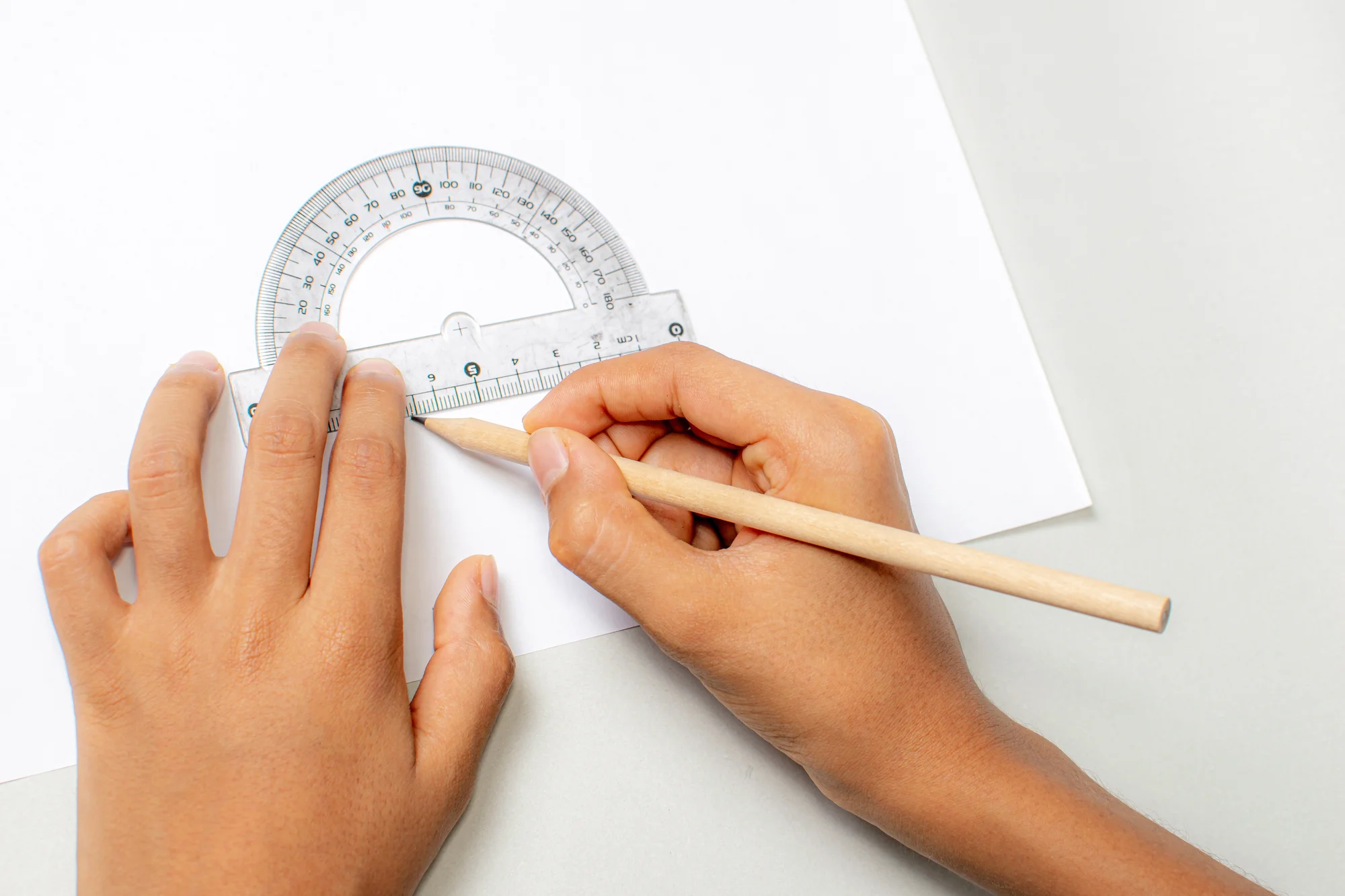
Protractors often confuse students at first, but with practice, angle measurement becomes second nature and helps them notice geometric patterns in everyday objects.
4. Introduction to Volume (Grade 5)
Volume extends the concept of area into three dimensions, measuring the space inside a solid object rather than on a flat surface. Students learn to think of volume as how much something can hold, whether that's water filling a fish tank, cereal filling a box, or blocks stacking to build a tower.
For rectangular prisms and cubes, students learn to use the formula:
Volume = length × width × height
The key conceptual leap here is understanding that volume builds on area. If you know the area of the base (length × width), you're essentially stacking that flat area multiple times to the height of the object.
📕 You May Also Like: What Is Volume in Math? A Kid-Friendly Guide
5. Classifying Triangles and Quadrilaterals (Grade 6)
In 6th grade, students learn to classify triangles in two different ways:
By sides:
-
Equilateral (all 3 sides are equal)
-
Isosceles (2 sides are equal)
-
Scalene (no sides are equal)
By angles:
-
Acute (all angles less than 90 degrees)
-
Right (one 90-degree angle)
-
Obtuse (one angle greater than 90 degrees)
They also learn to identify different types of quadrilaterals like rectangles, squares, parallelograms, trapezoids, and rhombuses based on their properties.
📕 You May Also Like: How to Identify Straight, Right, Acute, and Obtuse Angles?
6. Understanding the Coordinate Plane (Grades 6-7)
The coordinate plane (also called a coordinate grid) is introduced, starting with just the first quadrant where both x and y values are positive.
Students learn to plot points using ordered pairs like (3, 5) and to identify the coordinates of points on a grid. This skill becomes essential for graphing and geometry problems in later grades.

Understanding how shapes behave on a coordinate grid prepares students for algebra concepts like slope and distance that they'll encounter in later grades.
7. Surface Area and Area of Complex Shapes (Grades 6-7)
Students explore "nets," which are flat patterns that can be folded to create three-dimensional shapes. Imagine unfolding a cardboard box and laying it flat. That flat pattern is a net.
Students use nets to understand and calculate the surface area of prisms and other 3D shapes by finding the area of each face and adding them together.
Moving beyond rectangles, students also learn to find the area of triangles, parallelograms, and trapezoids by understanding how base and height relate to the shape's total space.
8. Angle Relationships (Grade 7)
Students learn four important types of angle pairs:
-
Adjacent angles: Two angles that share a common side and vertex (they're next to each other)
-
Vertical angles: When two lines intersect, they form two pairs of opposite angles called vertical angles. Vertical angles are always equal to each other.
-
Complementary angles: Two angles that add up to 90 degrees
-
Supplementary angles: Two angles that add up to 180 degrees
This is where algebra meets geometry. Students use what they know about angle relationships to set up and solve equations.
📕 You May Also Like: Complementary and Supplementary Angles - A Complete Guide
9. Circle Properties and Measurements (Grade 7)
Students dive into circles and learn key vocabulary and formulas:
-
Radius: The distance from the center to any point on the circle
-
Diameter: The distance across the circle through the center (always 2 times the radius)
-
Circumference: The distance around the circle, calculated with C = πd or C = 2πr
-
Area: The space inside the circle, calculated with A = πr²
Understanding the relationship between radius and diameter is crucial, as is recognizing that pi (π) appears in both circumference and area formulas because circles are fundamentally curved shapes.
Students often struggle initially with pi as an irrational number (approximately 3.14), but using it repeatedly in calculations helps build familiarity and comfort with this important mathematical constant.
📕 You May Also Like: Is Pi a Rational or Irrational Number?
10. Volume and Surface Area of Prisms and Pyramids (Grade 7)
Building on earlier volume concepts, 7th graders work with more complex three-dimensional shapes. They calculate:
-
Volume of rectangular and triangular prisms
-
Volume of pyramids (which is always ⅓ × base area × height)
-
Surface area of prisms and pyramids
Understanding these formulas helps students visualize how three-dimensional objects work, which is important for real-world applications like calculating how much water fills a pool or how much wrapping paper covers a gift box.
Students also tackle more challenging composite figures that combine multiple shapes. They learn to break down complex shapes into simpler parts, find each area separately, and combine them for a final answer.
📕 You May Also Like: A Kid-Friendly Guide to the Surface Area of a Rectangular Prism
Students who master these 3D concepts often find physics and engineering topics easier to grasp since they can visualize how objects occupy and interact with space.
Test Your Child's Geometry Readiness
Here are three practice problems that cover key skills from the list above. If your child can work through these comfortably, they likely have a solid foundation for 10th-grade geometry.
Problem 1: Perimeter and Area
A backyard is shaped like a rectangle that's 8 feet long and 5 feet wide. What is the perimeter? What is the area?
Solution:
In this exercise, you want to see whether your child can apply both formulas correctly and explain the difference between perimeter (distance around) and area (space inside).
Problem 2: Coordinate Plane and Triangle Classification
Plot the points A(0, 0), B(4, 0), and C(4, 3) on a coordinate grid. What kind of triangle is ABC? What is its area?
Solution:
-
When you plot these points, you'll see that angle A is a right angle (90 degrees), making this a right triangle
-
The base is 4 units (from A to B along the x-axis)
-
The height is 3 units (from B to C along the y-axis)
-
Area = ½ × 4 × 3 = 6 square units
Check whether your child can plot points accurately, recognize the right angle visually, and apply the triangle area formula.
Problem 3: Angle Relationships and Equations
Two angles are supplementary. One angle is 3 times the other. What are the measures of the two angles?
Solution:
-
Let x = the smaller angle
-
Then 3x = the larger angle
-
Since they're supplementary: x + 3x = 180
-
Combining: 4x = 180
-
Solving: x = 45 degrees
-
The two angles are 45 degrees and 135 degrees
The goal here is to translate the word problem into an equation, solve for the variable, and verify that the angles add up to 180 degrees.
Is Your Child Ready for 10th Grade Geometry?
If your child can comfortably work through the concepts we've covered so far, they're in good shape for 8th grade. But how can you tell if they're truly ready?
Signs Your Child Is Prepared
A student ready for 8th-grade geometry should be able to:
-
Identify and classify different types of triangles and quadrilaterals without hesitation
-
Use angle relationships (complementary, supplementary, vertical) to solve for missing angles
-
Calculate the area and perimeter of composite figures by breaking them into simpler shapes
-
Apply circle formulas to find the circumference and area
-
Work confidently with the coordinate plane to plot points and identify shapes
-
Calculate volume and surface area of basic 3D shapes like prisms and pyramids
Signs Your Child May Need Extra Support
Watch for these red flags that suggest some review might be helpful:
-
Struggling to remember which formula applies to which shape
-
Difficulty setting up equations when solving for unknown angles
-
Confusion about when to use perimeter vs. area vs. volume
-
Trouble visualizing 3D shapes or understanding how nets relate to surface area
-
Hesitation or anxiety when faced with multi-step geometry problems
The difference between a student who's prepared and one who's struggling often comes down to whether they truly understand the concepts or have simply memorized formulas without grasping the reasoning behind them.
If your child can explain why a formula works (for example, why the area of a triangle is half the area of a rectangle), they're thinking like a mathematician. If they can only recite formulas without understanding when or why to use them, some additional support could make a big difference.
If you notice any of these signs, structured support through a program like Mathnasium can help fill gaps and build confidence before high school geometry begins.

Mathnasium tutors have years of experience in identifying knowledge gaps and teaching geometry in a way that sticks.
How Mathnasium Helps Students Master Geometry Concepts
Mathnasium is a math-only learning center dedicated to helping K–12 students of all levels excel in math.
In our centers, we've worked with many students who feel overwhelmed by geometry concepts or who have gaps in their understanding from earlier grades. Our individually-tailored programs are designed specifically to support learners through the critical years when geometry becomes more abstract and requires stronger reasoning skills.
Behind each of our programs is a proprietary teaching approach called the Mathnasium Method™. Beyond rote memorization or shortcuts, our method is built to help students truly make sense of geometry and how it connects to the broader world of mathematics.
We support math mastery through:
-
Personalized learning: Each student begins with a diagnostic assessment that helps us identify current skills, knowledge gaps, and how they naturally think through math problems. We use those insights to build a custom learning plan tailored to their needs, ensuring we address any missing geometry basics before moving forward.
-
Teaching for understanding: We explain geometry concepts in clear, everyday language, using a mix of verbal, visual, mental, tactile, and written techniques. Students might use manipulatives to explore 3D shapes, draw diagrams to understand angle relationships, or connect formulas to real-world scenarios. This allows each student to approach geometry in the way that makes the most sense to them.
-
Caring, responsive tutors: Our tutors are specially trained in both the technical and emotional aspects of teaching. They know when to guide, when to challenge, and how to help students regain trust in their thinking, especially when geometry feels intimidating.
-
Independent problem-solving and critical thinking: We give students space to work through geometry challenges on their own, then rejoin them to check their reasoning. Instead of just giving them the answer, we help them understand the how and why behind each solution. This helps them develop problem-solving skills they can use throughout middle school, high school, and beyond.
-
A singular focus on math: We specialize in math and math only. Our robust, continually refined individual programs span thousands of custom materials built around how students actually learn and retain geometry skills and other mathematical concepts.
-
A supportive, fun environment: Many of our activities are hands-on or game-based. We use reward systems and consistent encouragement to keep students engaged. We celebrate progress because students gain motivation with every win.
The results speak for themselves:
-
94% of parents report improvement in their child's math skills and understanding
-
93% of parents notice a more positive attitude toward math
-
90% of students see higher grades in school
Mathnasium operates over 1,100 learning centers across the U.S., bringing our proven approach close to your community.
For families in or near Blue Ash, OH, Mathnasium of Blue Ash is a trusted local center with years of experience transforming how students think and feel about math. We're proud to have been recognized as:
If your middle schooler is ready to catch up, build stronger geometry basics, or prepare for 8th grade with confidence, our team is here to help.
📅 Schedule a Free Diagnostic Assessment at Mathnasium of Blue Ash
Not located near Blue Ash?
📍 Find a Mathnasium Learning Center Near You


 (513) 984-1212
 (513) 984-1212