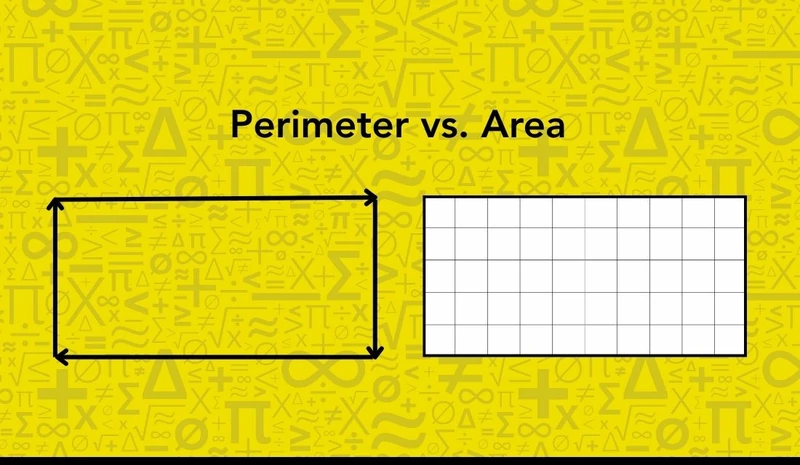
There are some math terms that students frequently mix up, like factors and multiples, mean and median, and—you guessed it!—perimeter and area.
And we get it!
The concepts of perimeter and area are usually introduced together; they both involve measuring shapes, and they even use similar-looking formulas. It’s no wonder so many kids, across all grade levels, struggle to tell them apart.
At Mathnasium, we’ve helped thousands of students work through this exact confusion. Now we’re sharing our approach with you so you can tackle it at home.
Read on to discover how we explain perimeter and area the Mathnasium way, why kids tend to mix them up, and six practical strategies you can use to help your child finally understand the difference.

So, What Is Perimeter?
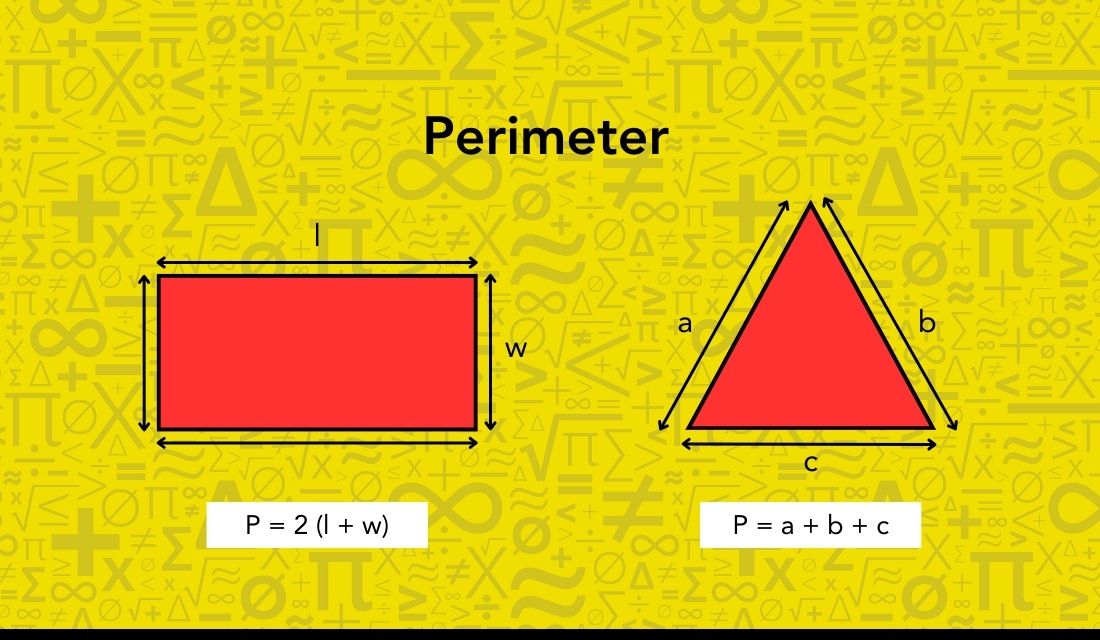
Perimeter is the distance around a two-dimensional (2D) shape.
Think of it as building a fence around your backyard. The total length of the fence is the perimeter; it’s what you get when you add up the lengths of all the sides.
For example, with a rectangle that’s 5 inches long and 3 inches wide:
Perimeter = 5 + 3 + 5 + 3 = 16 in
Or using the formula:
P = 2(l + w) = 2(5 +3 ) = 2 × 8 = 16 in
For a triangle, we’d add all three sides individually. So, if a triangle has sides measuring 4 inches, 5 inches, and 6 inches:
P = a + b + c = 4 + 5 + 3 = 11 in
The shape might change, but the point stays the same: add all the sides, and you’ve found the perimeter.
Perimeter is always measured in standard units like feet, inches, or meters.
And What Is Area?
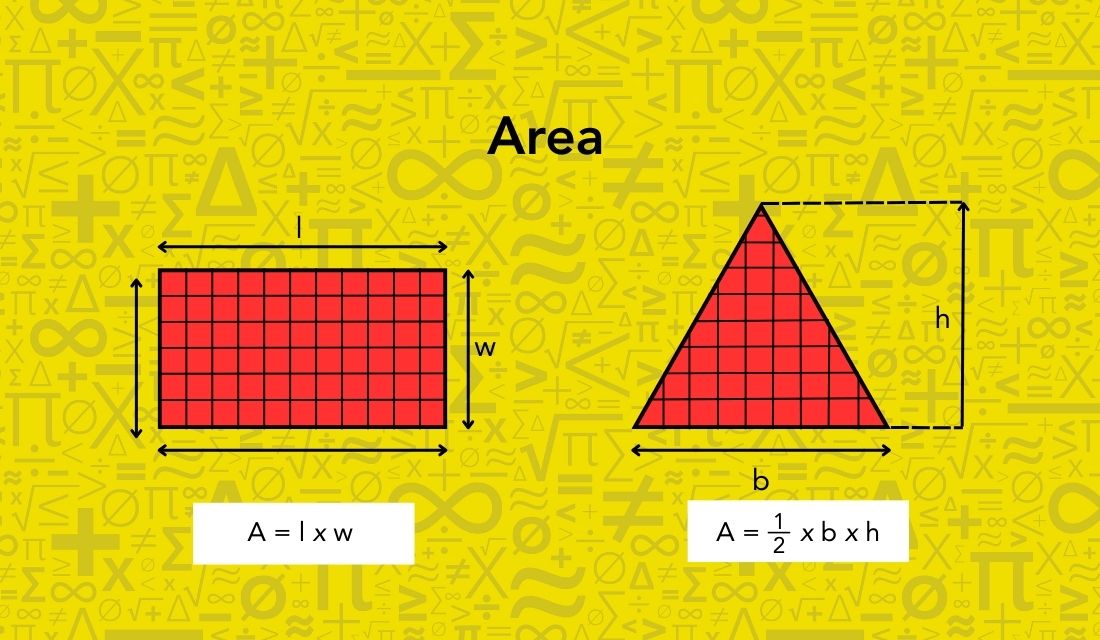
On the other hand, area is the amount of space inside a flat (2D) shape.
If perimeter is the fence, area is the grass you’d mow inside it, or the number of tiles you’d need to cover the floor.
How would we measure the area then?
Let’s say we have a rectangle that’s 5 inches long and 3 inches wide. To find out how much space is inside, we multiply the two dimensions, length and width:
A = l × w = 5 × 3 = 15 in2
For a triangle, we use a different approach. Imagine slicing a rectangle in half diagonally—that gives us a triangle. So, to find the area of a triangle:
A = \(\Large\frac{1}{2}\) × base × height or A = \(\Large\frac{1}{2}\) b × h
If a triangle has a base of 6 inches and a height of 4 inches:
A = \(\Large\frac{1}{2}\) × 6 × 4 = \(\Large\frac{1}{2}\) × 24 = \(\Large\frac{24}{2}\) = 12 in2
The shape might change, but the principle stays the same: area always measures the space inside a shape, and you find it by multiplying dimensions.
Area is always measured in square units, like square feet, square inches, or square meters.
Why?
Because it tells us how many equal-sized squares fit inside the shape.
If your child needs a deeper dive into area, check out our complete guide.
Why Do Kids Mix Them Up?
If your child confuses perimeter and area, they’re definitely not alone.
There’s no single reason, but based on what we’ve observed across grade levels, here are some of the most common causes behind the mix-up:
-
They’re usually taught together. Perimeter and area are often introduced in the same chapter, on the same worksheet, or even during the same lesson. That can make them feel like a matching pair, even though they serve completely different purposes.
-
They both use numbers and units but do different jobs. From the outside, it can sound the same: “Measure this rectangle. Use feet. Show your answer.” Without deeper context, students might not realize how the answers differ.
-
The visuals overlap. Whether it’s a square, rectangle, or triangle, the same shapes are used to teach both area and perimeter. That can easily blur the lines between the two.
-
Students memorize formulas without understanding them. We see this a lot: kids can recite “length times width” or “add all the sides,” but they’re not sure why that’s the right operation or what it actually measures.
-
They haven’t seen how these concepts show up in real life. When students can’t connect math to something tangible, like building a fence or laying tile, the ideas don’t fully click. Without that real-world anchor, formulas start to feel like floating facts.
📕You May Also Like: Surface Area of a Rectangular Prism – A Kid-Friendly Guide
How Parents Can Help Kids Understand the Difference
Knowing the difference between the two is a great start. But to really lock it in, our instructors recommend 4 practical strategies that can help the concept stick for good.
1. Use Everyday Objects
Rather than relying on formulas or even drawings to do the trick, give your child some context. Connect area and perimeter to things they see and use around the house.
For example:
-
Perimeter: Measuring the edge of a garden bed to figure out how much fencing or border edging to buy.
-
Area: Measuring how much carpet or tile is needed to cover a bedroom floor.
-
Perimeter: Lining up LED lights or holiday decorations around a bedroom wall.
-
Area: Figuring out how much wrapping paper is needed to cover a gift box.
Keep the streak going. What else can your child find at home that shows the difference between measuring around and measuring inside?
📕You May Also Like: How to Use Math Manipulatives Effectively at Home
2. Emphasize the Units
At Mathnasium, we always encourage students to pay close attention to units—because understanding what you're measuring is just as important as how you're measuring it.
Here's a distinction you can make:
-
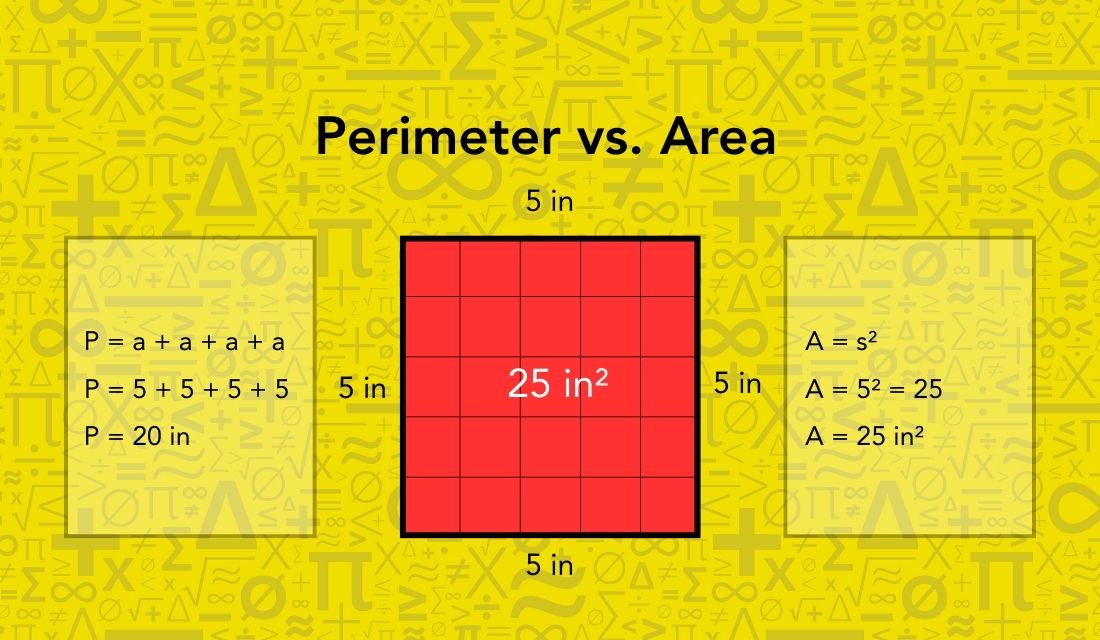
Perimeter is measured in linear units (like feet, inches, or meters) because you're measuring a continuous line around the outside of a shape.
-
Area is measured in square units (like square feet or square centimeters) because you're measuring the amount of space that fits inside a shape.
You can show this at home with a simple activity:
Use a string to measure around a book or placemat—that’s perimeter. Then use paper squares (sticky notes or cut-out squares) to cover the surface. Count how many you used—that’s area.
📕You May Also Like: Measurement Conversions: A Kid-Friendly Guide
3. Draw, Measure, and Find the Rule
If your child tends to rely on memorizing formulas, here’s a great way to help them understand where those rules actually come from.
Grab a ruler and some paper, and work together to draw a few simple shapes: a triangle, a square, a rectangle. Label the side lengths clearly.
Then ask guiding questions:
-
If we wanted to measure around the outside, what would we add?
-
What if we wanted to measure the space inside? How could we figure that out?
Let your child calculate perimeter and area in their own way. Encourage them to try multiple examples, switch up the side lengths, or draw different shapes.
After a few rounds, ask:
Instead of handing them a formula, you’re helping them uncover the pattern themselves. And when kids figure out how something works, they’re far more likely to remember and understand it.
📕You May Also Like: How to Nurture Math Thinkers, Not Just Answer-Getters
4. Turn Practice Into Play
Repetition helps kids build confidence, but repetition through games?
That’s where the magic happens.
Here are a few easy ways to turn area and perimeter into fun, hands-on activities at home:
-
Build-a-Shape Challenge: Give your child graph paper and set a challenge like “draw a shape with a perimeter of 20 units” or “create two shapes with the same area but different perimeters.” They’ll be thinking critically while drawing, calculating, and testing out ideas.
-
Board Game Spaces: Have your child design a mini board game, where each space is a different-sized rectangle or square. To move forward, players must solve for the area or perimeter of the space they land on.
-
Math Dice Toss: Toss two dice. The numbers represent the side lengths of a rectangle. Your child calculates the area or perimeter and scores a point for each correct answer.
The key is to build in opportunities to measure, reason, and solve without it feeling like another worksheet. Kids learn best when they’re engaged, curious, and having fun.
📕You May Also Like: 5 Math Games That Help Kids Rediscover the Joy of Learning

Our proprietary approach, the Mathnasium Method™, is designed to help students build a deep understanding of math concepts like area and perimeter.
How Mathnasium Helps Students Master Any Math Concept
At Mathnasium, we help students of all skill levels unlock their true math potential and transform how they think and feel about math in the process.
Whether your child needs support with understanding the difference between area and perimeter or tackling more advanced topics, our proven teaching approach, the Mathnasium Method™, empowers students to truly understand and enjoy math.
Here’s how it works:
Each student begins their Mathnasium journey with a diagnostic assessment. This isn’t just about pinpointing what they know and what they need to improve—it also helps us understand how they learn best.
Based on the insights from the assessment, we create personalized learning plans designed to meet each student’s individual needs.
Once the plan is ready, our specially trained instructors provide face-to-face instruction in a caring and fun environment. Guided by the personalized learning plan, our tutors use a combination of verbal, visual, mental, tactile, and written techniques to help students view math from multiple angles and develop a deep understanding of each concept.
We always allow time for productive struggle, giving students space to work through challenges and apply their knowledge. Then, we step in with caring guidance to help them understand both the “why” and the “how” behind math problems. This process builds problem-solving skills and builds the kind of critical thinking tools students can use in math and in life.
Mathnasium sessions often don’t feel like traditional lessons. We incorporate hands-on activities, games, and a reward system to keep students motivated and engaged.
The results speak for themselves:
-
94% of parents report an improvement in their child’s math skills and understanding
-
93% of parents report their child has a more positive attitude toward math
-
90% of students see an improvement in their school grades
With over 1,000 Mathnasium centers nationwide, we’re proud to support communities with top-rated math tutoring. For families in Ohio, Mathnasium of Blue Ash is your trusted local learning center, recently honored with:
If your child is looking to catch up, keep up, or get ahead in math, contact Mathnasium of Blue Ash or your nearest Mathnasium center. We’ll schedule a diagnostic assessment and build a plan that puts them on the best path to math mastery.


 (513) 984-1212
 (513) 984-1212