You have probably been working with angles since 3rd or 4th grade. But somewhere around 6th or 7th grade, math starts giving them proper names like "supplementary" and "complementary."
Whether you are meeting supplementary angles for the first time, brushing up before a test, or just trying to remember which one it is (hint: think "S" for "straight"), we’ve got you covered.
Our tutors will walk you through the definition, the different types, worked examples, and practice problems — everything you need to feel confident about supplementary angles.

Quick Facts About Supplementary Angles
-
Supplementary angles are two angles whose sum equals 180°.
-
Each angle in a supplementary pair is called the supplement of the other.
-
To find a missing supplementary angle, we subtract the known angle from 180°.
-
Supplementary angles can be adjacent, sharing a common side and vertex, or non-adjacent, sitting apart from each other.
-
Two 90° angles are the only pair of equal supplementary angles.
-
Supplementary angles do not have to be next to each other to be supplementary.
-
A straight angle can be made up of any two supplementary angles.
First, Let’s Review: What Is an Angle?
An angle is a figure formed by two rays that share a common endpoint. The shared endpoint is a vertex, and the two rays are the sides of the angle.
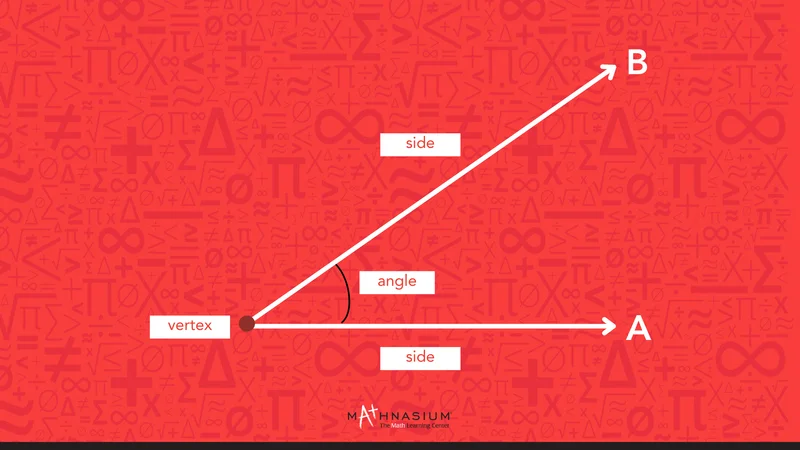
We measure angles in degrees, written with the symbol °. Degrees tell us how wide or narrow the opening between the two rays is.
📕 You May Also Like: What Is Vertex? Everything You Need to Know
What Are Supplementary Angles?
Supplementary angles are two angles that always add up to 180°.
Regardless of their position, as long as the sum of two angles equals 180°, they are considered supplementary angles. This relationship remains true whether the angles are positioned next to each other or are entirely separate.
Each angle in the pair is the supplement of the other. For example, if one angle is 110°, the other must be 70°, because 110° + 70° = 180°.
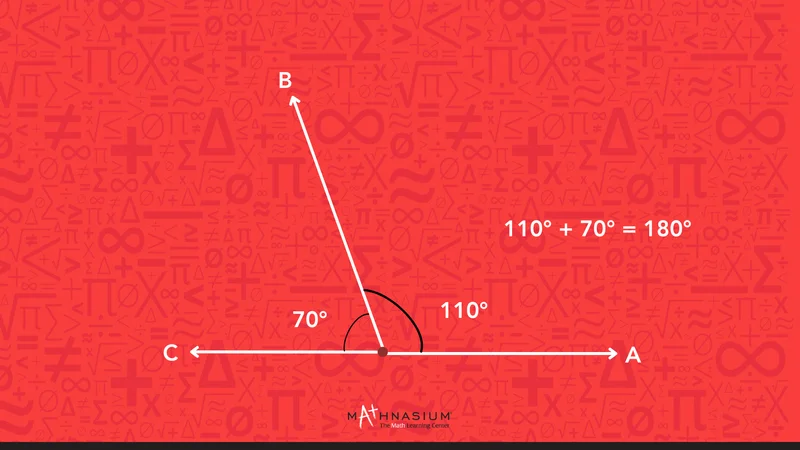
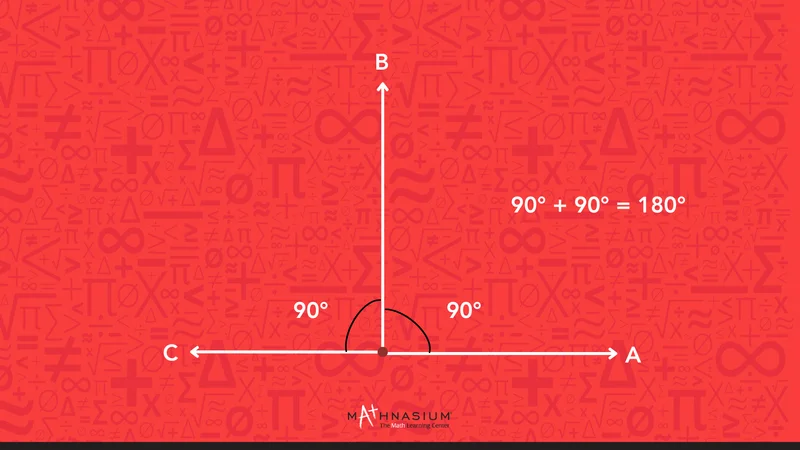
One angle is always acute (less than 90°), and the other is obtuse (greater than 90° but less than 180°). The only exception is when we have two right angles (90° each), which also sum to 180°.
📕 You May Also Like: Types of Angles: Acute, Right, Obtuse & Straight Explained
Supplementary vs. Complementary Angles
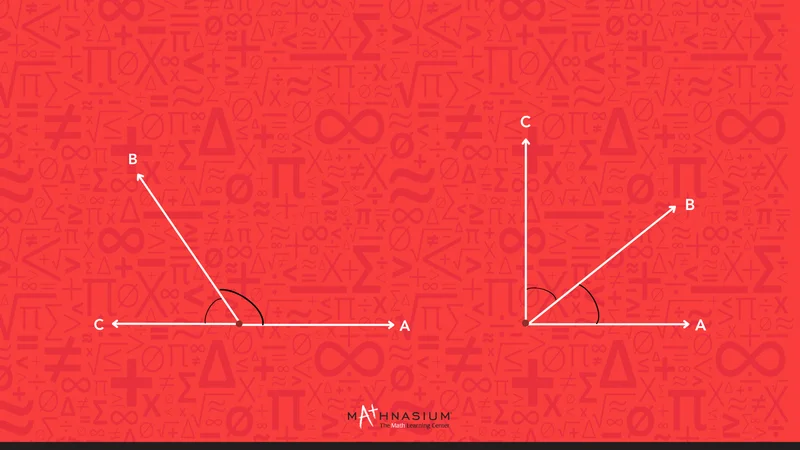
Complementary angles add up to 90° and form a right angle, which looks like the corner of a square. A quick way to remember it is by the letter "C" for ‘’corner’’.
On the other hand, supplementary angles add up to 180°, just like a straight line. We can memorize "S" for ‘’straight lines’’.
📕 You May Also Like: Complementary and Supplementary Angles - A Complete Guide
Types of Supplementary Angles
Supplementary angles can be classified into different types based on their placement or how they interact with each other.
There are two types of these angles:
1. Adjacent Supplementary Angles
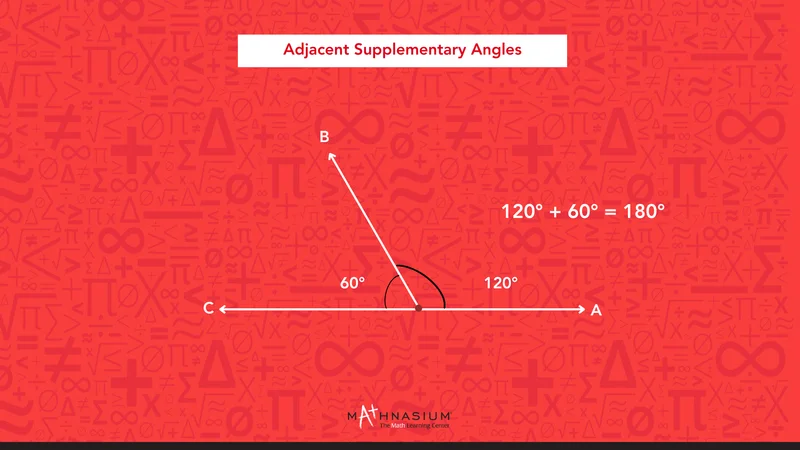
Adjacent supplementary angles are two angles that share a vertex and a common side. These angles sit next to each other and together form a straight line (180°). This is what we call a linear pair.
📕 You May Also Like: What Is Adjacent in Math? A Guide for Parents & Students
2. Non-adjacent Supplementary Angles
Non-adjacent supplementary angles do not share a common vertex or side, unlike adjacent supplementary angles. They can be located anywhere, on different lines, within different shapes, or even on separate diagrams.
The only requirement is that their sum must equal 180°.
Let's look at an example of two triangles. One triangle has an angle measuring 110°. In a completely different triangle, there's an angle measuring 70°.
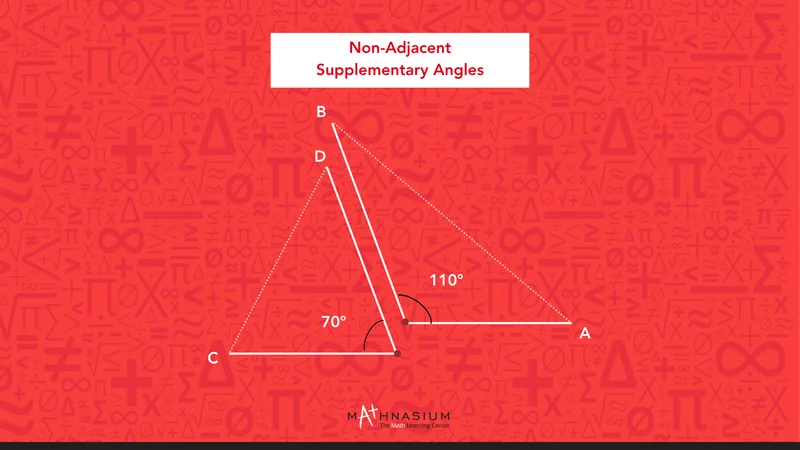
Even though these angles are not connected, they are still supplementary because110° + 70° = 180°.
Solved Examples of Supplementary Angles
Let’s go through a few solved examples of supplementary angles together.
Example 1: Finding the Supplementary Angle
If one angle measures 75°, what is its supplementary angle?
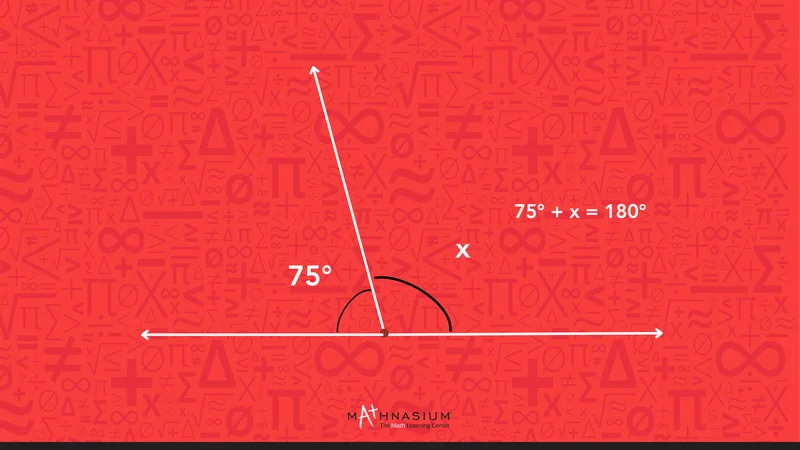
If we know that supplementary angles are two angles that equal 180° together, to find a missing angle, we just need to subtract the known measure from the total.
180° - 75° = 105°
So, the supplementary angle of 75° is 105°.
Example 2: Finding an Unknown Angle in a Linear Pair
Two adjacent supplementary angles are in a ratio of 2:3. What are their measures?
Let's write that mathematically: one angle is 2x, the other is 3x, and together they equal 180°.
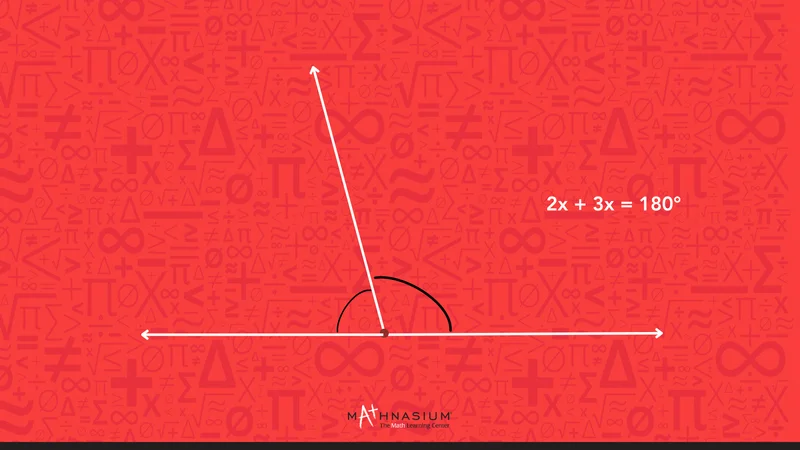
2x + 3x = 180°
5x = 180°
x = 180° ÷ 5
x = 36°
We found the x, so now let’s calculate our angles:
2x = 2 × 36° = 72°
3x = 3 × 36° = 108°
Our two angles measure 72° and 108°.
Quiz: Check Your Knowledge of Supplementary Angles
Ready to practice what we’ve covered? Give these challenges a try on your own and check your answers at the bottom of the guide.
-
If one angle is 130°, what is its supplementary angle?
-
Two angles are supplementary. If one is three times the other, find the angles.
-
Two adjacent angles form a straight line. If one is 85°, what is the other?
-
A triangle has one angle measuring 40°. Can you find an angle outside the triangle that makes a supplementary pair with it?
-
Two supplementary angles are equal. How much does each angle measure?
-
An angle measures (2x + 10)°. Its supplement measures (3x + 20)°. What is x, and what are the two angles?
-
A straight angle is split into two parts. The first measures 129°. What is the second one?
Frequently Asked Questions About Supplementary Angles
We put together answers to some of the questions we hear most often from students learning about supplementary angles.
1. Can three angles be supplementary?
No. Supplementary angles involve only two angles. If more angles are involved, their sum might still be 180°, but we would not classify them as supplementary angles.
2. Are all linear pairs supplementary?
Yes! A linear pair is a pair of adjacent angles that form a straight line, which always means they add up to 180°.
This applies to every possible combination, whether the angles are 90°/90°, 30°/150°, or 1°/179°. The rule holds without exception.
3. Are vertical angles always supplementary?
No. Vertical angles are equal in measure. However, they are not necessarily supplementary. For example, if two vertical angles each measure 45°, their sum is 90°, not 180°.
4. Can a reflex angle be part of a pair of supplementary angles?
No. A reflex angle is greater than 180°, so there is no second angle that can make their sum exactly 180°.
5. Do supplementary angles have to be whole numbers?
No. Supplementary angles can be any two values that add up to 180°, including decimals. For example, 90.5° and 89.5° are supplementary, as are 45.25° and 134.75°.

Mathnasium's specially trained tutors help students work through supplementary angles in a caring and fun group environment.
How Mathnasium Helps Students Master Supplementary Angles (and Any Math Concept)
Mathnasium is the only math-only learning center helping K-12 students of all skill levels learn and master any math topic, including supplementary angles.
For us, mastery goes beyond getting the right answer. Mastery means understanding why the answer is correct well enough to apply the same reasoning to a problem they have never seen before.
To help students reach that level of understanding, we use the Mathnasium Method™, a proprietary teaching approach. Unlike a one-size-fits-all curriculum, our approach is designed around each student's individual needs and learning style.
Each student begins with a diagnostic assessment that reveals their strengths and knowledge gaps. Those insights inform a personalized learning plan tailored to their goals.
With the plan in place, our tutors deliver face-to-face instruction in a warm and supportive setting.
To make math make sense, we use natural language and a combination of verbal, visual, mental, tactile, and written techniques.
We break each concept down into manageable steps, showing them both the how and the why behind the answer. This helps them develop the problem-solving tools and critical thinking they can use in math and beyond.
Fun is a core part of how we work. Our activities are often game-based, students earn rewards, and every bit of their progress is celebrated. This keeps them truly engaged and their confidence growing with every session.
And the results speak for themselves:
-
94% of parents report an improvement in their child's math skills and understanding
-
93% of parents report their child's improved attitude toward math after attending Mathnasium
-
90% of students saw an improvement in their school grades
Mathnasium operates over 1,100 learning centers, bringing top-rated math instruction close to you.
For families in or near Frisco, TX, Mathnasium of Frisco East is a trusted local center with years of experience transforming how each student thinks and feels about math. With over 100 stellar Google reviews and multiple Reader’s Choice Awards from Living Magazine, our center has been recognized for:
If your child is looking to catch up, keep up, or get ahead in math, our team is happy to help.
📅 Schedule a Free Diagnostic Assessment at Mathnasium of Frisco East
Not near Frisco?
📍 Find a Mathnasium Learning Center Near You
Pssst! Check Your Answers Here
If you worked through the practice problems, here are the answers:
1. 180° - 130° = 50°
2. The angles are x and 3x
x + 3x = 180°
4x = 180°
x = 180° ÷ 4
x = 45°
One angle is 45 degrees. The other angle is 3x or 345°=135°
3. 180° - 85° = 95°
4. The angle outside the triangle would be 140° (since 40° + 140° = 180°)
5. Two equal angles add up to 180°.
x + x = 180°
2x = 180°
x = 90°
Each angle is 90°
6. (2x + 10) + (3x + 20) = 180° → 5x + 30 = 180° → 5x = 150° → x = 30°
Our angles are 70° (230+10) and 110° (330+20)
7. 129° + x = 180° → x = 51°
How did you do?


 (972) 292-9886
 (972) 292-9886