What Is Prime Factorization? Explain It to a 10-Year-Old
Jan 30, 2025
| Queen Creek
Prime factorization is like discovering the secret ingredients that create a number. It helps us break it apart and see which smaller numbers are inside.
Let’s have a look!
Today, Mathnasium tutors will guide you through what prime factorization is, how to do it using three different methods, and where it shows up in real math problems with solved examples, practice problems, and answers to our students’ FAQs.
Quick Facts: Prime Factorization
What is prime factorization? The process of breaking a number down into the prime numbers that multiply together to build it.
What are prime factors? The prime numbers that multiply together to make a given number. For example, the prime factors of 12 are 2 × 2 × 3.
How do you find the prime factorization of a number? There are three methods: the Factor Tree Method, the Division Method, and Exponentiation.
Can every number be prime factorized? Yes. Every whole number greater than 1 has a unique prime factorization.
Does it matter which method you use? No. All three methods lead to the same answer.
Where does prime factorization show up in math? Finding the Greatest Common Factor (GCF), finding the Least Common Multiple (LCM), and simplifying fractions.
What Is Prime Factorization?
Prime factorization is the process of breaking a number down into its smallest building blocks: prime numbers. These are the numbers that multiply together to create our original number.
To understand how it works, let’s refresh on two terms first:
A prime number has exactly two factors: 1 and itself. Numbers like 2, 3, 5, 7, and 11 are prime because nothing divides them evenly except 1 and themselves.
Number 2 is the smallest prime number and, surprisingly, the only even one. Every other even number is divisible by 2, so none of them qualify.
Think of prime numbers as the atoms of math, as we can't break them down any further.
2. Prime Factors
Prime factors are the prime numbers that multiply together to build a given number. For example, the prime factors of 12 are 2 × 2 × 3, and the prime factors of 18 are 2 × 3 × 3.
A factor, more broadly, is any number that divides another evenly without leaving a remainder. For example, 12 has six factors: 1, 2, 3, 4, 6, and 12.
How to Do Prime Factorization? (with Solved Examples)
There are a few ways in which we do prime factorization. Let’s go through each method and see how it works step by step.
Here’s a fun video guide to prime factorization that you may want to check out.
1. Factor Tree Method
The Factor Tree Method is a fun and visual way to break a number into its prime factors.
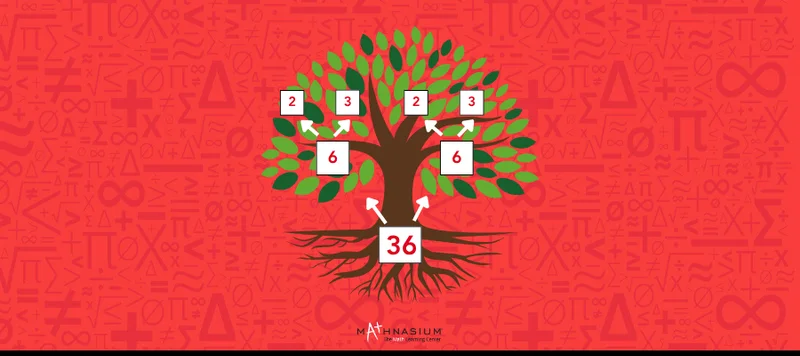
Imagine the number as the "trunk" of a tree and the factors as the "branches." We keep splitting the branches until all the "leaves" are prime numbers. It’s like growing a tree of math facts.
Here's how it looks step by step:
Start with the number you want to factorize.
Split it into any two factors.
If a factor isn't prime, split it again.
Repeat until every branch ends in a prime number.
Write the original number as a product of those primes.
Let's try it with 36.
Let’s split it into 6 and 6 (66). Neither number is prime, so we split again: 6 = 2 × 3 and 6 = 2 × 3. Now every branch ends in a prime number.
36 = 2 × 2 × 3 × 3, or 36 = 22 × 32
2. Division Method
The Division Method is a step-by-step process of dividing a number by the smallest prime numbers until we can’t divide anymore.
The steps we always follow are:
Start dividing the number by the smallest prime (2, 3, 5, etc.) that divides evenly.
Continue dividing the quotient by the smallest prime until the quotient becomes 1.
The prime factors are the divisors (prime numbers) we used.
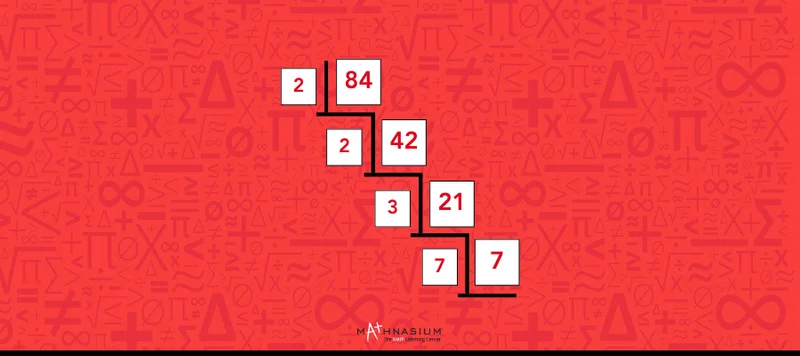
Let’s see how the Division Method works when doing the prime factorization for the number 84:
First, we divide 84 by the smallest prime factor (2):
84 ÷ 2 = 42
The quotient is 42 and not 1, so we need to divide it further by the smallest prime factors available until we reach 1:
42 ÷ 2 = 21
We cannot divide 21 by 2, so the next prime is 3.
21 ÷ 3 = 7
Now that we have reached 7, the only prime we can use to divide is 7.
7 ÷ 7 = 1
We’ve reached 1. So, we can write 84 as the product of the prime numbers we used while dividing:
84 = 2 × 2 × 3 × 7
or
84 = 22 × 3 × 7
It’s like peeling layers off an onion, one prime at a time, until you’re left with only prime factors.
The Exponentiation Method is a way to simplify prime factorization by grouping identical prime factors and expressing them using exponents.
Instead of listing the same prime numbers multiple times, we can represent them compactly with a power.
For instance, to simplify 2 × 2, which is 2 times 2, we can just use the exponent 22:
84 = 2 × 2 × 3 × 7
84 = 22 × 3 × 7
The steps include:
Perform factorization by using a factor tree or division method.
Group identical prime factors and express them using exponents.
Let’s factorize 48.
48 = 2 × 24
2 × 24 = 2 × (2 × 12)
2 × (2 × 12) = 2 × (2 × (2 × 6))
2 × (2 × (2 × 6)) = 2 × (2 × (2 × (2 × 3)))
Now, we can group all the 2’s together. We have four 2’s, which means that 2 was multiplied by itself four times. We also need to include the 3 in the answer. Our final answer is:
48 = 24 × 3
We also have a video guide on exponents for you to check out.
To find the GCF, we should first perform prime factorization on each number. Then, we identify the prime factors common to all numbers. Finally, we multiply the common prime factors and get the GCF.
Let’s practice using prime factorization to find the GCF of 24 and 36:
First, we perform prime factorization on each number:
24 = 2 × 2 × 2 × 3 = 23 × 3
36 = 2 × 2 × 3 × 3 = 22 × 32
Now, we find the prime factors common to both 24 and 36, which will be 2, 2, and 3. In other words, they have at least two 2’s and one 3. Finally, we multiply them and get our answer
To find the LCM, we first perform prime factorization on each number. It is best to use exponentiation to make things easier.
This is where exponentiation comes in handy. We then list all the prime factors by using the highest power of each prime. Lastly, we should multiply these prime factors to get our LCM.
Let’s find the LCM of 24 and 36:
First, we perform prime factorization on each number:
24 = 2 × 2 × 2 × 3 = 23 × 3
36 = 2 × 2 × 3 × 3 = 22 × 32
Then, we take the highest power of each prime (23 and 32) and multiply:
Your Turn! Check Your Knowledge of Prime Factorization
Ready to practice what we’ve covered? Find the prime factorization for these five numbers on your own and check your answers at the bottom of the guide.
45
38
126
250
60
72
100
Frequently Asked Questions About Prime Factorization
Here are some of the questions we often hear from our students while finding factors, with their answers to clear out any confusion.
1. Why is 1 not a prime number?
For a number to be prime, it needs exactly two factors: 1 and itself. Since 1 only has one factor (itself), it doesn't qualify.
2. Does it matter which two factors I start with in the factor tree?
No. We can start with any two factors and still get the same prime factorization at the end. Try splitting 12 into 2 × 6 or 3 × 4. Both paths lead to 2 × 2 × 3.
3. Can a number have more than one prime factorization?
No. Every number has exactly one prime factorization. No matter which method we use or where we start, we always end up with the same set of prime factors.
4. What's the difference between the factor tree and the division method?
Both methods get us to the same answer. The factor tree shows the process visually through branching, while the division method works through it step by step. Try both and see which one feels more natural to you.
5. Can every number be prime factorized?
Yes. Every whole number greater than 1 can be broken down into prime factors. Some numbers, like 7 or 13, are already prime, so their prime factorization is just themselves.
Mathnasium's specially trained tutors guide students through the prime factorization process in a supportive, engaging environment.
How Mathnasium Helps Students Master Prime Factorization (And Any Math Concept)
Mathnasium is the only math-only learning center helping K-12 students of all skill levels learn and master any math concept, prime factorization included.
To help students build a deep understanding of any math concept or skill, we don’t rely on a one-size-fits-all curriculum but on our proprietary teaching approach, the Mathnasium Method™.
Each student starts with a diagnostic assessment that helps us identify their current skills, knowledge gaps, and learning goals. From there, we build a personalized learning plan tailored to their needs and pace.
Our specially trained tutors use natural language to phrase concepts and a combination of verbal, visual, mental, tactile, and written techniques to help students understand the math they are working with.
If students get stuck on a concept like factors, we break it down into manageable steps and teach both the how and the why behind it. Students gradually learn to do the same independently, walking out of our centers with the problem-solving skills and critical thinking tools they can use in math and beyond.
Fun is an important part of how we work. Sessions often include game-based and hands-on activities that keep students engaged and learning enjoyable. Students earn rewards along the way, and every bit of progress gets celebrated, so confidence grows alongside mastery.
The results speak for themselves:
94% of parents report an improvement in their child's math skills and understanding
93% of parents report their child's improved attitude toward math
90% of students saw an improvement in their school grades
With over 1,100 learning centers, Mathnasium brings top-rated math instruction close to your community.
If you’re in or near Queen Creek, AZ,Mathnasium of Queen Creek is a trusted local center with years of experience helping students become confident math thinkers.
Our commitment to student success is reflected in the support of our community, with more than 200 five-star Google reviews from local families.
Here’s what one parent had to say about their experience with Mathnasium of Queen Creek.
Whether your child needs to catch up, keep up, or get ahead in math, we are happy to help.
If you worked through the practice problems, here are the answers:
45 = 3 × 3 × 5 = 32 × 5
38 = 2 × 19
126 = 2 × 3 × 3 × 7 = 2 × 32 × 7
250 = 2 × 5 × 5 × 5 = 2 × 53
60 = 2 × 2 × 3 × 5 = 22 × 3 × 5
72 = 2 × 2 × 2 × 3 × 3 = 23 × 32
100 = 2 × 2 × 5 × 5 = 22 × 52
How did you do?
Visit Us at Mathnasium of Queen Creek
Mathnasium of Queen Creek is a math-only learning center for K-12 students in Queen Creek,
AZ. Trusted by over a million parents, Mathnasium uses personalized learning plans
and the proprietary Mathnasium Method™ to help students catch up, keep up, and get ahead on their math journey.
Our specially trained tutors deliver face-to-face instruction in a supportive and fun small-group environment,
working with students both in center and online to develop a deep understanding of math, build confidence,
and improve academic performance.


 (480) 279-3122
 (480) 279-3122