At Mathnasium, one of the ways we help math make sense is by showing how it connects to real life. When students see how multiplication helps plan a road trip or how fractions show up in baking, there’s often an “aha” moment.
But one connection that surprises students most? Music.
Still, math shows up in the background of every song we hear, hidden in the rhythms, patterns, and structure that make music work. To shed more light on this connection, our tutors unpack 6 surprising but proven parallels between math and music.
1. Rhythm Is Fractions in Action
If you’ve ever clapped along to a beat or tapped your foot during a song, you’ve actually used a math concept in real life: fractions.
In music, every note has a time value. A whole note fills an entire measure. A half note takes up half that time (\(\Large\frac{1}{2}\)). Quarter notes (\(\Large\frac{1}{4}\)), eighth notes (\(\Large\frac{1}{8}\)), and sixteenth notes (\(\Large\frac{1}{16}\)) split the beat into even smaller pieces. It’s the same idea you learn in math class when breaking things into halves, fourths, or eighths.
Time signatures follow that same logic. For example, \(\Large\frac{4}{4}\) time means each measure contains four beats, and each of those beats is the length of a quarter note (\(\Large\frac{1}{4}\)). That’s four one-fourth notes, which add up to a whole, just like fractions in math class.
Some musicians practice this by clapping different note lengths, like once per beat for quarter notes and twice per beat for eighth notes (\(\Large\frac{1}{8}\)). Think of this as an easy way to hear and feel how fractions work.
2. Octaves Work Through Doubling
Even if you’ve never heard the word “octave,” you’ve definitely heard the sound. It’s when a note repeats, same name, same feel, but sounds higher or lower than the one before.
Here’s why: when you go up one octave, the pitch of the note doubles in frequency. For example, the note A on a piano vibrates at 440 hertz. The next A up, one octave higher, vibrates at 880 hertz. Double again, and you’re at 1760. The pattern keeps going.
Pianos and other instruments are built around this doubling. Each time you move up an octave, the notes repeat in a new range, and that’s what gives music its sense of structure and space.
In math, this doubling follows powers of 2, just like you learn in Prealgebra: 2, 4, 8, 16, 32, and so on.
Seeing this pattern in music helps students connect abstract math ideas to something they can hear.
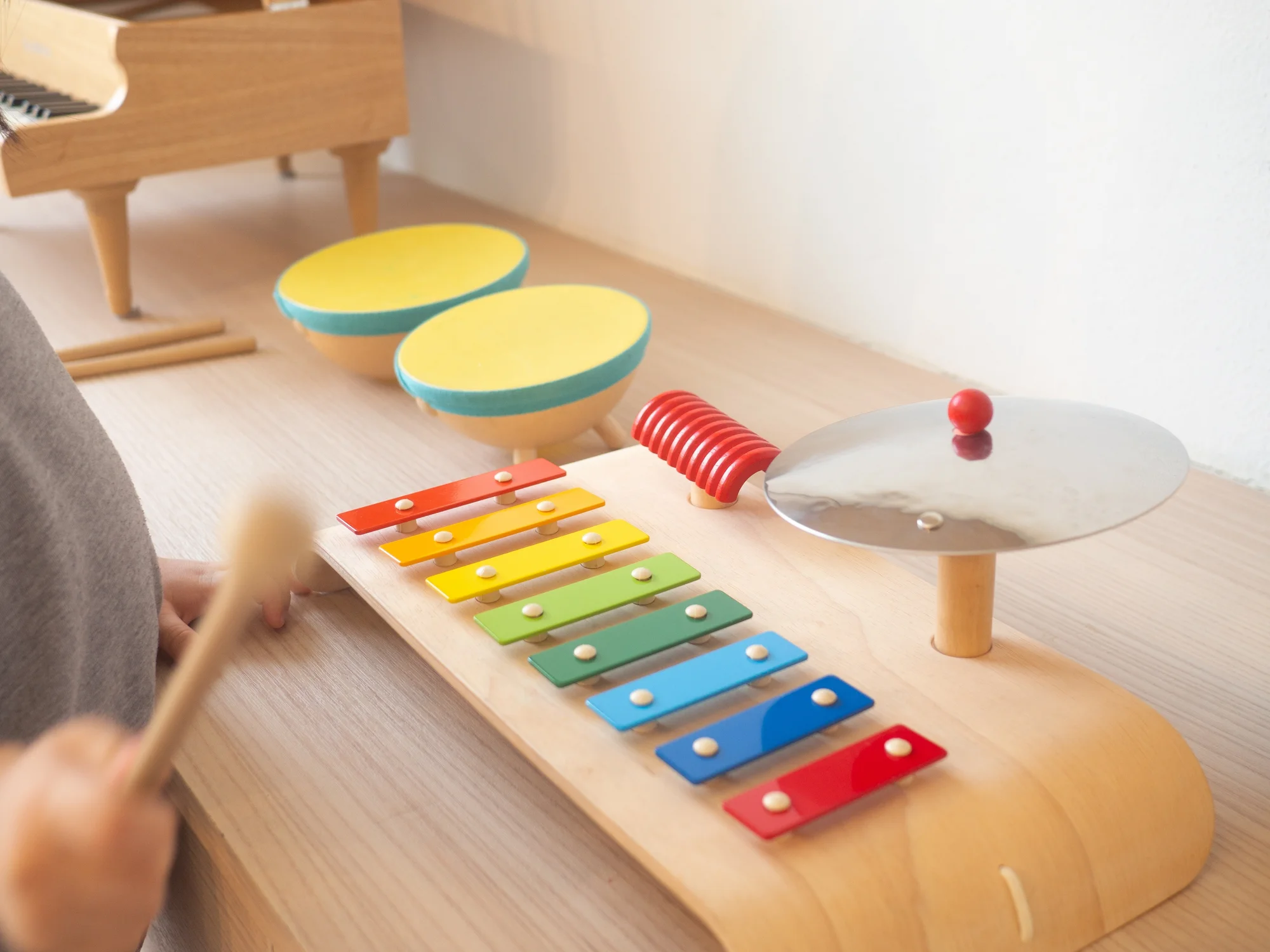
Each colored bar holds a beat. Playing them in rhythm helps kids feel how fractions divide time.
3. Harmonies Are Simple Ratios
Why do some notes sound great together while others clash? The answer is – you guessed it! – in math.
Long ago, the philosopher Pythagoras discovered that when two notes sound good together, their frequencies form a simple ratio. A 3:2 ratio creates what musicians call a perfect fifth. A 4:3 ratio forms a perfect fourth.
They may sound like musical terms, but they’re really describing ratios, pure math at work.
Let’s take the guitar as an example. When you press a string at the 12th fret (the halfway point on the string), you cut its length in half. That gives you a 2:1 ratio, which is exactly one octave higher than the open string.
The math behind it is simple, but the sound is something we all recognize.
The same ratios show up everywhere, from pianos and violins to brass instruments and voices. Musicians rely on these ratios when building chords or arranging notes, so that the sound feels balanced and full.
Amazing, right?
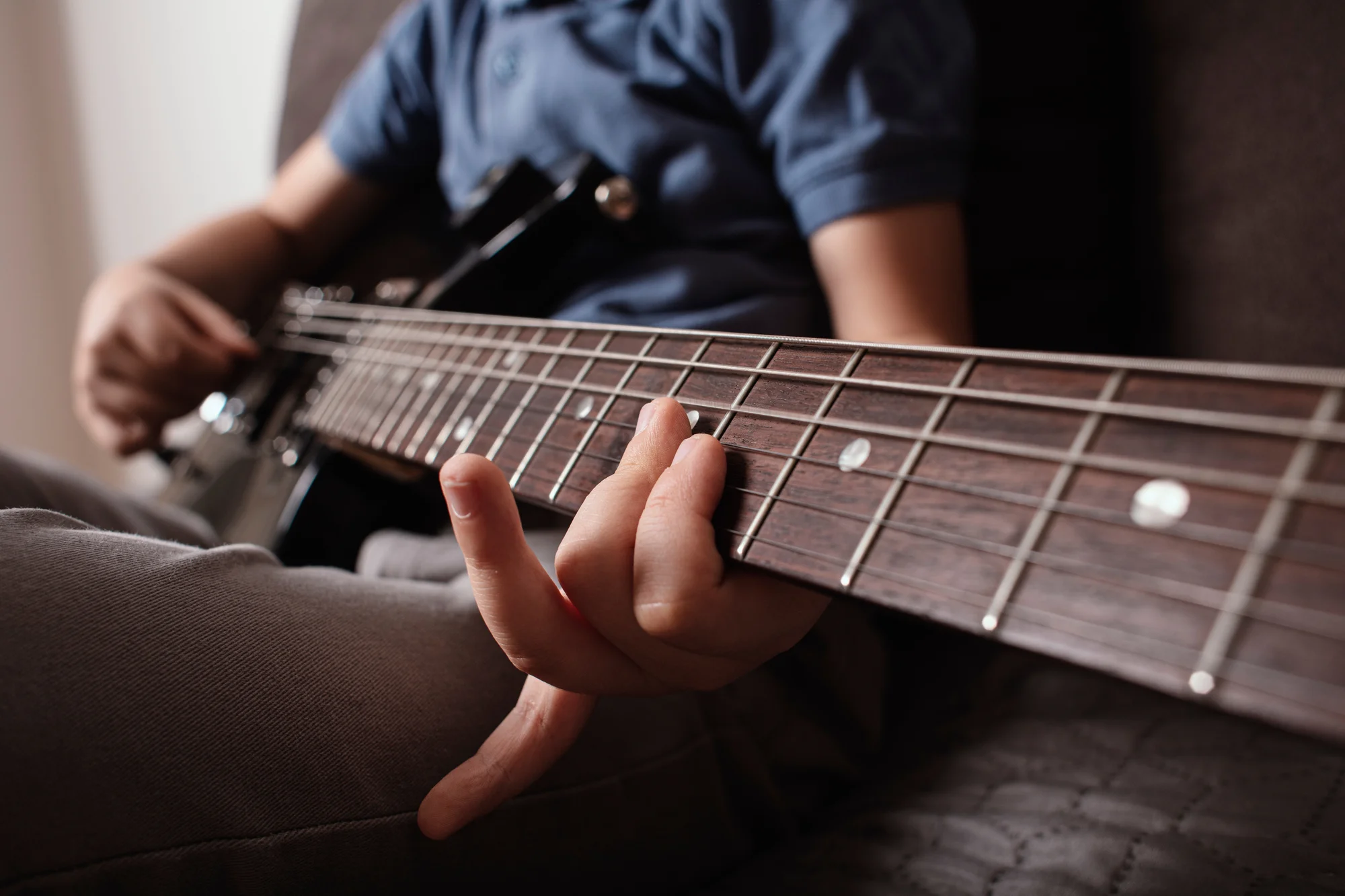
Pressing at the 12th fret cuts the string length in half, doubling the frequency and jumping up an octave.
4. Song Structure Uses Repeating Patterns
Listen closely to almost any song, and you’ll start to notice something: the same parts come back again and again. Verses, choruses, even a familiar hook, they follow a structure that gives the song its shape.
That structure often follows a pattern like ABABCB. The verses (A) introduce new lyrics, the chorus (B) repeats the main idea, and the bridge (C) breaks the pattern just before returning to the chorus. It’s like solving a math problem that follows a rule, until one step changes direction.
Then there are rounds and canons, or songs where different voices layer the same melody at different times. Think of “Row, Row, Row Your Boat.” Each part follows the same line, but staggered. It’s timing, sequencing, and symmetry all working together.
Students build similar skills in math when they analyze number sequences, solve logic problems, or spot rules in geometric designs. By helping them recognize those same patterns in music, we give them a different way to exercise that kind of thinking, one that’s creative and grounded in what they already enjoy.
5. Tempo and BPM Are Rate Problems
Each song moves at a certain speed. Musicians call this the tempo, and it’s measured in beats per minute, or BPM. Whenever we tap our foot along to a fast song, we’re feeling that number in action.
Think of BPM like any other rate: miles per hour, words per minute, steps per day. It’s just one quantity measured over time.
Let’s say a song is set at 120 BPM and has 240 beats. How long is it? That’s a rate problem, and the answer is two minutes.
And just like a car speeding up or slowing down, songs can change tempo too. Musicians often shift the speed for dramatic effect. When they do, they’re working with the same kind of math students use to solve changing-rate problems in class.
Want to make it even more interesting?
Some styles of music stack rhythms on top of each other, like three beats played against four. That’s called a polyrhythm, and the math behind it? Finding when both patterns meet, using least common multiples.
6. Musicians Do Mental Math, One Measure at a Time
When musicians read a piece of music, they’re doing quick math without solving anything on paper.
Each measure gives them a set amount of time to fill, almost like a budget. In \(\Large\frac{4}{4}\) time, they get four beats to work with. A quarter note takes up one beat. An eighth note takes half. The combinations have to line up just right to complete the measure.
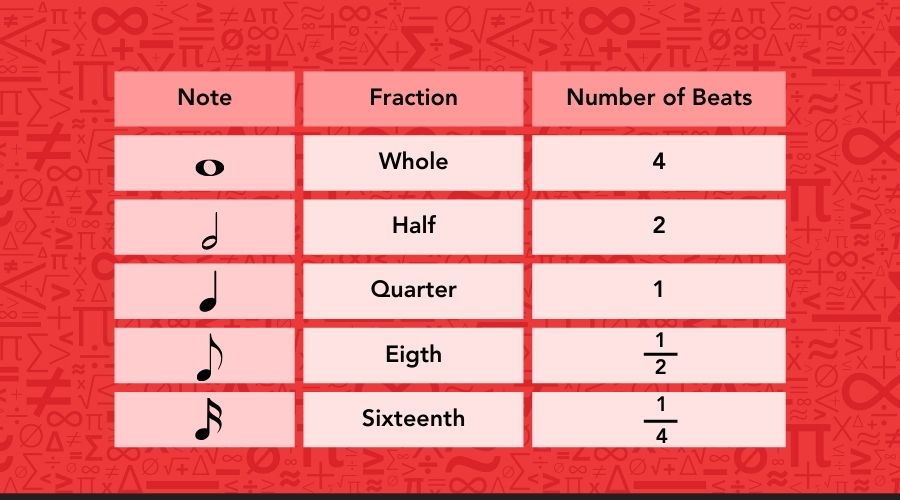
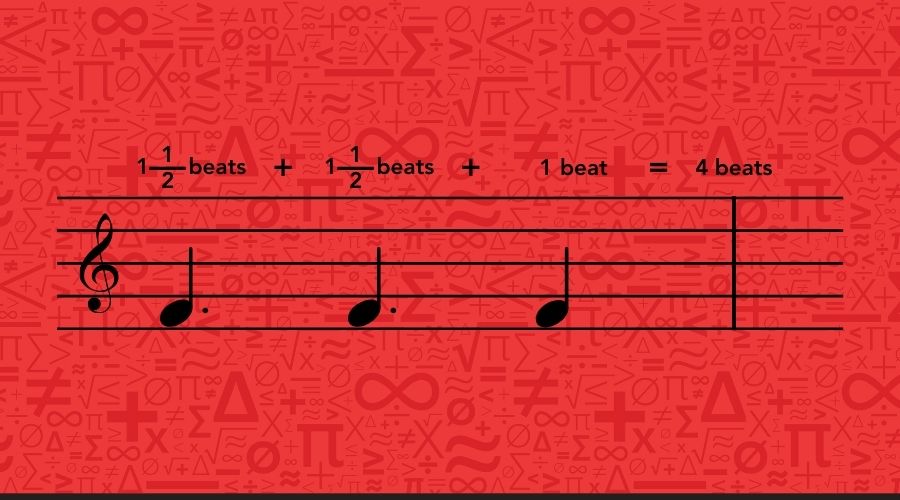
Now picture a dotted quarter note. The dot adds half the note’s value so it lasts for 1\(\Large\frac{1}{2}\) beats. If you play two of those back to back, you’ve spent three beats. Add a quarter note, and the measure is complete.
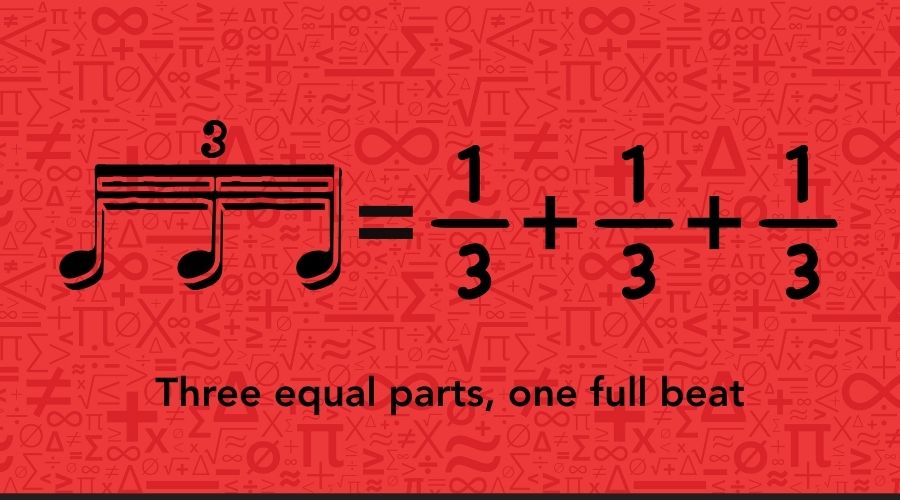
Then come triplets, which squeeze three notes into the space of one beat. That’s one beat divided into thirds:
\(\Large\frac{1}{3}\) + \(\Large\frac{1}{3}\) + \(\Large\frac{1}{3}\) = 1.
And just to keep things interesting, composers often change time signatures mid-song. A piece might start in \(\Large\frac{4}{4}\) (four quarter-note beats per measure), then shift to \(\Large\frac{6}{8}\) (six eighth-note beats per measure). The beat feels different, and the math behind it changes, too.
Musicians constantly adapt. They divide, multiply, adjust for timing, and balance values, all while keeping the music flowing.
It’s mental math in motion.
📕You May Also Like: 5 Ways Mental Math Supports Long-Term Math Success

At Mathnasium, we help students become curious thinkers: connecting math to life, not just the classroom.
How Mathnasium Builds Curious Math Thinkers
When students come to Mathnasium for math support, we aim not only to help them reach their academic goals, but to build curious math thinkers. This goes beyond processes, steps, and formulas to show them how math really works and how it applies to everyday life. That includes music too.
So, how do we do that?
Our proprietary teaching approach, the Mathnasium Method™, is designed for exactly that.
Our approach starts with a diagnostic assessment. This low-pressure, interactive dialogue helps us pinpoint each student’s unique strengths, areas for improvement, and learning preferences.
With these insights, we design a learning plan customized to their needs. Once the plan is in place, our tutors provide face-to-face instruction in a supportive and fun setting, guided by that plan.
During sessions, we use a mix of verbal, visual, mental, tactile, and written techniques to show math from different angles. We don’t aim to simply get through a math task, we help students understand the how and why behind each concept. This often includes real-world analogies, such as music, budgeting, or even planning a trip.
Working with our instructors, students not only fill in knowledge gaps but also develop the critical thinking tools and problem-solving skills they can use in math and beyond.
Our approach brings measurable results:
-
94% of parents report an improvement in their child's math skills and understanding
-
93% of parents report an improved attitude towards math after attending Mathnasium
-
90% of students saw an improvement in their school grades
If your child is looking to catch up, keep up, or get ahead in math, your local Mathnasium Learning Center is here to help. We’ll schedule a diagnostic assessment and, from there, work our way not just toward math mastery but toward changing how they think and feel about math.


 (424) 383-6284