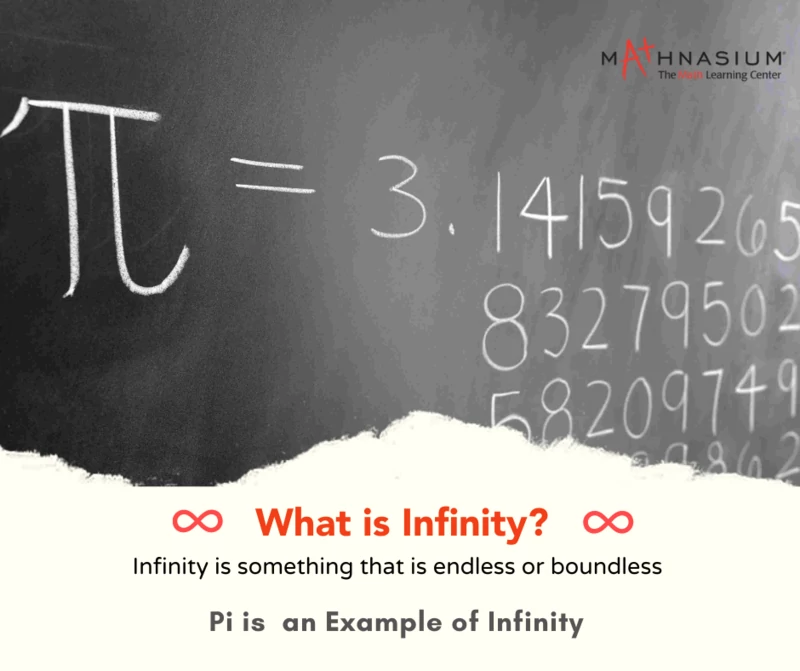












An indefinitely large number or quantity. Unbounded. A number larger than any bounded quantity.
Infinity describes something – a number or quantity – that goes on forever. Unlike regular numbers, we can’t count to infinity or reach it by adding more.
As such, infinity is larger than any number we can name. No matter how high we count, there’s always one more number that follows, which is why we say the list of whole numbers — 0, 1, 2, 3, 4, ... — is infinite.
In geometry, a line that goes on endlessly in both directions is another example of something that has infinite length. We often use the symbol ∞ to represent infinity in equations or diagrams.
Infinity helps us:
-
Talk about sets of numbers that never end
-
Understand patterns, sequences, and limits
-
Explore ideas in algebra, geometry, and calculus
It’s important to remember that infinity isn’t a number we calculate with. Infinity is a concept that helps us describe very large or endless things in math.
When Do Students Learn About Infinity?
Students are introduced to the idea of infinity early on, even if they don’t work with it formally in calculations until later. They may talk about “big numbers” and learn that there’s no largest number.
Grades 3–5 – Introduction to Infinity
Students start to understand that numbers can keep going without end. They may learn that some sets (like whole numbers) are infinite.
Grades 6+ – Exploring Infinity in Math
Students encounter infinity in geometry (with lines and rays) and algebra (with sequences). In high school, they may see infinity in concepts like limits or asymptotes.