











What is Pi (π)?
The ratio of the circumference of a circle to its diameter
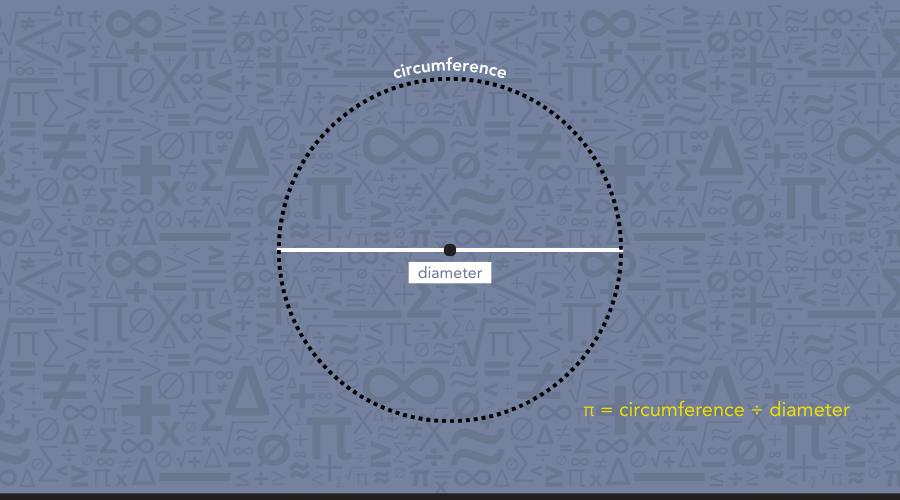
Pi (π) is a special number that tells us how the distance around a circle (its circumference) compares to the distance across the circle (its diameter). No matter the size of the circle, the ratio is always the same:
π = circumference ÷ diameter
Pi is an irrational number, which means it can’t be written as a simple fraction and its decimal goes on forever without repeating. The value of pi starts like this:
π ≈ 3.141592653...
Most of the time, we use the rounded version 3.14 to make calculations easier. Pi is used in many formulas involving circles, like finding:
- Volume of a sphere = \(\Large\frac{4}{3} π r{^3}\)
- Area of a circle: A = π × radius\({^2}\)
When Do Students Learn About Pi?
Students are introduced to the concept of pi as they begin exploring circles and their properties in upper elementary and middle school.
Grades 5–6 – Introduction to Pi
Students begin exploring circles and the relationship between circumference and diameter. They use 3.14 to approximate pi in measurements and formulas.
Grades 7+ – Working with Pi in Geometry and Algebra
Students apply pi in formulas to calculate area, surface area, and volume of circular and three-dimensional figures. They also begin working with pi more symbolically in advanced math.