











What is an Interval?
The distance from one number (or unit) to another. The space between two numbers. A measurement of the separation of two values.
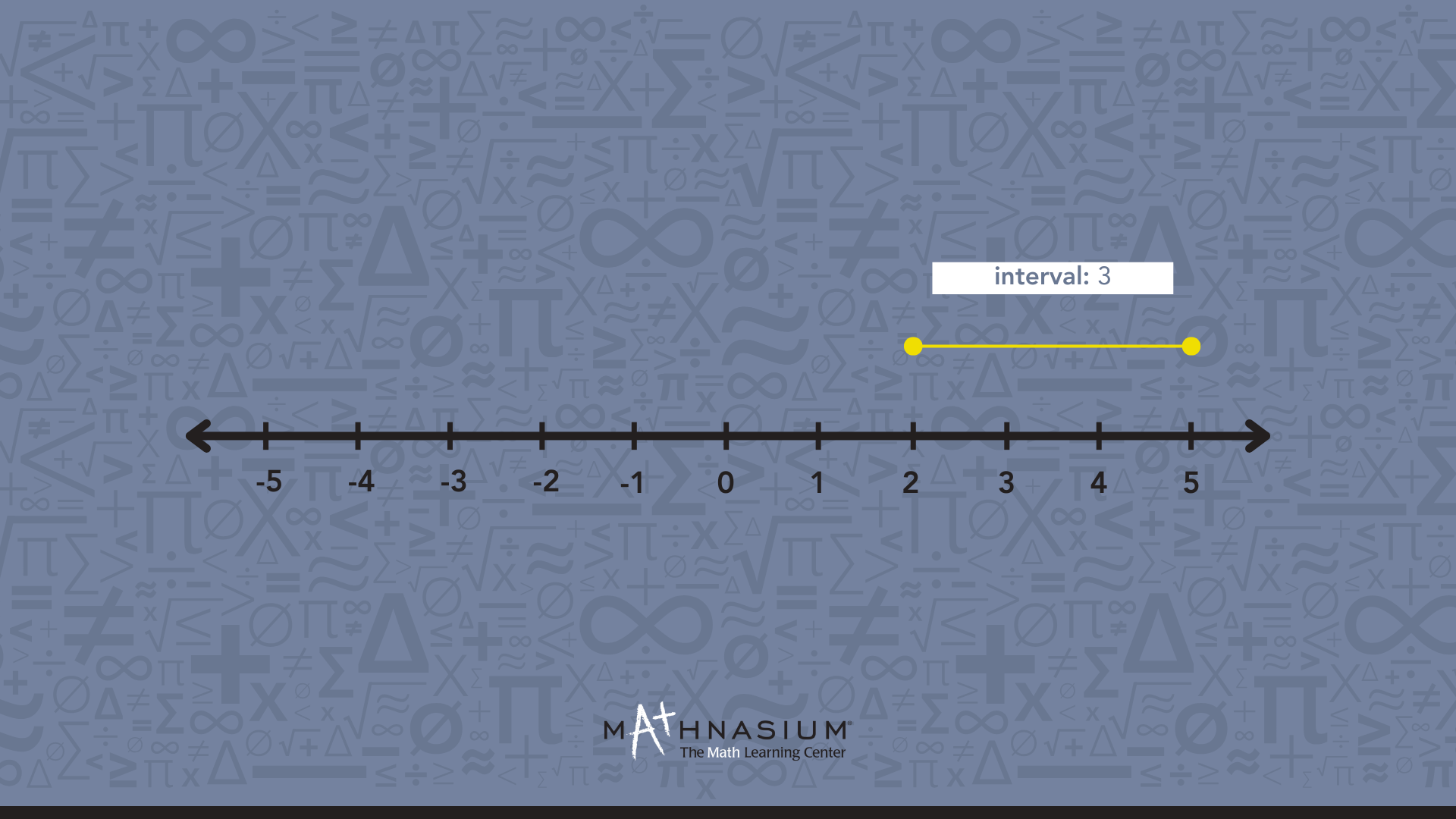
In math, an interval shows the space or distance between two numbers. It tells us how far apart two values are on a number line. For example, the interval between 2 and 5 is 3, because 5 – 2 = 3.
Intervals can be:
- Between whole numbers (like the interval between 10 and 15 is 5)
- Between decimals (like the interval between 1.2 and 3.7 is 2.5)
- Open or closed (meaning whether one or both endpoints are included)
We use intervals to:
- Read and interpret number lines and graphs
- Measure time between events
- Understand data ranges in charts or tables
- Display solutions to inequalities
When Do Students Learn About Intervals?
Students begin learning about intervals as they explore number lines and measurement in elementary school, and continue using them in data analysis and algebra.
Grades 2–3 – Exploring Number Lines and Distances
Students begin recognizing intervals as the space between numbers and use number lines to show measurement and count intervals.
Grades 4–5 – Intervals in Time and Data
Students begin working with intervals in time, line graphs, and bar graphs. They learn to calculate distances and interpret data intervals.
Grades 6+ – Intervals in Algebra and Statistics
Students use intervals to solve algebraic inequalities, interpret statistical data, and work with coordinate graphs.