







What is the Metric System?
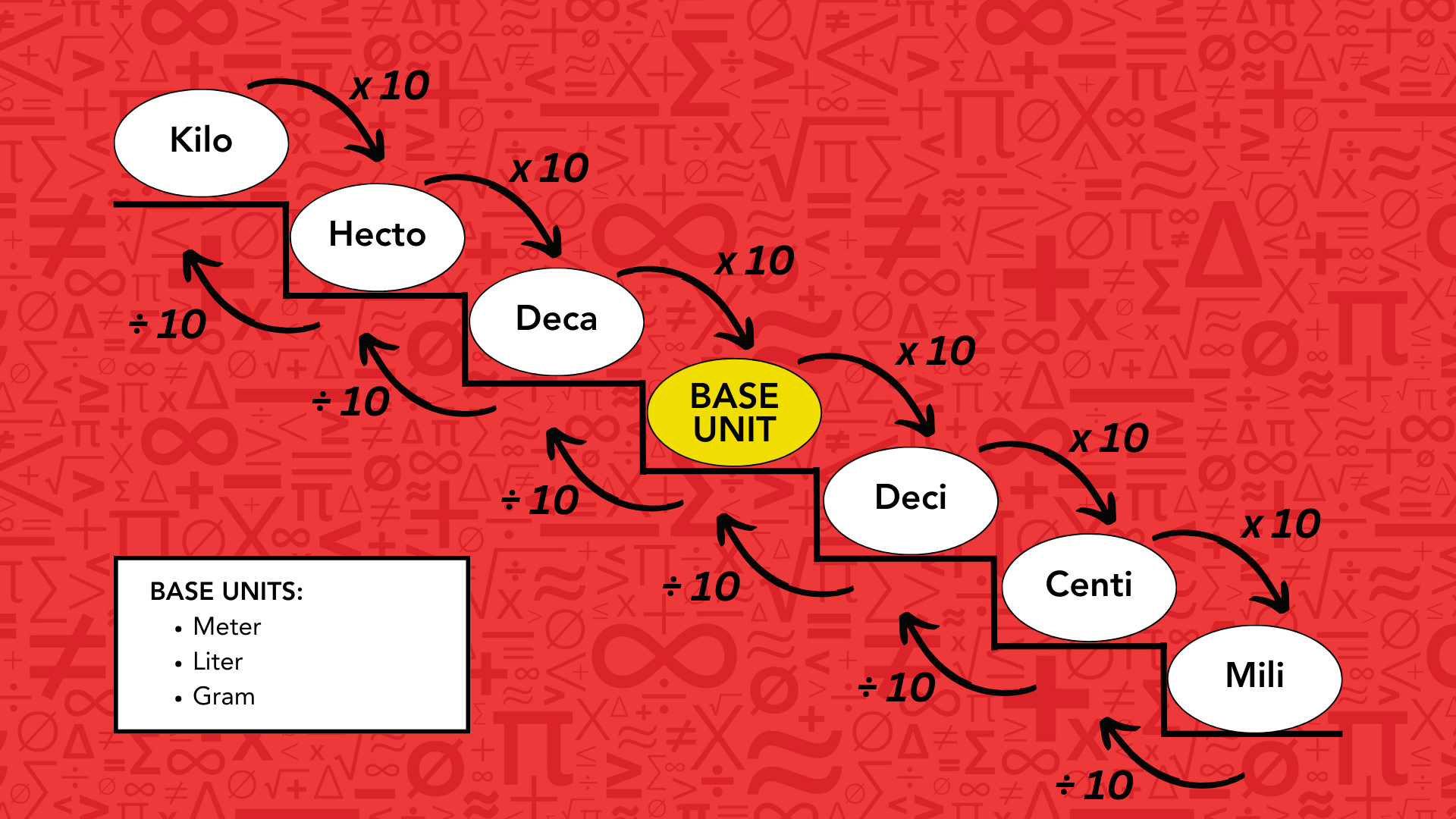
The international standard for measuring mass (weight) [grams], distance [meters], and capacity [liters]. When going from a smaller unit to a larger unit, each unit of measure is 10 times greater than the previous unit. When going from a larger unit to a smaller unit, each unit of measure is 10 times smaller than the previous unit.
The metric system is a system of measurement used by most of the world. It’s based on powers of ten, which means it's simple to convert between units, just move the decimal point!
The most common metric units are:
- Length: meter (m), kilometer (km), centimeter (cm), millimeter (mm)
- Mass (weight): gram (g), kilogram (kg), milligram (mg)
- Capacity (volume): liter (L), milliliter (mL)
For example, 1 meter = 100 centimeters, and 1 liter = 1,000 milliliters. This base-10 structure makes the metric system especially easy to use in math and science.
We use the metric system when:
- Measuring in science and math
- Comparing distances or weights
- Understanding units used internationally
When Do Students Learn About the Metric System?
Students begin learning about the metric system as part of measurement and data skills in elementary school.
Grades 2–3 – Introduction to the Metric System
Students learn basic metric units and begin measuring objects using rulers, scales, and measuring cups.
Grades 4+ – Conversions and Applications
Students convert between metric units, compare measurements, and apply metric understanding to multi-step problems.