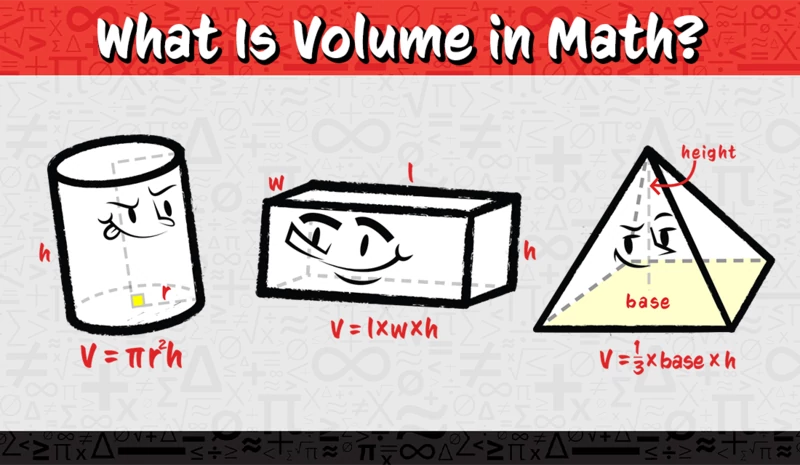












A solid bounded by polygons; a 3D object that has polygons as its faces.
A polyhedron is a three-dimensional (3D) shape made up entirely of flat polygon faces. Each face is a polygon, such as a triangle, square, or rectangle. The faces meet along straight edges, and the edges meet at points called vertices.
Examples of polyhedra include:
- A cube (6 square faces)
- A rectangular prism (6 rectangular faces)
- A pyramid (a polygon base with triangular faces meeting at a point)
Can you guess which of these shapes are polyhedra?
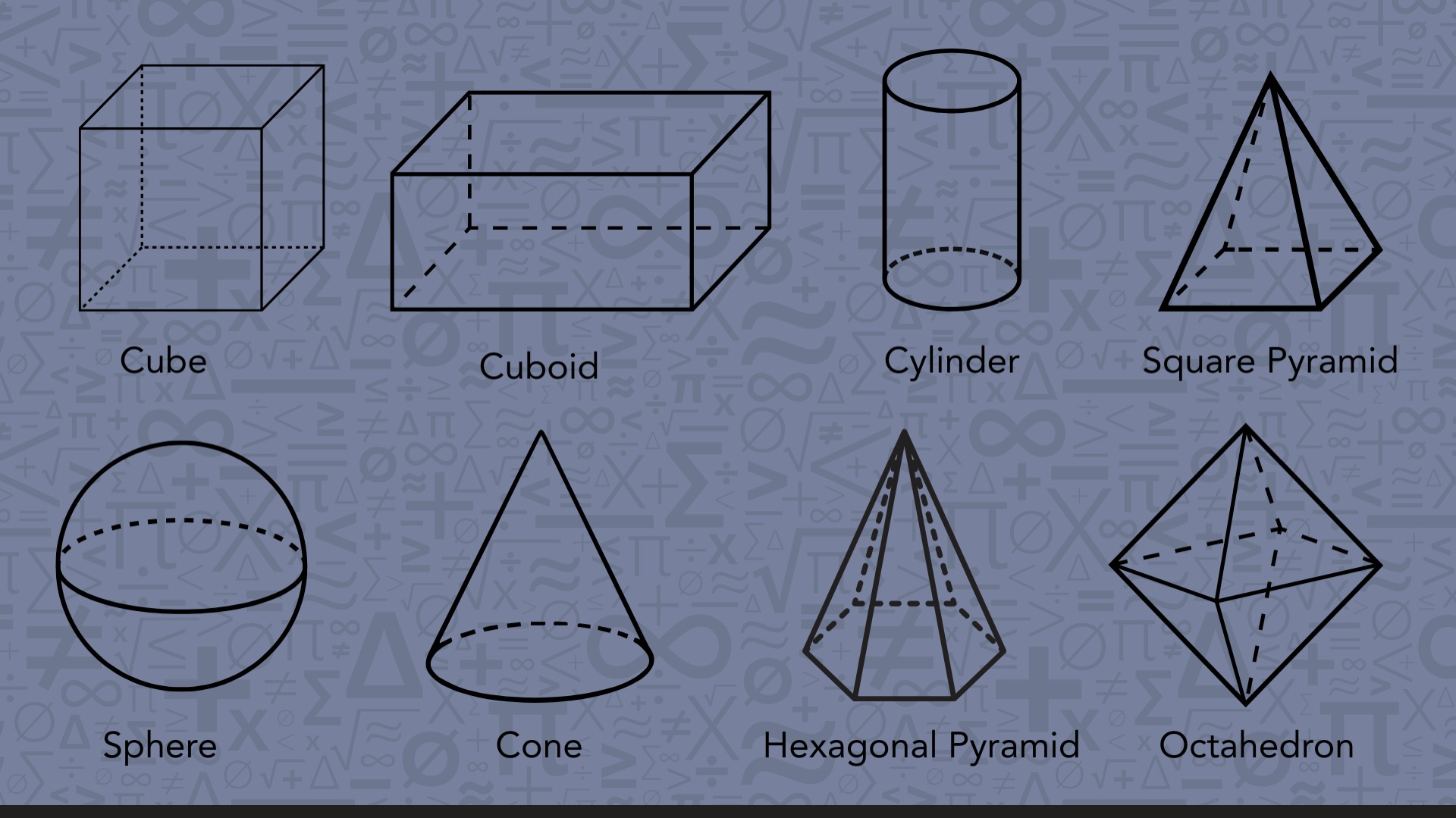
If you guessed cube, cuboid, square pyramid, hexagonal pyramid, and octahedron, you are correct!
Shapes like spheres, cones, and cylinders are not polyhedra because they
- Have curved surfaces instead of flat polygon faces, they
- Do not have straight edges
Polyhedra help us study:
- Surface area (the total area of all faces)
- Volume (how much space the shape holds)
- The relationship between faces, edges, and vertices
When Do Students Learn About Polyhedra?
Students begin exploring three-dimensional shapes in elementary school and study polyhedra more formally in later grades.
Grades 3–5 – Introduction to 3D Shapes
Students learn to identify cubes, rectangular prisms, and pyramids and describe their faces, edges, and vertices.
Grades 6+ – Working with Polyhedra in Geometry
Students classify polyhedra, calculate surface area and volume, and explore geometric relationships between faces, edges, and vertices.