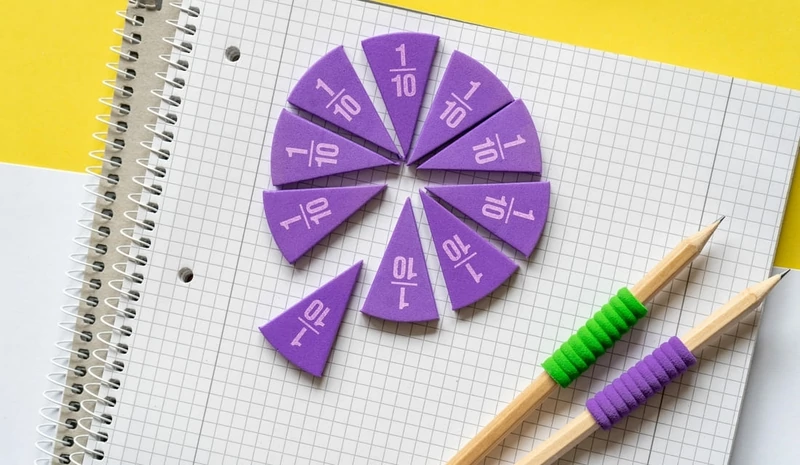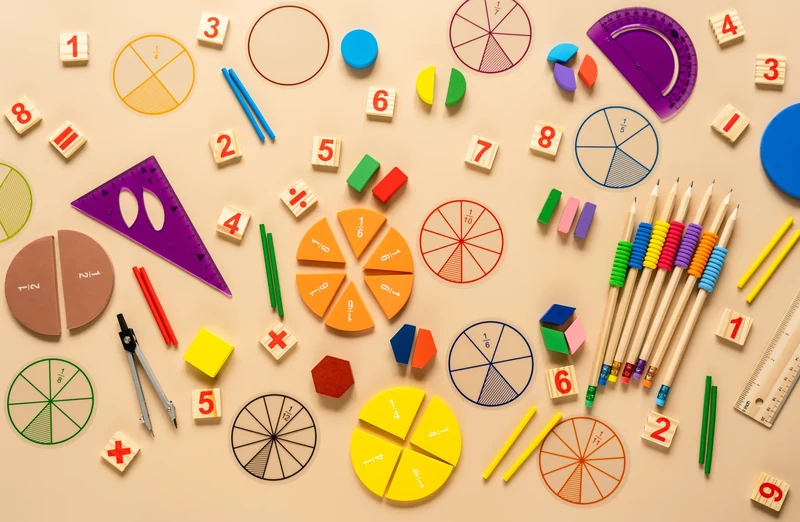










A section or quantity within a larger thing; a part of a whole.
In math, a portion is a piece of something larger. It tells us how much of a whole we are working with.
Portions can be expressed in different ways depending on the context:
-
As a fraction: one portion out of four equal parts is \(\Large\frac{1}{4}\)
-
As a decimal: 0.25
-
As a percent: 25%
For example, if a pizza is cut into 8 slices and we take 3, we have a portion of the pizza, specifically, 3 out of 8 slices, or \(\Large\frac{3}{8}\) of the whole.
"Portion" is closely related to terms like "fraction," "section," and "part." What makes it useful is that it can describe any-sized piece of a whole, whether equal or unequal, and in almost any context, from sharing food to reading graphs to solving word problems.
When Do Students Learn About Portions?
Students begin working with portions as soon as they start exploring parts of a whole.
Grades K–2 – Parts of a Whole
Students divide shapes and groups into equal parts and describe those parts using words like half and quarter. This is their first experience with portions.
Grades 3–5 – Portions as Fractions, Decimals, and Percents
Students connect portions to fractions, decimals, and percentages and work with them in word problems and real-world contexts.
Grades 6–8 – Portions in Ratios and Data
Students use portions when working with ratios, proportions, and data representations such as circle graphs.