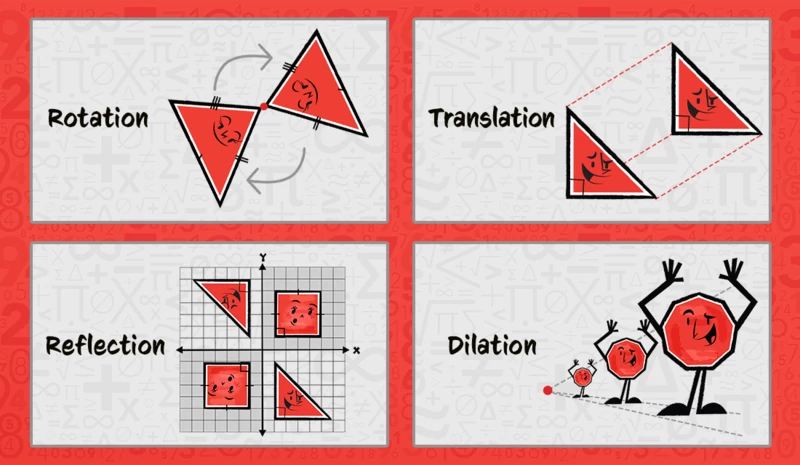












A transformation that turns a figure about a point.
In geometry, a rotation is a type of transformation that turns a shape around a fixed point. The shape doesn’t change its size or shape; it just spins or rotates to a new position.
That fixed point is called the center of rotation, and the amount of turning is measured in degrees (like 90°, 180°, or 270°). The direction of the turn can be clockwise or counterclockwise.
For example:
- Turning a triangle 90° around a point will move it to a new spot, but it will still look exactly the same, just rotated.
- A windmill's blades rotate around the center bolt—that’s rotation in action!
We see rotations in:
- Art (like rotating shapes in designs)
- Games and puzzles (like turning pieces)
- Real life (like wheels, clocks, or spinning tops)
When Do Students Learn About Rotations?
Students learn about rotations as part of exploring transformations in geometry.
Grades 4–5 – Introduction to Rotations
Students begin to recognize and describe simple rotations in shapes and figures.
Grades 6+ – Applying Rotations in Geometry
Students apply rules for rotating figures on a coordinate plane and use rotation in symmetry, angle relationships, and geometric proofs.