












A line that intersects a system of other lines, usually parallel lines.
A transversal is a line that crosses two or more other lines at different points. When it crosses parallel lines, it creates a set of angles at each intersection, and those angles have predictable, useful relationships.
For example, imagine two parallel horizontal lines, like train tracks, and a third line cutting across both at an angle. That crossing line is the transversal. At each point where it meets a track, a set of four angles is formed. Because the tracks are parallel, the matching angles on each side of the transversal are equal.
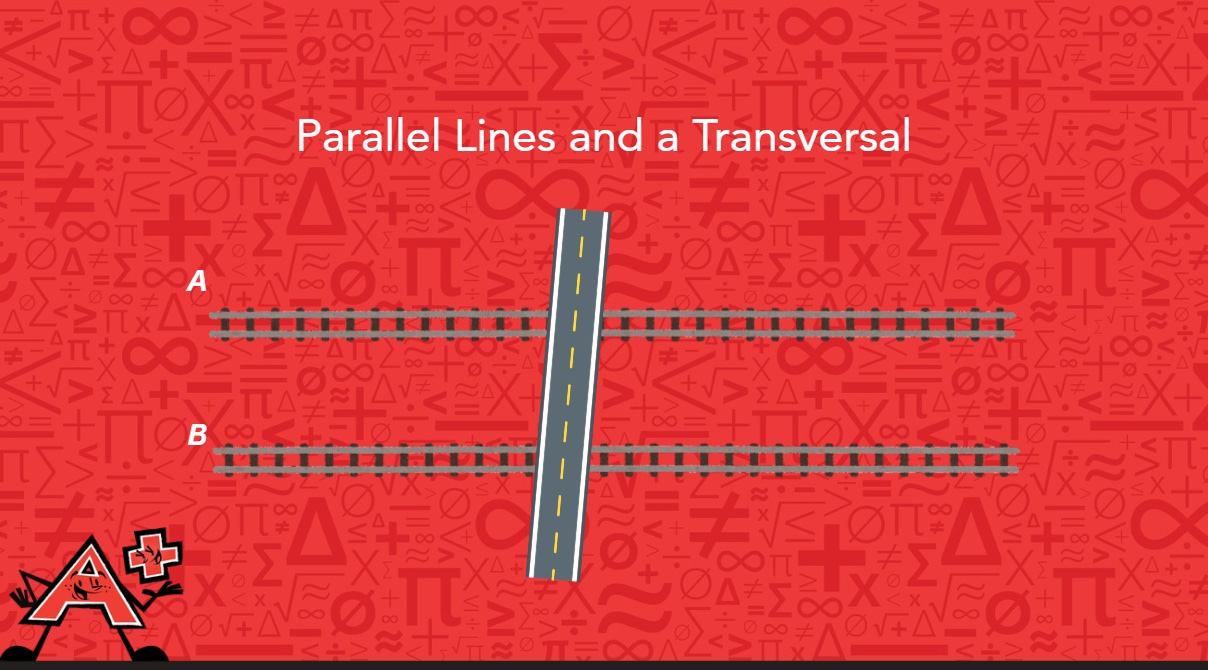
These angle pairs have specific names:
-
Corresponding angles (same position at each intersection)
-
Alternate interior angles (on opposite sides of the transversal, between the parallel lines)
-
Alternate exterior angles (on opposite sides of the transversal, outside the parallel lines)
-
Co-interior angles, also called consecutive interior angles (on the same side of the transversal, between the parallel lines)
Understanding transversals helps students solve for unknown angles and build reasoning skills in geometry.
When Do Students Learn About Transversals?
Students encounter transversals as part of their study of angles and parallel lines.
Grades 6–8 – Angles and Parallel Lines
Students are introduced to transversals and the angle relationships they create, learning to identify and calculate corresponding, alternate, and co-interior angles.
Grades 9+ – Transversals in Proofs and Advanced Geometry
Students use transversal relationships in formal geometric proofs and apply them in more complex problems involving parallel lines, polygons, and coordinate geometry.