












A quadrilateral with exactly one pair of parallel sides.
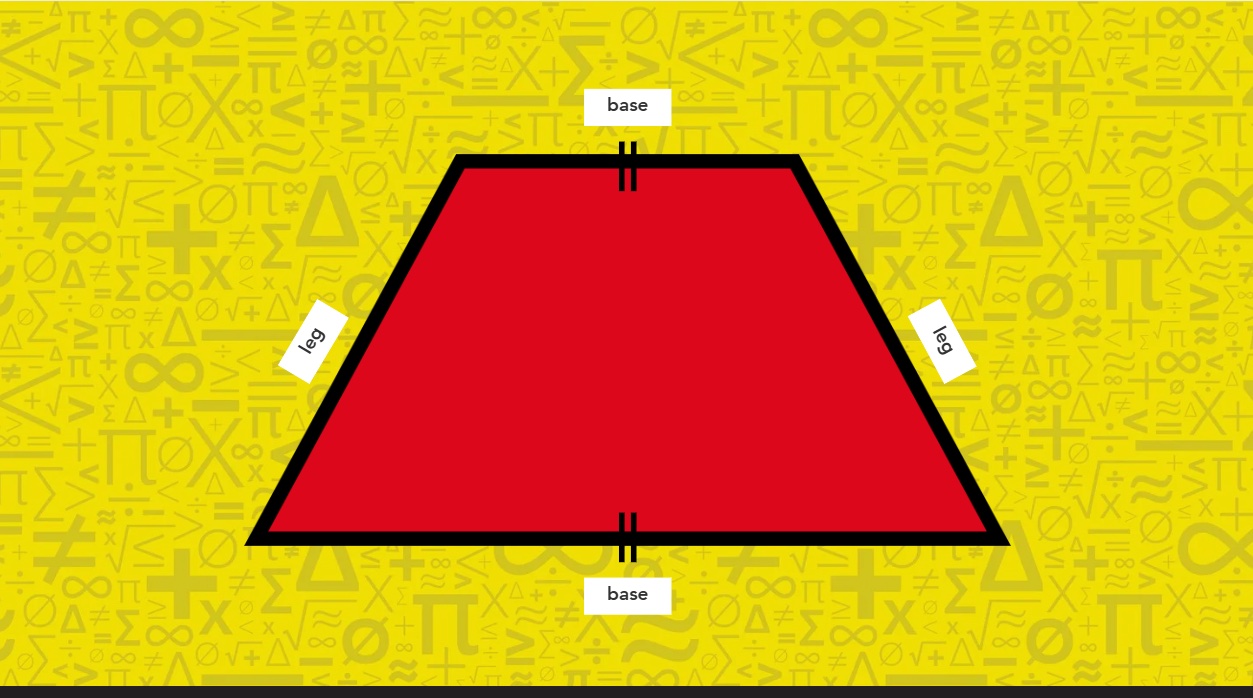
In the US, we define a trapezoid as a four-sided shape (called a quadrilateral) that has exactly one pair of parallel sides. These two parallel sides are called the bases, and the other two sides are called the legs.
In other countries, a trapezoid is sometimes defined as a quadrilateral with at least one pair of parallel sides. But, to avoid confusion, we will stick to the US version.
To spot a trapezoid:
-
Look for a shape with four sides
-
Check that only one pair of those sides is parallel
-
The non-parallel sides will usually slant or angle inwards or outwards
In math, we often use trapezoids when:
-
Comparing and classifying quadrilaterals
-
Exploring angles, symmetry, and shape properties
-
Calculating area using the formula that averages the two bases
You might see trapezoids in ramps, tabletops, bridges, or even folded napkins — any shape that flares out or narrows down with two sides that never meet.
When Do Students Learn About Trapezoids?
Students begin learning about trapezoids when they study basic shapes and properties of quadrilaterals.
Grades 3–5 – Introduction to Trapezoids
Students learn how to recognize trapezoids and distinguish them from other quadrilaterals. They explore properties such as parallel sides, angles, and symmetry, and classify shapes based on these features.
Grades 6+ – Working with Trapezoids in Geometry
Students apply formulas to calculate the area of trapezoids and use them in more advanced geometry problems involving coordinate grids, angle measures, and transformations.