

Dadeland
8320 S Dixie Hwy
Miami, FL 33143
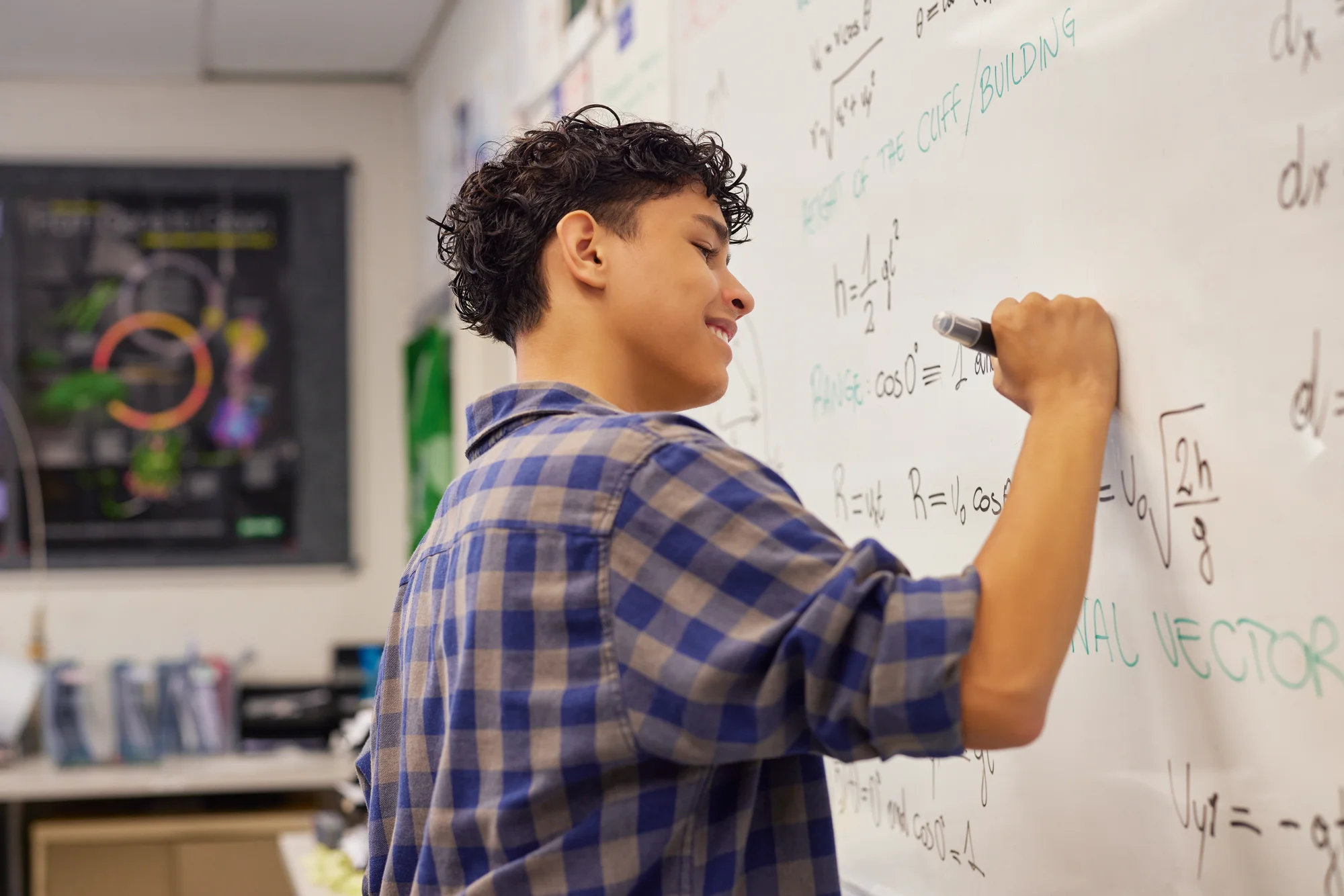
Transitioning from middle to high school math marks a major evolution in how students think about and engage with math. It requires a whole new way of reasoning, problem-solving, and applying what they’ve learned.
At Mathnasium, we’ve helped thousands of families navigate this jump with clarity and confidence, and we’re here to help you do the same.
So what exactly changes when your student enters high school math, and how can you help them prepare? Let’s explore!

In middle school, students often focus on arithmetic fluency, number sense, and foundational pre-algebra topics. But once they reach high school, they encounter a more rigorous curriculum that prioritizes abstract reasoning and the real-world application of mathematical principles.
Instead of simply calculating an answer, students are now expected to:
• Model relationships using equations and inequalities
• Justify their steps with logic and proofs
• Interpret and analyze data across multiple representations
• Communicate mathematical ideas with precision
This shift can be especially challenging if students haven’t yet developed a deep understanding of the prior math concepts or if they’ve been relying on memorization instead of reasoning.
📕 You May Also Like: How to Nurture Math Thinkers, Not Just Answer-Getters
The math coursework and available advanced classes will vary somewhat from state to state and school to school.
In Florida, where our center is based, most students begin high school math with Algebra I. From there, a typical course sequence includes:
• Geometry
• Algebra II
• Precalculus or Math for College Algebra
• Advanced options like Calculus, Statistics, or Dual Enrollment college math
Some students may enter high school having already completed Algebra I in middle school, which places them on a more accelerated track. Others may require additional support to close skill gaps and build fluency in foundational concepts.
Florida uses the B.E.S.T. Standards (Benchmarks for Excellent Student Thinking), which emphasize clarity, consistency, and coherence across grade levels. These standards aim to develop:
• Procedural fluency (knowing how and when to apply strategies)
• Conceptual understanding (knowing why the math works)
• Mathematical reasoning (justifying and explaining answers)
• Application and modeling (solving real-world problems)
Understanding what lies ahead empowers you to help your child prepare. High school math success comes from a solid understanding of how math concepts connect and build on one another.
Whether your student is just entering Algebra I or already aiming for Calculus, knowing what to expect in high school math allows you to support them with intention.
At Mathnasium, we work with students across all skill levels to help them master these expectations and grow into confident, capable problem solvers.

Success in high school math depends on a deep understanding of the prior math concepts, which emphasizes reasoning over memorization
Algebra is the language of high school math; success in Algebra I and Algebra II classes sets the stage for everything that follows, including Geometry, Precalculus, standardized tests, and even college readiness.
Let’s explore the specific skills and concepts students should master before transitioning to Algebra classes in high school.
📕 You May Also Like: Is Your Student Ready for Their Algebra Class? [+Quiz]
Algebra I is where high school math officially begins here in Florida. It’s also the course that most students take in ninth grade, though some may have completed it in eighth.
The curriculum introduces students to expressions, equations, and functions, where they learn to graph lines, solve for unknowns, make connections between mathematical models and real-life situations, and more.
It’s a big leap from arithmetic, and one that requires fluency with foundational skills, particularly operations with negative numbers, fractions, and integers.
In Florida, Algebra I under the B.E.S.T. Standards emphasizes both problem-solving and reasoning. Students are expected to:
• Analyze how changes in an equation affect its graph
• Explain their steps using mathematical language
• Draw conclusions from multiple representations—graphs, tables, and expressions alike
To support your child, encourage them to:
• Practice solving and graphing linear equations by hand
• Work through real-world problems that involve rates, budgeting, or proportional reasoning
• Use graphing tools to explore the connection between equations and visual models
• Get comfortable with interpreting slope and y-intercepts in context
Algebra II takes everything students learned in Algebra I and turns up the complexity. This course builds on earlier concepts, but also introduces entirely new mathematical tools: quadratics, polynomials, exponential and logarithmic functions, rational equations, and complex numbers.
At this stage, students are expected not only to solve problems, but also to justify their approach, interpret multiple solution paths, and understand how different types of functions behave.
To be ready for Algebra II, students should be comfortable with:
• Rearranging equations to isolate variables
• Factoring expressions and solving quadratic equations
• Graphing and comparing linear, quadratic, and exponential functions
• Analyzing word problems involving growth, decay, and real-world modeling
In Florida, Algebra II is often the final algebra course before students move on to Precalculus or math for college algebra. It’s also a course that sharpens the skills students will use on college entrance exams like the SAT.
Parents can support their child’s success by encouraging consistent practice and by helping them build comfort with algebraic language.
Even something as simple as reviewing vocabulary, like roots, coefficients, intercepts, and asymptotes, can make a difference in how quickly students gain confidence.
📕 You May Also Like: How to Make Sure Your Child Is Ready for Algebra
Geometry is a unique challenge for many high school students, not because it’s harder than Algebra, but because it requires a very different way of thinking.
In Algebra, students manipulate symbols and follow procedures. In Geometry, they must learn to visualize, reason logically, and justify every step of their process.
That shift from numerical problem-solving to spatial reasoning can catch students off guard if they haven’t been prepared for it.
In Florida, students typically take Geometry after completing Algebra I, and in some cases, after Algebra II if they’re following a non-traditional path. The B.E.S.T. Standards for Geometry emphasize clarity in reasoning, proof construction, and the ability to apply geometric concepts in both pure and applied contexts.
To prepare your student for success in Geometry, start by strengthening a few key skills:
• Comfort with Algebra I concepts, especially solving equations and working with formulas
• Familiarity with basic geometric terms—like points, lines, angles, and polygons
• Ability to visualize and draw figures with accuracy
• Experience applying the Pythagorean Theorem and basic area and perimeter formulas
But technical skills are just the beginning. Students also need to learn how to approach problems systematically, how to write proofs clearly, and how to explain their reasoning out loud. That’s where students who haven’t yet developed the confidence or structure to communicate their thinking may struggle.
At Mathnasium, we guide students through Geometry by connecting it to ideas they already understand. For example, instead of jumping straight into formal proofs, we start by asking students to describe what they see, what they know, and what they can deduce.
From there, we build the language and logic they’ll use to craft full explanations. We call it “teaching for understanding,” and it’s why our Geometry students learn to think like mathematicians.
📕 You May Also Like: Is Your Student Ready for Their Geometry Class? [+Quiz]

Advanced high school math classes require students to apply that knowledge to increasingly complex and unfamiliar problems
For students who excel in math and are aiming for competitive college programs or STEM careers, high school math doesn’t end with Algebra II or Geometry. These students often pursue advanced coursework like Precalculus, Calculus, Statistics, or dual enrollment college classes before graduation.
But enrolling in these courses is only part of the equation, and being ready for the demands they bring is what truly sets students apart.
Advanced high school math courses require students to synthesize everything they’ve learned in previous years and apply that knowledge to increasingly complex and unfamiliar problems.
• In Precalculus, students explore trigonometric functions, vectors, complex numbers, and more abstract algebraic structures.
• Calculus demands conceptual fluency in limits, derivatives, and integrals—concepts that challenge even the most confident math learners.
• Statistics, though often underestimated, introduces an entirely new domain of thinking: how to collect, analyze, and draw conclusions from data using mathematical models.
In Florida, these courses align with national expectations for college readiness, and in some cases, they follow advanced course standards that are consistent nationwide. High performance in these classes can lead to college credit, scholarships, and enhanced admissions opportunities.
📕 You May Also Like: SAT® vs. ACT® Math – Everything You Need to Know in One Guide
Success in these upper-level courses requires students to be fluent in foundational skills, particularly those from Algebra and Geometry. But they also need to develop academic habits and reasoning strategies that will serve them across all subjects.
As a parent, you can help your student get ready by encouraging them to:
• Review algebraic manipulation and equation solving regularly
• Practice interpreting graphs and functions beyond linear models
• Develop precision in mathematical language, including notation and terminology
• Work on multi-step word problems that require critical thinking and modeling
• Build familiarity with trigonometric ratios and unit circle concepts (for Precalculus and beyond)
Encourage your student to preview challenging topics before the school year starts. Many advanced students benefit from working with a tutor or attending summer bridge programs that help front-load key ideas.

With over 1,000 learning centers nationwide, Mathnasium brings personalized support and proven teaching approach to your neighborhood
Mathnasium is a math-only learning center that has helped thousands of high school students transform how they think and feel about math.
Whether your student is preparing for Algebra I, tackling Geometry, or reaching for a Calculus score that opens college doors, we’re here to support them every step of the way.
What makes our approach different?
We don’t tutor from a textbook or follow a one-size-fits-all curriculum. Instead, we use the Mathnasium Method™—a proprietary teaching approach that blends personalized learning plans, face-to-face instruction in a caring and fun group environment, and a deep focus on conceptual understanding.
Each student begins their journey with a diagnostic assessment. This is a tool that helps us uncover what they know, where they’re struggling, and how they learn best. Based on the assessment insights, we build a personalized learning plan that fills knowledge gaps and gradually introduces new topics in sequence.
Our specially trained tutors don’t just help students "get through" their next test. They guide students toward truly understanding how math works, breaking down complex topics, asking the right questions, and encouraging critical thinking.
Students learn at their own pace with consistent, caring guidance that builds both competence and confidence.
We also support students with:
• Algebra and Geometry instruction
• Homework and test preparation
• College entrance exam readiness (SAT® and ACT®)
• Advanced math enrichment and competition prep
At our learning center and in our live online classrooms, we offer the same high-quality instruction and community-based environment. No matter whether your student attends in person or online, they’ll be supported by the same team and the same commitment to their success.
And the results speak for themselves:
• 94% of parents report improvement in their child’s math skills and understanding
• 90% of students see improvement in their school grades
• 93% of parents report a more positive attitude toward math after attending Mathnasium
Let’s talk about what’s next. Book your student’s free assessment today.
Mathnasium of Dadeland is a math-only learning center for K-12 students in Miami, FL. Trusted by over a million parents, Mathnasium uses personalized learning plans and the proprietary Mathnasium Method™ to help students catch up, keep up, and get ahead on their math journey.
Our specially trained tutors deliver face-to-face instruction in a supportive and fun small-group environment, working with students both in center and online to develop a deep understanding of math, build confidence, and improve academic performance.
Schedule Free Assessment
 (305) 433-7842