










The sum of the areas of all the faces, including the bases, of a 3-D object.
Surface area is the total area that covers the outside of a three-dimensional (3-D) object. Imagine wrapping a gift: the surface area is the amount of wrapping paper needed to cover the whole object without any gaps or overlaps.
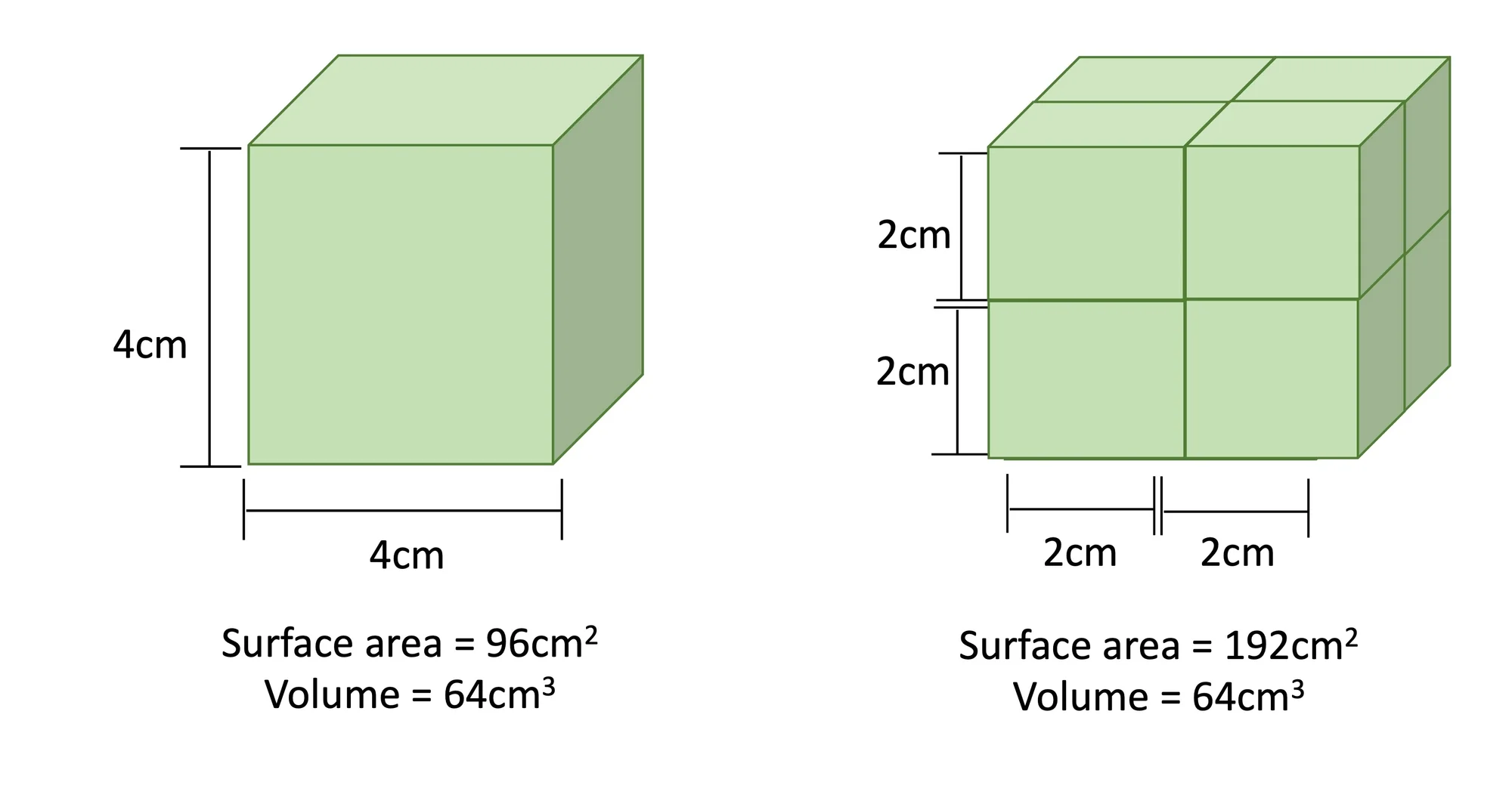
To find the surface area of a shape, we calculate the area of each of its flat surfaces (called faces) and add them all together.
For example:
-
A cube has 6 square faces. If each face is 4 inches by 4 inches, the area of one face is 16 in², and the total surface area is 6 × 16 = 96 in².
-
A rectangular prism has 3 pairs of opposite faces. We find the area of each pair and sum them.
Surface area is important in real life when we:
-
Paint walls or cover furniture
-
Wrap gifts
-
Design packaging
When Do Students Learn About Surface Area?
Students begin learning about surface area once they understand area in two dimensions and are ready to apply it to 3-D shapes.
Grades 5–6 – Introduction to Surface Area
Students explore how to find surface area by adding up the areas of faces and using nets.
Grades 7+ – Calculating Surface Area with Formulas
Students apply formulas to find the surface area of prisms, pyramids, cylinders, and more.