











Turned backward in position, direction, or order.
In math, “reverse” means going backward from a result or reversing the order of steps in a process. We use the concept of reversal in many areas of math, especially when solving problems or checking our work.
For example:
- Reversing the steps of a multi-step problem helps us check if we got the right answer.
- Reversing the digits in a number (like turning 12 into 21) is a fun way to explore patterns.
- We also reverse operations: if we add 5 to get 10, we subtract 5 to get back to 5.
The idea of reversing shows up in:
- Inverse operations (like undoing multiplication with division)
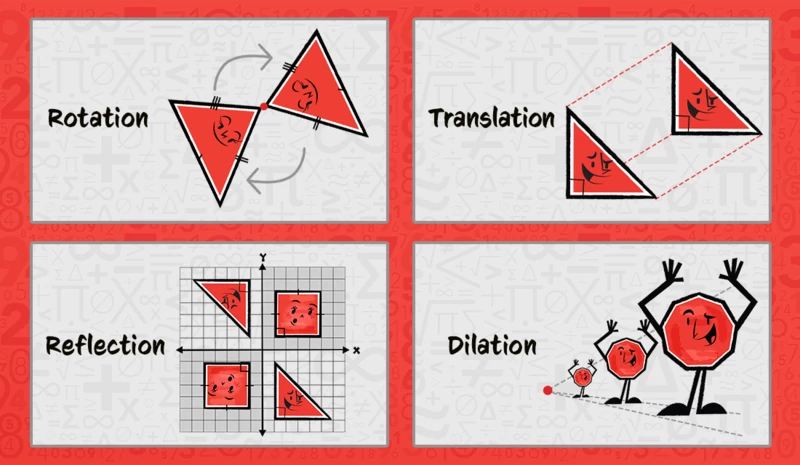
- Reversing directions in geometry or graphing
- Problem-solving and estimation
When Do Students Learn About Reverse in Math?
Students begin using the idea of reversing in early grades when solving equations, checking their answers, and understanding opposite operations.
Grades 1–2 – Exploring Reverse Operations
Students learn that subtraction “undoes” addition.
Grades 3–5 – Applying Reverse Thinking
Students learn that division undoes multiplication and use reverse thinking in word problems and multi-step operations.