What Is a Line Segment? A Complete & Kid-Friendly Guide
Mar 12, 2025
| Richardson West
Lines show up in math earlier than most students realize, and they never really leave. Grade after grade, they keep building on each other and form the foundations of geometry. One of the first stops on that journey is the line segment.
But is a line segment just a piece of a line, or is there more to it?
Today, Mathnasium tutors guide you through everything you need to know about line segments: what they are, how they differ from lines and rays, how to measure them, and how to spot them in shapes with solved examples, a fun quiz, and answers to the questions students ask us most.
Quick Facts About Line Segments
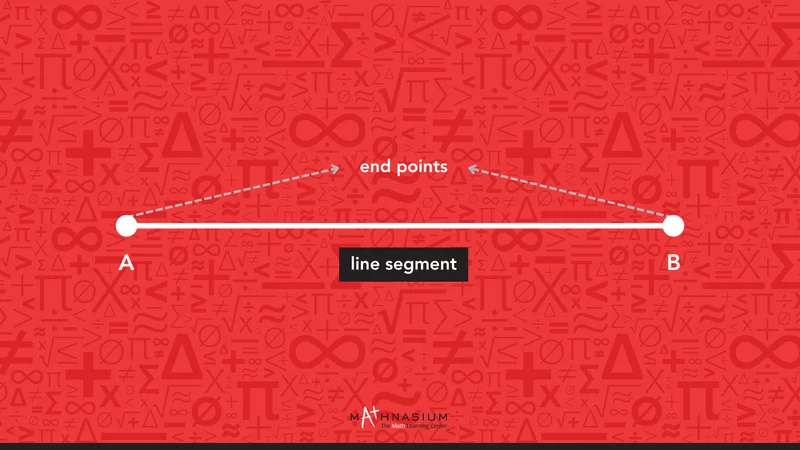
A line segment is a straight path between two points with a fixed length.
A line segment has exactly two endpoints, one at each end.
Unlike a line, a line segment does not go on forever in either direction.
Unlike a ray, a line segment has two endpoints, not one.
We write a line segment using its two endpoints with a bar on top, like \(\overline{AB}\).
Line segments can be horizontal, vertical, or diagonal.
When we connect multiple line segments, they form the sides of polygons like triangles, squares, and rectangles.
We can measure a line segment with a ruler or by counting spaces on a grid.
If we compare it to a line, which goes on forever in both directions, a line segment has a clear starting and ending point.
Let’s take a tightrope as an example. It stretches between two poles and doesn't go on forever. The edge of a table as well. It has two distinct ends. Can you think of any other examples?
In math, we write a line segment using its two endpoints with a bar over them. For example, we write a line segment connecting points A and B as \(\overline{AB}\). We can use any two letters as long as we don't forget the little bar on top.
What Is the Difference Between Line, Line Segment, and Ray?
In math, we often mention a line segment along with lines and rays. While they may look alike, they each have different properties.
When we know how they are different, we can find them in shapes, pictures, and even things that surround us.
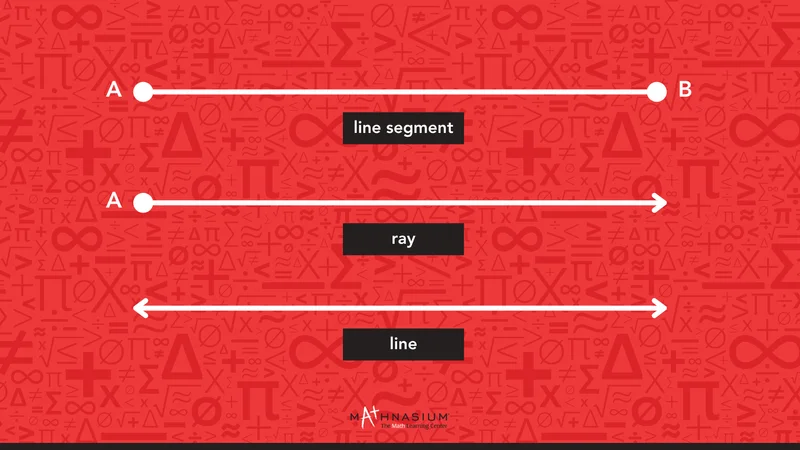
Line: Goes on forever in both directions and has a straight path. It has no endpoints and no fixed length. Think of a road that stretches endlessly or the horizon.
Line Segment: A straight path with two endpoints. It has a fixed length and does not go on forever. An edge of a notebook or a crayon, for example.
Ray: Starts at one point and goes on forever in one direction on a straight path. In this case, a ray is a flashlight beam shining into the distance or an arrow flying through the air. They start somewhere, but keep going.
Line
Line Segment
Ray
Endpoints
None
Two
One
Fixed Length
No
Yes
No
Goes on forever
Both directions
No
One direction
Example
The horizon
Edge of a notebook, a crayon
A flashlight beam
How Do We Measure a Line Segment?
Since a line segment has a fixed length, we can measure it just like we measure a piece of string or a side of a book.
But how do we do that in math?
We can use any length measurement system, unit, or tool to determine the length of a line segment.
One simple method is to use a ruler. Place one end of the ruler at the starting point of the line segment and check the number at the ending point, which tells us its length.
Let's check out an example below.
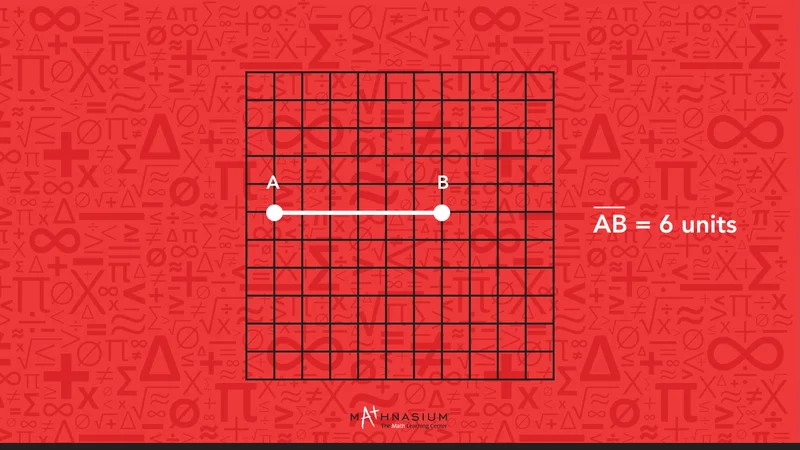
If we draw a line segment on a grid or graph, we can count the spaces between the two endpoints to find the length, like so:
Now that you know how to measure a line segment, you can try it on your own.
Check out our video guide on graphing points and lines.
Solved Examples of Line Segment
Let's work through a few solved examples together and master line segments.
Example 1
Is this path a line, a line segment, or a ray?
Since the line has arrows on both ends, it goes on forever in both directions. Even though points A and B are marked, they do not stop the line. They are just points on it.
A line segment, on the other hand, has two clear endpoints and does not extend beyond them.
So, what we see here is a line, not a line segment, because it never ends.
Example 2
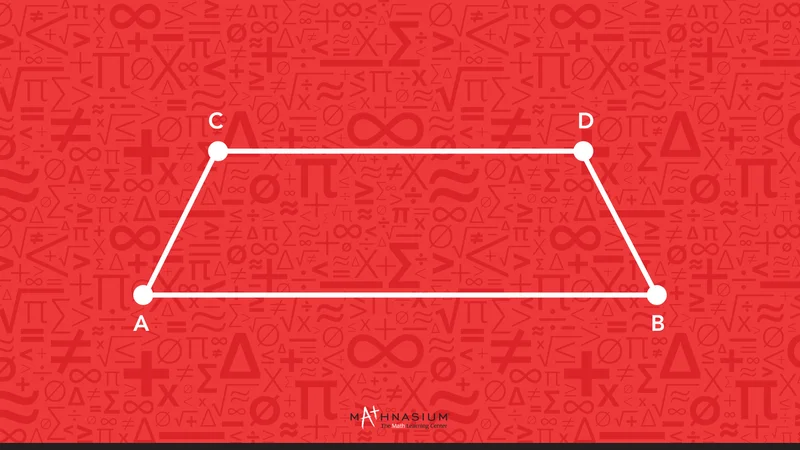
Count the number of line segments in this shape:
We can see that our trapezoid ABCD has four points (A, B, C, and D). These points form the endpoints of the line segments.
Since a trapezoid has four sides, and each side is a line segment, we have:
\(\overline{AB}\)
\(\overline{BC}\)
\(\overline{CD}\)
\(\overline{DA}\)
So, there are four line segments in trapezoid ABCD.
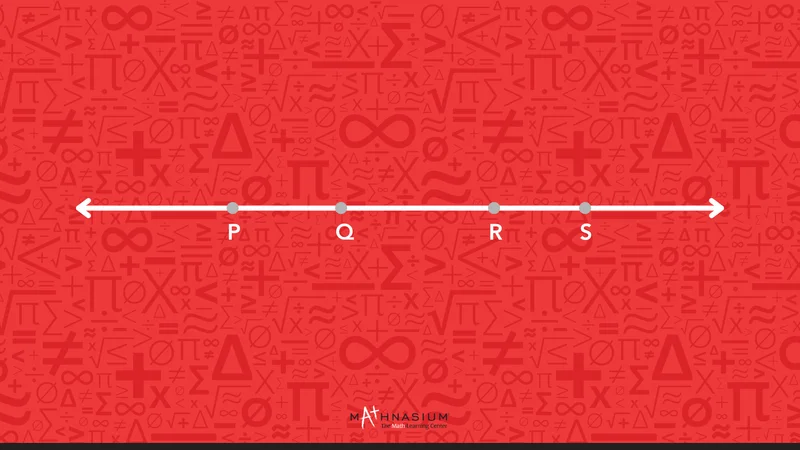
We can see that our path has four points: P, Q, R, and S.
Since a line segment is a straight path between two endpoints, we can form different segments by choosing any two points.
Let's list all the possible line segments:
\(\overline{PQ}\)
\(\overline{PR}\)
\(\overline{PS}\)
\(\overline{QR}\)
\(\overline{QS}\)
\(\overline{RS}\)
By connecting every pair of points, we found six line segments in total.
Quiz: Check What You've Learned About Line Segments?
Ready to practice what we’ve covered? Give our 2-minute quiz a try and check your answers at the bottom of the guide.
1. Which of these is the best definition of a line segment?
A straight path that goes on forever in both directions
A straight path with one endpoint that extends forever
A straight path between two endpoints with a fixed length
A curved path with no endpoints
2. Which of the following is not a line segment?
The edge of a book
A pencil
A street with a clear start and end
A beam of light shining from a flashlight
3. How many line segments can be formed from four points on a straight line?
3
4
5
6
4. Which of these shapes is made entirely of line segments?
A circle
A triangle
A curved road
A wavy line
5. How many line segments are in a square?
3
4
5
6
6. A line segment has:
No endpoints
One endpoint
Two endpoints
Three endpoints
7. Which of the following pairs of shapes are made entirely of line segments?
Circle and oval
Rectangle and pentagon
Circle and triangle
Oval and square
8. A triangle has 3 line segments. How many line segments do a triangle and a rectangle have together?
5
6
7
8
Frequently Asked Questions About the Line Segment
A line segment is one of the building blocks of geometry and shapes. But while learning about it for the first time, students often have questions.
Here are some of the most common ones we hear from our students.
1. Can a line segment be part of a curved shape?
No, a line segment is always straight. If a shape has curves, it is not made entirely of line segments. However, some curved shapes, like polygons with many tiny sides, can appear curved from a distance.
2. Can two line segments share the same endpoints?
Yes. In fact, many shapes are formed this way. For example, in a triangle, each endpoint is connected to two different line segments.
3. Is the distance between two points the same as the length of a line segment?
Yes. The distance between two points is exactly the length of the line segment connecting them. That's why measuring a line segment is the same as finding the distance between its two endpoints.
4. Is there the longest possible line segment?
No, a line segment can be any length. It can be as short as a centimeter or as long as a highway. All it needs is two endpoints.
5. If two line segments cross, do they form a new line segment?
Not necessarily. Two line segments can intersect at a point, each keeping its own endpoints and length.
6. Can a shape have both line segments and curves?
Yes. Some shapes, like semicircles or mixed figures, can have both straight and curved parts. Only the straight parts are considered line segments.
At Mathnasium, students explore geometry concepts in a caring and fun group environment that builds both skills and confidence.
Master the Line Segment (or Any Other Math Concept) at Mathnasium
Mathnasium is a math-only learning center dedicated to helping K-12 students of all skill levels excel in math.
Whether your child is just getting started with line segments or working through more advanced geometry, our specially trained tutors are here to help.
Each student begins with a diagnostic assessment that reveals where they are on their math journey and where the knowledge gaps are. From there, we build a personalized learning plan tailored to their needs, pace, and goals.
Our teaching is guided by the Mathnasium Method™, a proprietary teaching approach that uses real-world examples, visual tools, and hands-on techniques to make math make sense.
Students work in a caring and fun group environment where they feel comfortable asking questions, making mistakes, and building confidence.
Fun is an important part of the Mathnasium Method™. Our activities are often game-based and hands-on. We let students earn their rewards and celebrate each step of progress together, so their confidence grows with each session.
The results speak for themselves:
94% of parents report an improvement in their child's math skills and understanding
93% of parents report an improved attitude toward math
90% of students saw an improvement in their school grades
Mathnasium operates over 1,100 learning centers, bringing our top-rated math instruction close to your community.
For students and families based in or near Richardson, TX, Mathnasium of Richardson West is a trusted local resource with a proven record of building confident math thinkers.
In addition to over 100 five-star Google reviews, our center has been recognized by Living Magazine’s Best of Richardson and Murphy Reader’s Choice Awards, including:
Best Tutoring (2022–2024)
Best Early Education (2024)
Whether your student is looking to catch up, keep up, or get ahead in math, our local team is happy to help!
If you’ve given our quiz a go, check your results below:
Question 1: C) A straight path between two endpoints with a fixed length
Question 2: D) A beam of light shining from a flashlight
Question 3: D) 6
Question 4: B) A triangle
Question 5: B) 4
Question 6: C) Two endpoints
Question 7: B) Rectangle and pentagon
Question 8: C) 3 + 4 = 7
How did you do?
Visit Us at Mathnasium of Richardson West
Mathnasium of Richardson West is a math-only learning center for K-12 students in Richardson,
TX. Trusted by over a million parents, Mathnasium uses personalized learning plans
and the proprietary Mathnasium Method™ to help students catch up, keep up, and get ahead on their math journey.
Our specially trained tutors deliver face-to-face instruction in a supportive and fun small-group environment,
working with students both in center and online to develop a deep understanding of math, build confidence,
and improve academic performance.
Mathnasium's grade-specific 8-week plans keep your child's math skills sharp this summer. Built for kids finishing 1st–4th grade. Flexible and TEKS-aligned.


 (972) 231-6284
 (972) 231-6284