











Parallel to the horizon; at right angles to a vertical line.
In math, something is horizontal when it runs left to right, straight across, like the horizon you see when the sky meets the earth. A horizontal line runs flat and straight, left to right.
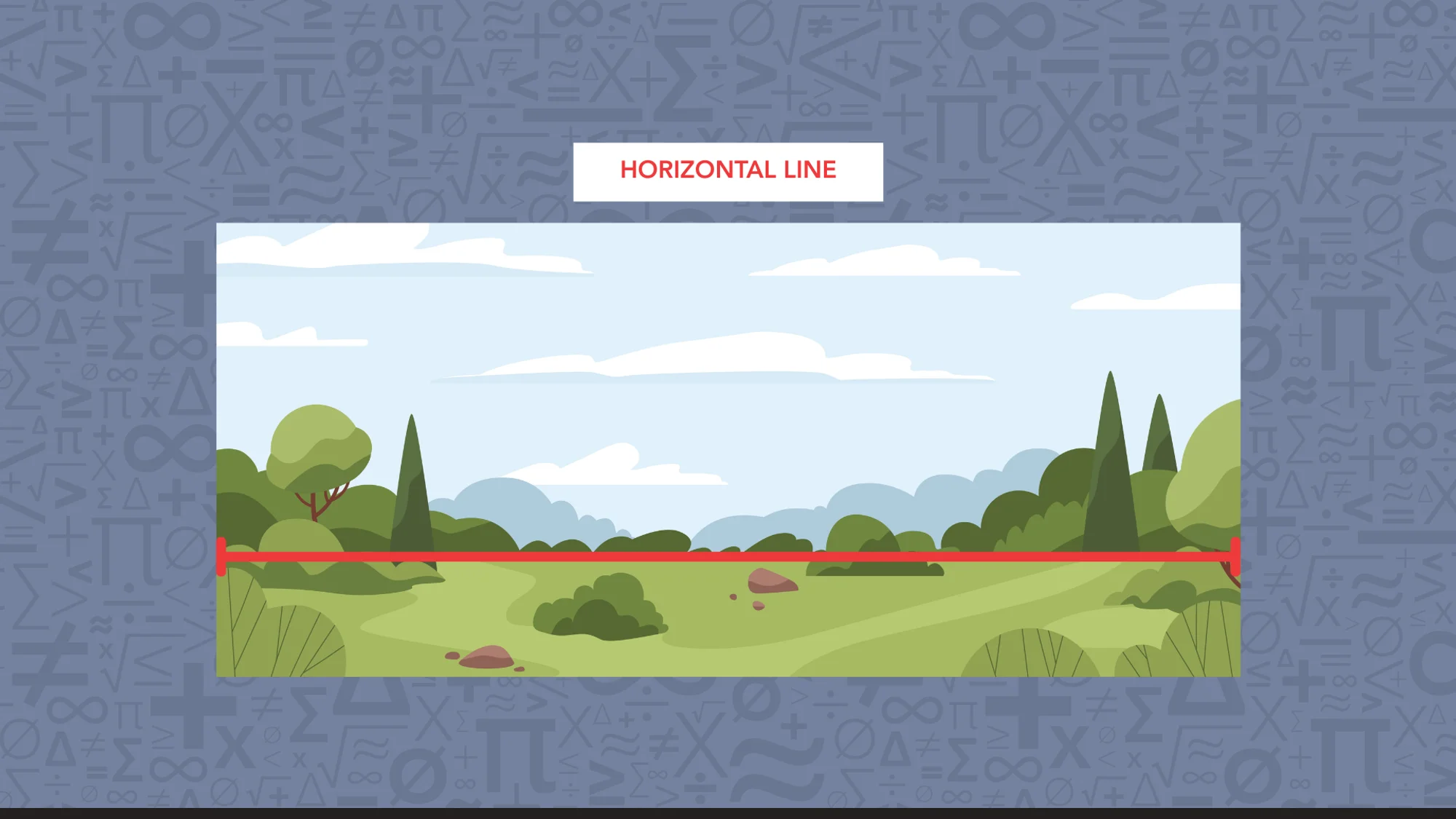
It’s the opposite of a vertical line, which goes up and down. The two directions, horizontal and vertical, meet at a right angle (90°).
Let’s look at some examples of horizontal we see day-to-day:
-
The x-axis on a graph is horizontal — it runs left to right
-
A number line is horizontal
-
The top edge of a table or a shelf is horizontal
In math, we use horizontal lines in:
-
Graphing and coordinate geometry
-
Describing directions and positions
-
Working with symmetry and parallel lines
When Do Students Learn About Horizontal Lines?
Students are introduced to the concept of horizontal direction early on while exploring lines and basic geometry.
Grades 1–2 – Recognizing Horizontal Lines
Students begin to describe and identify horizontal lines in everyday objects and simple shapes as part of learning basic geometry.
Grades 3–5 – Connecting Horizontal to Geometry and Graphing
Students learn that horizontal lines are perpendicular to vertical lines and use these ideas when drawing shapes, identifying right angles, and graphing.
Grades 6+ – Using Horizontal in Coordinate Geometry
Students apply the idea of horizontal to identify horizontal lines (slope = 0), analyze parallel lines, and work with horizontal distances on the coordinate plane.