At Mathnasium math centers, many of our most engaging sessions don’t feel like lessons at all. They’re game-based activities, designed to build math skills in a setting that feels low-pressure and fun. These aren’t breaks from learning. They are the learning.
Some of our biggest a-ha moments happen during these games, especially for students feeling worn down by classroom routines, test prep, or worksheets.
This playful, purposeful approach deserves more attention. That’s why today, our tutors are sharing their insights: why some students lose interest in math, how games can change that experience, and a few you can try at home.
Why Some Students Lose Interest in Math
When students begin to pull away from math, it’s rarely just because the work is “too hard.” More often, it’s a combination of underlying factors that erode their interest and confidence:
-
Disconnected instruction: Math is often presented as a series of steps to memorize, not a tool for solving real problems.
-
Fear of mistakes: High-stakes testing and public correction create pressure around being wrong.
-
Pace mismatch: The curriculum moves forward whether a student is ready or not, leaving gaps that compound over time.
-
Lack of autonomy: Worksheets and rigid formats offer little room for exploration, strategy, or student choice.
Left unaddressed, these experiences can build into what educational psychology calls math anxiety.
What is that, exactly?
Math anxiety is a fear-based response that disrupts a student’s ability to work with numbers and often causes them to avoid math altogether.
Games can flip that script; more on how in just a moment.

When math feels like a chore, not a challenge, students start to check out.
What Makes Games Different: The Psychology of Play
Math games stand apart from standard assignments. They tap into how kids naturally explore, take risks, and build understanding on their own terms.
-
Mistakes feel safe: In a game, getting something wrong isn’t considered a setback but a part of figuring things out. Students try, adjust, and keep going without fear of judgment.
-
Feedback is instant: Whether it’s a score, a move that doesn’t work, or a quick win, kids see right away what’s working and what’s not. That kind of response helps them learn faster.
-
Motivation comes built in: Well-selected games give students a sense of choice and progress. They want to keep playing because the challenge feels worth it.
-
Learning is social: Math games often encourage collaboration. Kids explain their thinking, build off each other’s strategies, and learn by doing together.
-
Big ideas feel doable: Games are naturally broken into small steps. Students tackle one challenge at a time, with just enough difficulty to keep it interesting, not overwhelming.
Educational theorists like Johan Huizinga have long pointed to the power of play in learning. More recently, an experimental study confirmed that game-based math activities can improve problem-solving by giving students engaging, hands-on ways to apply what they’re learning.
Which Games Help Build Math Skills?
When most people think of board games, card games, or logic puzzles, they think of downtime. However, many of these help kids pick up useful math habits, like spotting patterns, working with numbers, or thinking a few steps ahead.
You’ll probably recognize most of the names on this list. What’s worth noticing is how each one connects to a different kind of math thinking.
We’ll break them into groups and show you exactly what they help build.
A. Strategy Board Games
Strategy board games are built around careful planning and decision-making. Players think through each move, consider how others might respond, and adjust their approach along the way.
Names you’ve likely heard of? Chess, Checkers, Connect Four, Blokus, and Mancala—all classics that still get kids thinking hard.
So how do they tie into math?
As they play board games, students are quietly developing key math skills, like logical reasoning, pattern recognition, sequencing, and the ability to analyze structure. Habits like these support the kind of thinking needed in algebra, geometry, and multi-step problem solving.
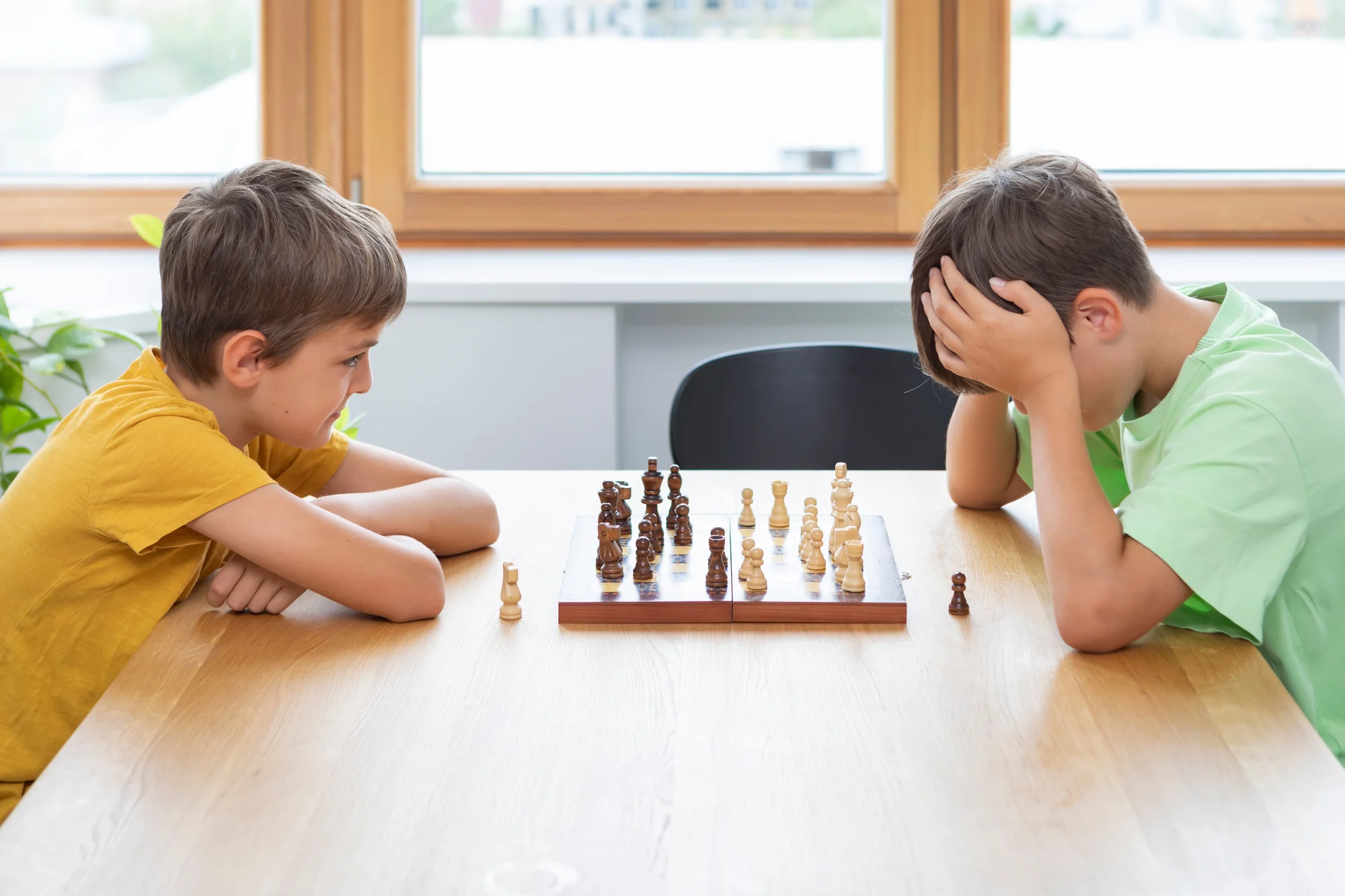
Board games like chess help kids practice logic, pattern recognition, and planning.
B. Card Games
Games like Uno, Set, and classic playing cards encourage kids to work with numbers in fast, flexible ways.
As they match, sort, and build combinations, they’re practicing number sense, mental math, pattern recognition, and basic probability.
📕 You May Also Like: 5 Fun, Educational Math Card Games You Can Play with a Standard Deck
C. Dice Games
With just a few rolls, games such as Yahtzee and Qwixx turn math into a fast-paced challenge. Players calculate scores while thinking through possible outcomes and deciding whether to take a chance or lock in a safer move.
Behind the scenes, they’re practicing mental math, exploring number combinations, and applying basic probability.
📕 You May Also Like: 5 Ways Mental Math Supports Long-Term Math Success
D. Visual Logic Games
When a logic puzzle asks you to unblock a path or align a sequence just right, it calls for careful observation and clear, ordered thinking.
Classics like Rush Hour or Laser Maze guide players to work within constraints and adjust their strategy as new information unfolds.
The more time kids spend on challenges like these, the more they practice spatial reasoning, pattern analysis, and step-by-step problem solving, which are key skills in geometry and higher-level math.
Mathnasium-Recommended Games to Try at Home
Beyond the classics we mentioned earlier, our instructors like to suggest a few games that blend math practice with play in just the right way. They’re flexible for different ages and designed to support the kind of math thinking we build in our learning centers every day.

At Mathnasium, we regularly use games during instruction and know which ones spark learning, build skills, and keep students engaged
1. Store (Ages 4–8)
This isn’t a game you buy. This is the one you set up. Store is a simple role-play activity where one child acts as the cashier and the other as the shopper, using real or play money to “buy” items from around the house. Parents can label everyday objects with prices, then let kids count out the correct amount to make a purchase.
This activity is a playful way to build early counting skills, compare values, and develop a basic understanding of how money works. You can make it more interesting by adding price tags, setting spending limits, or running limited-time “sales.”
2. Pattern Block Puzzles (Ages 5–10)
Pattern Block Puzzles are either store-bought or easily printed at home. The activity involves using a set of colorful geometric tiles, like triangles, hexagons, trapezoids, and more, to fill outlines or create original designs.
To play, kids choose a puzzle outline and fit the blocks inside it without gaps or overlaps. Think of it like building with shapes, but each move requires thinking through size, fit, and symmetry.
What starts as creative play quickly becomes hands-on geometry. Kids build spatial awareness, recognize how shapes relate to one another, and start thinking in fractional parts, especially when they notice how several smaller shapes can combine to fill a larger one.
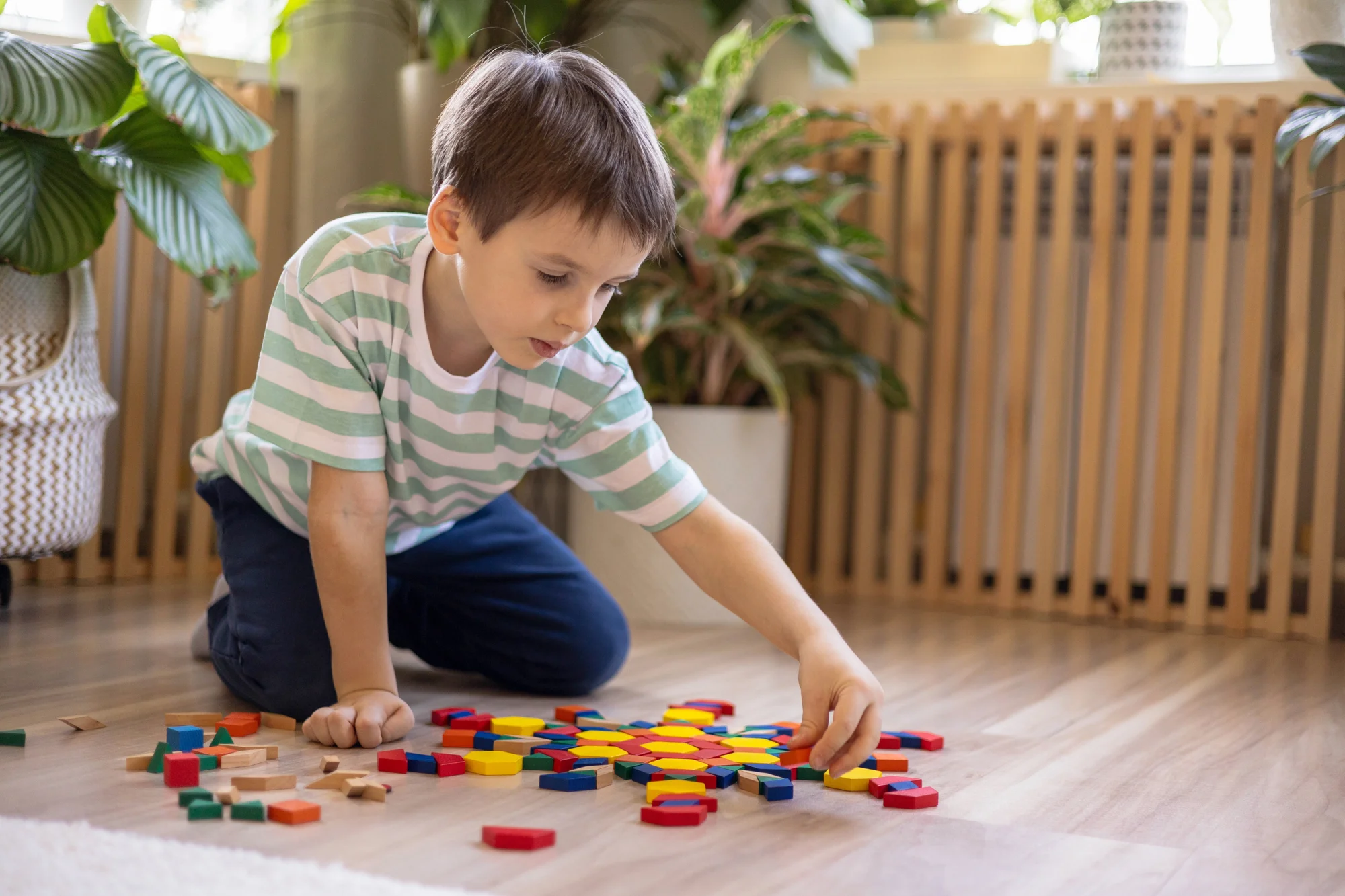
Pattern block puzzles build spatial reasoning and introduce early fraction thinking.
3. Target Number (Ages 6–12)
Target Number is a do-it-yourself game you can play with just a set of dice or number cards. We recommend it because it’s simple to set up, easy to vary, and works well for solo play or with a group.
To play, choose a target number (like 24 or 50), then roll four dice or draw four cards. The goal is to use those numbers along with basic operations, like addition, subtraction, multiplication, or division, to get as close as possible to the target. There’s usually more than one solution, so kids can test out different strategies and see what works best.
We’ve found that Target Number helps build number sense, mental math, and operational flexibility. It also encourages trial and error in a low-pressure setting, which helps students learn to reason through their choices instead of guessing.
For an extra challenge, you can set a time limit, restrict the number of operations allowed, or ask for multiple ways to reach the same result.
4. Sum Swamp or Prime Climb (Ages 6–12)
Both Sum Swamp and Prime Climb are store-bought board games designed specifically to make arithmetic feel like play. Each game uses movement across a board and player choices to bring math operations to life in a visual, interactive way.
Sum Swamp is ideal for early learners. Players roll dice and solve simple addition or subtraction problems to move through a swamp-themed board filled with detours and fun twists. Our instructors recommend it for its simplicity, fast pace, and ability to build confidence with basic facts.
Prime Climb, for slightly older kids, introduces multiplication, division, and prime numbers using a color-coded spiral board. Players use math to land on specific numbers, avoid setbacks, and outsmart opponents. We love it because it’s rich in strategy, but still easy to follow once the rules click.
Both games help reinforce mental math, pattern recognition, and number relationships.
5. 24 Game (Ages 8+)
The 24 Game is a well-known card game you can purchase, but it’s just as easy to recreate at home. All you need is a way to generate four numbers—playing cards or number slips work fine—and the goal is always the same: use those four numbers and any combination of operations to make exactly 24.
We often play this one with students in our centers. It’s fairly quick to explain, but surprisingly challenging. Kids get drawn in fast, and suddenly they’re testing ideas and talking through what worked.
The game is ideal for building fluency with numbers and operations. More than that, it helps kids think clearly under pressure and develop persistence, because when a solution doesn’t come easily, they learn to try again from a different angle.
How Mathnasium Makes Math Learning Engaging and Fun
At Mathnasium, we don’t believe kids hate math. More often, it’s the experience they had with math that shapes how they feel about the subject: when math feels confusing, overwhelming, or isolating.
That frustration usually isn’t about ability, but about how math is being taught and how it’s being experienced.
That’s why we show them a different kind of experience: one where math is meaningful and fun, often with games built in.
This experience is shaped by the Mathnasium Method™, a proprietary teaching approach designed to help each student unlock their true math potential.
How does it work?
It begins with a diagnostic assessment. Designed to be relaxed and engaging, this is a one-on-one interaction that helps us pinpoint your child’s strengths, areas for improvement, and learning preferences.
With those insights, we create a customized learning plan tailored to their specific needs.
Once the plan is in place, our instructors provide face-to-face math instruction in a supportive, focused environment. Every session follows the plan closely, with just the right balance of structure and encouragement.
To help math make sense, we use a mix of verbal, visual, mental, written, and tactile techniques. Many of our activities are game-based, and our centers include built-in rewards to keep students motivated and engaged.
During sessions, we guide the student to understand the why and how behind each math concept so that they develop problem-solving skills and critical thinking tools to use in math and beyond.
The results?
-
94% of parents report an improvement in their child's math skills and understanding
-
93% of parents report an improved attitude towards math after attending Mathnasium
-
90% of students saw an improvement in their school grades
If your child is looking to catch up, keep up, or get ahead in math, your local Mathnasium center is ready to help. We’ll build a personalized learning plan for them and guide them toward math mastery in a way that feels supportive, motivating, and fun.


 (424) 247-7304