











In math, the environment where points, lines, shapes, and objects can be measured.
In math, space is the environment where mathematical objects, like points, lines, shapes, and figures, exist and interact. It is often thought of as extending infinitely in one or more directions.
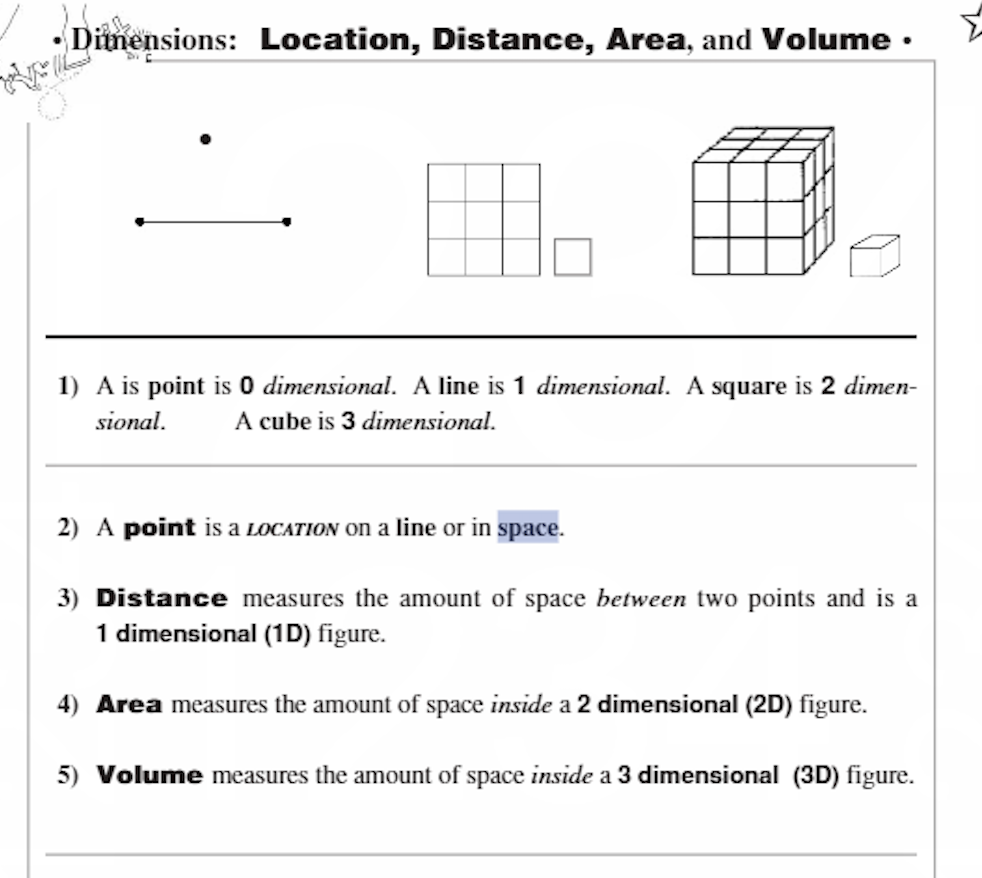
We use the concept of space to describe and measure:
-
Length on a number line (1D space)
-
Area inside a shape like a rectangle or triangle (2D space)
-
Volume in solids like cubes or spheres (3D space)
-
Relationships in algebra and vector spaces (higher dimensions)
Think of space as the setting or “stage” where math happens. A point is a location in space. A line stretches across space. Shapes take up space. Whether we’re plotting coordinates on a grid or measuring how much room something takes up, we’re working with space in math.
When Do Students Learn About Space?
Students are introduced to the idea of space when they explore three-dimensional shapes and measurements in early grades and continue to build spatial reasoning as they progress.
Grades K–2 – Introduction to 3D Shapes
Students explore objects in their environment and learn to identify solid shapes such as cubes, cones, cylinders, and spheres. They describe shapes by the number of faces, edges, and vertices.
Grades 3–5 – Exploring Volume and Position in Space
Students move from identifying shapes to measuring and reasoning about volume and representing solids using nets and coordinate grids. They begin describing positions and movements in 3D contexts.
Grades 6+ – Working with Geometry in Space
Students use coordinate geometry and formulas to analyze, draw, and model three-dimensional figures. They calculate surface area and volume of various solids and explore spatial relationships through transformations.